


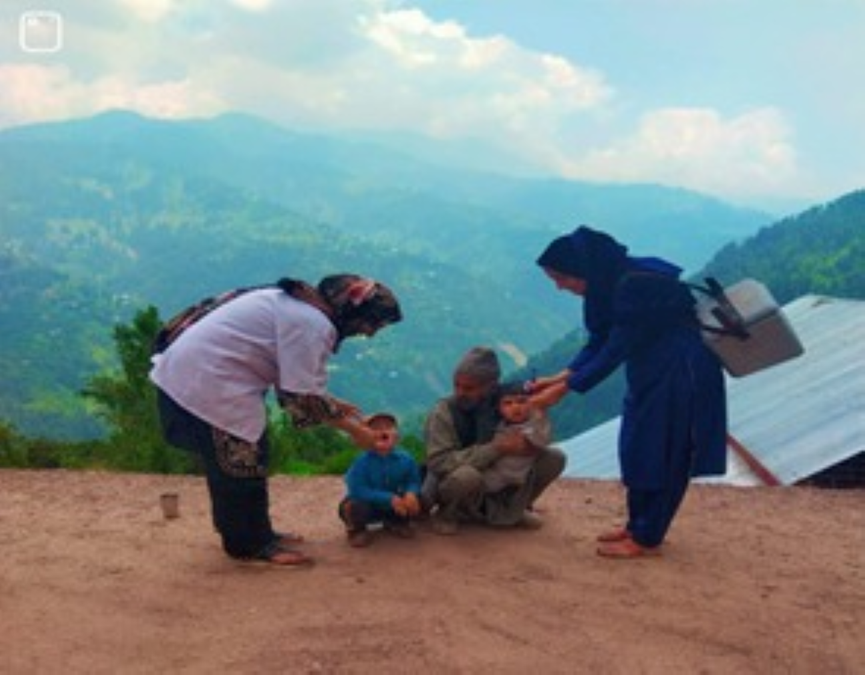
Srinagar, June 29: As dawn breaks over Kashmir’s mountains, teams of health workers shoulder vaccine carriers and set out on arduous journeys across rushing mountain streams, dense forests and steep ridges to ensure that not a single child is left behind in the Pulse Polio campaign.
For these frontline workers, vaccination is not just a routine assignment – it is a mission that often takes them to some of the valley’s most inaccessible villages, including settlements tucked away along the Line of Control (LoC) in Uri, Boniyar and Kupwara districts.
Armed with vaccine carriers packed with ice packs, registers and essential supplies, the teams trek for hours through rugged mountain trails, cross icy nallahs on foot, and navigate difficult terrain to reach nomadic families, shepherd settlements and isolated hamlets where roads simply do not exist.
In many places, vehicles can only take them so far. Beyond that begins a demanding journey on foot, with health workers climbing mountains, crossing wooden bridges and makeshift log crossings, and sometimes wading through streams to reach children under five years of age.
Officials say every vaccination round is planned meticulously, with micro-plans identifying even the smallest habitations so that every eligible child receives the life-saving oral polio vaccine.
“No child should miss the vaccine because of geography,” said Block Medical Officer (BMO) Uri Dr Balwinder Singh.
“Our teams begin early in the morning and often walk several kilometres through hilly terrain. They cross nallahs, climb steep mountains and visit villages situated close to the LoC. Despite the physical challenges, their commitment never wavers because protecting every child from polio remains our highest priority,” he said.
Dr Singh said health workers have repeatedly demonstrated exceptional dedication, often travelling in difficult weather conditions to ensure complete immunisation coverage.
In neighbouring Boniyar, the story is no different. Block Medical Officer Boniyar, Dr Ruqaya Showkat, said many health workers spend an entire day travelling to reach a handful of children living in remote villages.
“Our vaccinators and ASHA workers undertake physically demanding journeys carrying vaccine carriers while trekking through mountainous terrain. Sometimes they walk for several hours just to vaccinate two or three children in an isolated habitation. Their determination reflects the spirit of public healthcare,” she said.
She said the department leaves no habitation uncovered, irrespective of its distance or accessibility.
“Parents in these far-flung villages cooperate wholeheartedly with our teams, understanding the importance of vaccination. Their support has also contributed significantly to the success of the Pulse Polio programme,” she added.
The challenges become even greater in the border district of Kupwara, where several habitations are located deep inside forests or high-altitude areas.
A senior health official in Kupwara said reaching every child often requires crossing mountain passes and seasonal streams.
“Our teams frequently trek through difficult forest routes and hilly landscapes carrying vaccine carriers on their shoulders. Some villages can only be accessed after several hours of walking. Yet our workers never hesitate because they understand that every child deserves protection against polio irrespective of where they live,” the official said.
The official said meticulous planning and community participation have helped maintain high vaccination coverage even in the district’s remotest villages.
Health officials said every Pulse Polio campaign is backed by weeks of preparation involving mapping of households, deployment of vaccination teams and identification of transit points to ensure no child under the age of five is missed.
For many vaccinators, the journey is filled with uncertainty. Flash floods can swell mountain streams without warning, narrow footpaths become slippery after rain, and changing weather often complicates travel. Yet, the determination to protect children keeps them moving.
Behind every child vaccinated in Kashmir’s remote mountains lies a story of resilience, endurance and unwavering commitment by healthcare workers who continue to cross rivers, climb mountains and brave the challenges of the frontier so that no child is left vulnerable to a preventable disease.
