


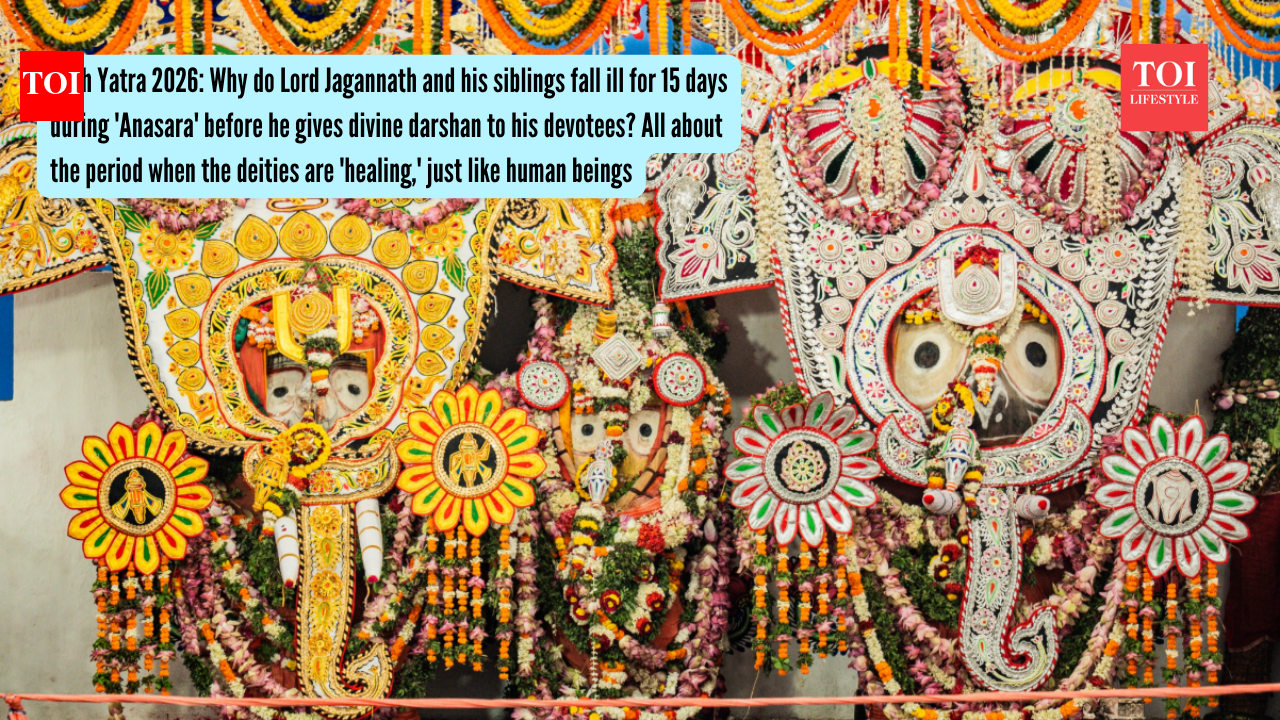
Shree Khetra or Lord Jagannatha’s land is gearing up for the greatest annual festivity where the Lord of the cosmos gives the most resplendent darshan to his devotees, who wait with bated breath all year long.The prelude to the Rath Yatra begins with the Snana Purnima, where Lord Jagannatha and his siblings are given a divine bathe with 108 pots of sacred water, gearing up for one of the world’s most spectacular festivals. But right after that, the deities fall ill with fever, and the doors to the inner sanctum are shut to the visitors for fifteen days.
Snana Purnima sringar of Lord Jagannatha and his siblings (Photo: @SJTA_Puri/ X)
So, why do Lord Jagannatha and his siblings fall ill for 15 days every year?
The three presiding deities vanish from public view, and an entire tradition of “illness” and “recovery” plays out behind a bamboo screen. For two weeks, there is no darshan, no glimpse of the beloved Lord and His siblings, only whispered rituals carried out by a select group of priests.And even though it sounds almost like a folk tale, it has been observed with unbroken devotion for centuries. So what exactly happens during this mysterious phase, and why do the deities need to “recover” before they can ride out in their chariots for Rath Yatra?The answer lies in a ritual called Anasara, one of the most fascinating and symbolic customs in the Jagannath tradition.
What exactly happens and when?
The story begins with the Snana Yatra, the grand bathing festival held on the full moon day of the Hindu month of Jyestha. Lord Jagannath, Lord Balabhadra, and Devi Subhadra are brought out and bathed with 108 pitchers of sacred water to mark the end of summer’s peak heat. According to OdishaTV, after this divine bath, the Holy Trinity is believed to fall ill and is moved into seclusion at the ‘anasara pindi’ inside Puri Srimandir.
What is Anasara?
This period of illness and isolation is known as Anasara, or Anavasara. The word literally means “no opportunity to see the Lord.” As OdishaTV explains, the deities are kept in a special chamber at the 12th-century shrine called Anasara Ghara and are treated much like ordinary human patients recovering from fever.The entire 15-day window runs from the full moon night of Snana Yatra to the following new moon day, til the famous Navajouban Darshan, when the deities reappear before devotees in fresh, repainted forms.
So, what happens inside a sacred, ancient shrine?
What actually happens inside the closed chamber is a sequence of detailed treatments performed by the Daitapati servitors, who handle the “secret ritual” for the gods.The deities are treated like human beings, healing from illness, the process is quite elaborate, and has been carried forward through centuries and generations.On Anasara Panchami, a fragrant medicinal oil called phuluri, which blends sesame oil, sandalwood, camphor, and other aromatic herbs, is applied to the deities.From the sixth day to the ninth, a herbal paste called Osua, made from resin and sesame oil, is used. Sandalwood and saffron pastes follow on Ekadasi, then layers of wheat-flour paste, quicklime paste, and finally a wrap of silk cloth over 35 feet long.On the final day before the new moon, the deities are repainted using vegetable dyes in a ritual called Banak Lagi, after which they are considered fully recovered and ready for Navajouban Darshan.
What do devotees do when deities are resting?
While the Lords rest and recuperate, devotees do not stay away empty-handed. They instead head to the Alarnath Temple in Brahmagiri, roughly 23–25 kilometres from Puri, believing Lord Jagannath manifests there during this period.According to OdishaBytes, darshan of Lord Alarnath in the form of Lord Narayan during Anasara is considered equal to having darshan of Lord Jagannath himself.A popular legend tied to this belief involves the saint Chaitanya Mahaprabhu, who, unable to see Lord Jagannath during Anasara, prayed at the ocean’s edge and was guided in a dream to Brahmagiri, where he finally saw his Lord within the Alarnath idol. Residents of Brahmagiri believe the temple became a devotional destination during this period ever since Saint Chaitanya visited it after missing the view of Lord Jagannath.
Practices of quarantine have been followed to treat the ill in the Puri temple for ages
Interestingly, this centuries-old practice of treating “patients” in the form of deities in isolation has often been compared to modern public health measures. The very concepts of quarantine, social distancing, and self-isolation that became household terms during the coronavirus pandemic mirror a custom Odisha’s temple culture has followed for generations.Once the 15 days end, the deities, fully recovered, are ready for Navajouban Darshan, refreshed, setting the stage for the grand Rath Yatra that follows soon after.
