


New Delhi: India’s T20 template has cracks. The numbers have indicated that for a while and now, finally, the team management is saying it too.
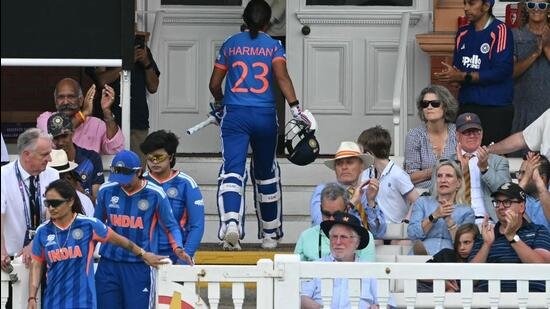
After India’s group-stage exit at the Women’s T20 World Cup following their six-wicket loss to Australia on Sunday, both captain Harmanpreet Kaur and head coach Amol Muzumdar admitted after the campaign that India’s T20 strategy needs a “rethink.”
Before the tournament, it was highlighted that teams dominating the middle overs are likely to succeed in modern women’s T20 cricket. Unsurprisingly, that is where India’s biggest issues lie.
Their campaign exposed that they are still working with a template that has gradually fallen behind the world’s best. Between overs 7 and 15, India scored 356 runs at a run rate of 7.91, significantly behind Australia (9.21) and England (8.95), the first teams to qualify for the semi-finals.
India’s dot-ball percentage stood at 29.8%, significantly higher than Australia’s (20.5%), while their boundary percentage of 16.2% was comfortably the lowest among the three leading sides.
India’s middle-order batting appeared as one of the weak links throughout the tournament, even in games they managed to win. Yastika Bhatia, Jemimah Rodrigues and Harmanpreet Kaur looked out of sync most of the time.
Bhatia and Rodrigues are decent players against spin and capable accumulators, but neither naturally fits the role of an enforcer who can immediately change the tempo after the Powerplay. As a result, India often spent the middle overs preserving wickets instead of maximising scoring opportunities before asking Harmanpreet or Richa to rescue the innings at the death.
Overall, in the middle overs, India managed a strike rate of just 128.4 compared to Australia’s 150 and England’s 143.9 throughout the tournament. South Africa lags behind India on many fronts (strike-rate, boundary percentage, average, and more) in the middle overs, which is why their loss in that fixture stings more in hindsight.
Rather than consistently finding boundaries, India relied on rotating the strike throughout the tournament, reflected in a rotating-shot percentage (28.4), higher than Australia’s (23.5), England’s (22.2) or South Africa’s (25). That approach may have worked a few years ago, but T20 cricket has moved on.
India’s personnel issue goes beyond the middle order. They used five different pace combinations during the tournament, constantly shuffling personnel without settling on a clear attack. They insisted it was down to a horses-for-courses approach but that lack of continuity was reflected in the meagre returns from the pacers.
There is also a significant difference in their home and away records. Since the last T20 World Cup, Indian batters have scored 1272 runs in 49 innings at an average of 38.5 and a strike rate of 150.3 at home, compared to 2409 runs in 124 innings at an average of 25.1 and a strike rate of 132.5 away, indicating their discomfort in unfamiliar conditions.
The Women’s Premier League has undoubtedly expanded India’s talent pool, with youngsters like G Kamalini, Bharti Fulmali and Anushka Sharma earning call-ups. Yet none has forced their way into the XI, been given a long rope or threatened established personnel. The competition has created depth and bench strength, but not enough pressure to drive a change in India’s philosophy.
Barring fielding, India’s problems are no longer isolated technical flaws but structural issues. The world’s best T20 teams attack relentlessly through the middle overs – as was shown by Australia’s Ash Gardner and Ellyse Perry or South Africa’s Marizanne Kapp and Tazmin Brits against India. They carry multiple boundary hitters and back bowlers to keep taking wickets even under pressure.
India’s current “T20 strategy” is increasingly at odds with where the format is heading. Now that the team management has publicly acknowledged it, it remains to be seen whether there will finally be an overhaul in philosophy or personnel.
