


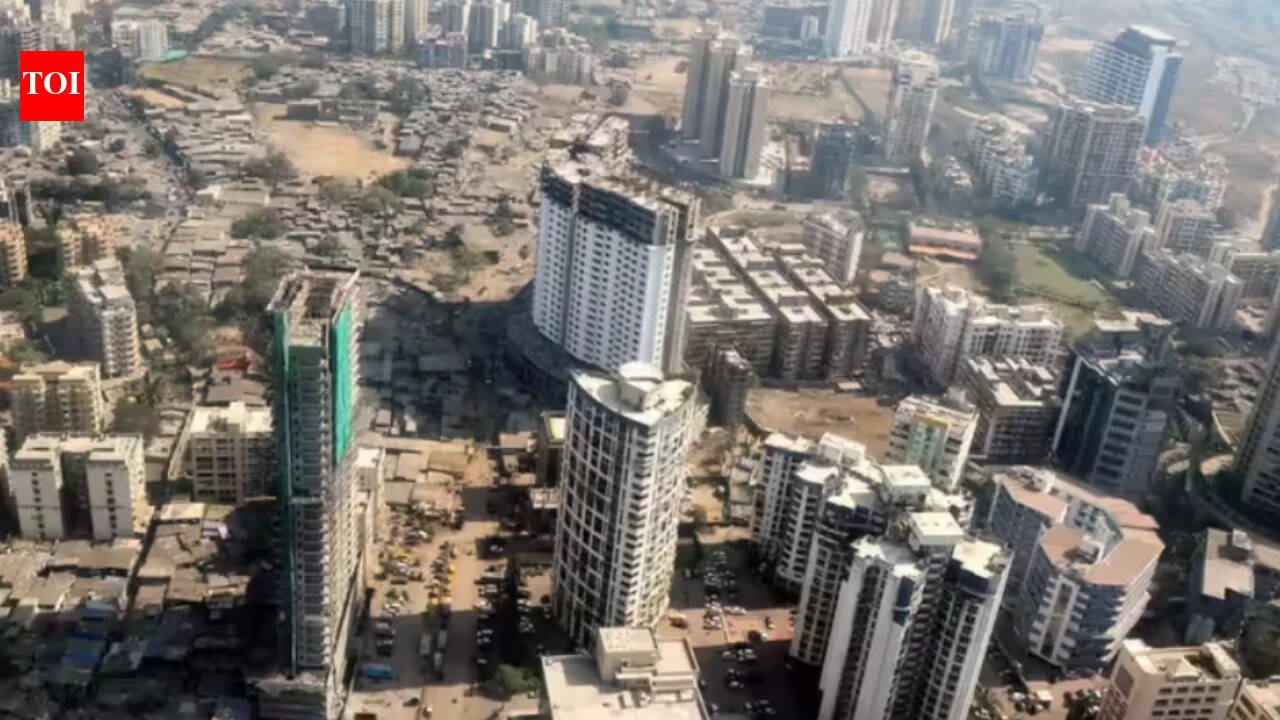
MUMBAI: Geopolitical uncertainty arising from the ongoing West Asia conflict appears to have taken some steam out of India’s residential property market, with housing sales across the country’s seven largest cities declining 6% year-on-year during the April-June quarter even as developers continued to launch new projects.According to ANAROCK Research, around 90,715 homes were sold across the top seven cities in Q2 2026 compared with 96,285 units in the corresponding quarter last year. On a sequential basis, sales declined 11%.For the Mumbai Metropolitan Region (MMR), however, the slowdown did little to dent its position as the country’s largest residential market.MMR recorded the highest absorption of about 28,710 homes during the quarter, nearly one-third of total sales across the top seven cities, despite registering an 8% decline from the 31,275 units sold a year ago.The region also led fresh supply, with developers launching about 34,555 homes, a 23% increase over the corresponding quarter last year, although launches fell 14% compared to the January-March period.More than 57% of the new supply in MMR was priced below Rs 1.5 crore, indicating sustained developer focus on upper-mid income homebuyers.Together, MMR and Bengaluru accounted for nearly 48% of all homes sold and 53% of new launches across India’s seven major residential markets.The report attributed the moderation in demand to uncertainty triggered by the West Asia conflict, its impact on global supply chains and caution among homebuyers amid concerns over the technology sector.“The Middle East war’s impacts on the entire sector were all too obvious. We now have a more balanced housing market where new supply is catching up with absorption as sales growth moderated across most cities,” said Anuj Puri, Chairman, ANAROCK Group.He added that demand continues to be driven by premium housing, infrastructure-led corridors and cities with strong Global Capability Centre (GCC) employment, while uncertainty surrounding the IT and ITeS sectors and rapid advances in artificial intelligence have prompted some prospective buyers to postpone purchase decisions.Despite slower sales, developers maintained confidence by increasing launches 7% annually to about 1.06 lakh units across the top seven cities. ANAROCK said much of the new supply came from large and listed developers launching projects on land parcels acquired during 2025.The report also highlighted a clear shift towards premium housing. Homes priced between Rs 80 lakh and Rs 1.5 crore accounted for the largest share of fresh launches at 27%, followed by the Rs 1.5 crore-Rs 2.5 crore segment with 25%.Luxury housing priced above Rs 2.5 crore contributed another 22%.In contrast, affordable housing continued to lose ground, with homes priced below Rs 40 lakh accounting for just 6% of total new supply, a single-digit share that underlines the widening gap between demand and availability in the budget segment.Among other cities, only Kolkata, Hyderabad and Bengaluru recorded annual growth in housing sales, while Pune witnessed the steepest decline of 15%. Hyderabad posted the highest increase in fresh launches at 53%, while Bengaluru saw a 41% jump in new supply.Residential prices continued to rise, though at a slower pace. Average prices across the seven cities increased 7% year-on-year but only 1% over the previous quarter, suggesting price appreciation is stabilising after the sharp gains seen over the past two years.NCR recorded the highest annual price increase at 13%, followed by Bengaluru at 8%.Meanwhile, unsold inventory across the seven cities rose 10% year-on-year to over 6.16 lakh units by the end of June 2026, reflecting improving supply.Bengaluru registered the highest inventory growth at 34%, while NCR remained the only market where inventory levels stayed largely unchanged.The findings suggest that while housing demand has moderated amid global uncertainties, developers remain optimistic about long-term demand, particularly in metropolitan regions such as MMR where infrastructure expansion and employment growth continue to underpin residential activity.
