


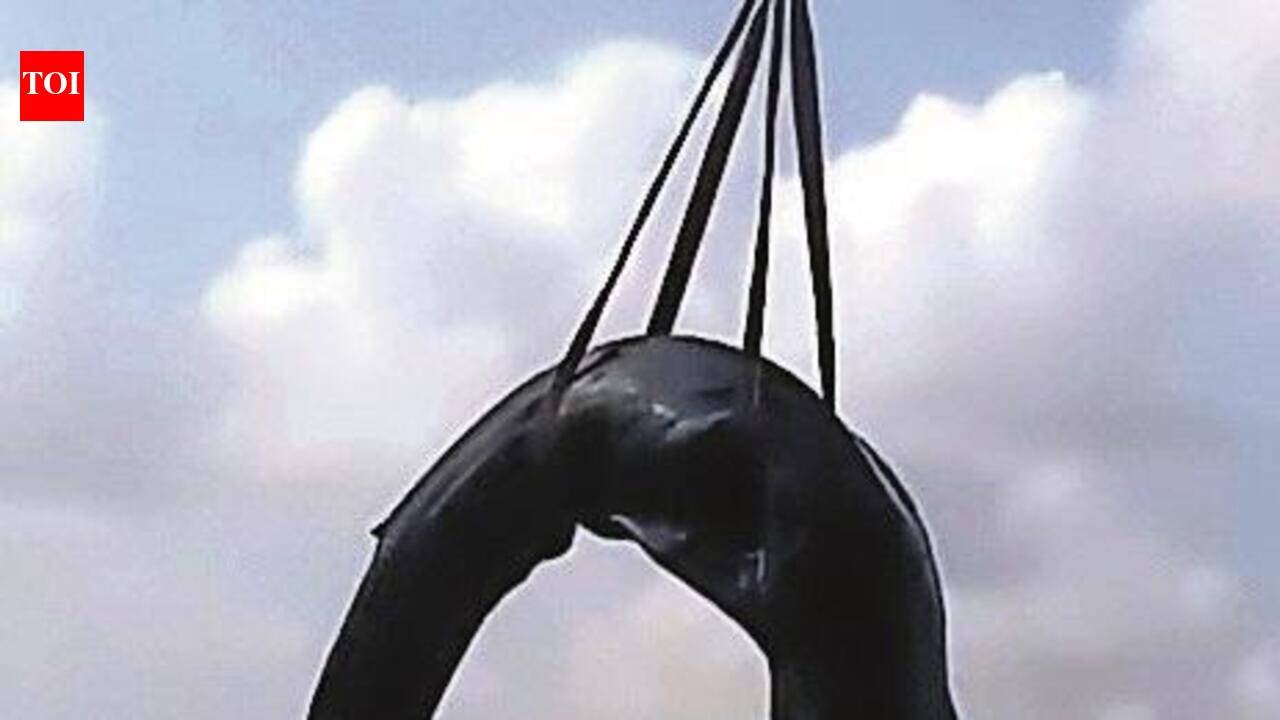
Mumbai: A blue whale calf, about 25ft long, died after being stranded along the rocky Bandra coast on Saturday morning.Veterinarians, officials from the forest department’s mangrove cell and the civic body, and other rescue teams attempted to save it but failed. The carcass was recovered with the help of a crane for examination and later buried at Versova beach.It’s unclear why the calf beached itself. State agencies have launched an investigation into it. Whales can strand themselves due to severe illness, injury, disorientation, navigational errors, and human-induced disruptions. Sometimes, they can follow a distressed pod member into shallow waters.Marine mammal expert Dipani Sutaria told TOI: “The blue whale is an endangered species. The veterinarian who checked the carcass said there were no external injuries. However, during monsoon, the mother whale and her calves may have been chasing a shoal of fish or plankton close to the coast, and this particular calf may have become disoriented and hit the rocky Bandra coast. It is also possible that the mother whale may have been injured after being hit by a large trawler and the calf, therefore, lost its way. Underwater noise disturbances, unhealthy biochemicals in the sea or predators like orca can also affect whales.”N Vasudevan, marine biologist and former head of the state mangrove cell, recalled that in 2016, a blue whale had stranded itself on the Raigad coast. “Despite efforts to push it back into the water, it did not survive. More research can throw light on why whales get stranded.”Environmentalists and other marine biologists wondered why the rescue attempts failed. “It is unfortunate that the blue whale calf could not be saved despite attempts to push it back into the sea. There is barely any research done on why the blue whale—the world’s biggest mammal—and other whale species get stranded. I suspect industrial and sewage pollution discharged into the ocean to be the cause of harming marine animals, besides the presence of several fishing trawlers and ships, which can harm whales,” said environmentalist D Stalin of NGO Vanashakti.B N Kumar, director of NatConnect Foundation, which works on environmental causes, called the death “deeply distressing”.Nandakumar Pawar, director of Sagar Shakti, the marine division of Vanashakti, said the death should be treated as an isolated wildlife tragedy. “It is a stark reminder that the health of our seas and the livelihoods of our traditional fishing communities are inseparably linked. When the marine ecosystem is under stress from pollution, habitat degradation and unregulated coastal activities, it is not only marine species that suffer but also thousands of fisherfolk who depend on healthy waters for their survival.”
