


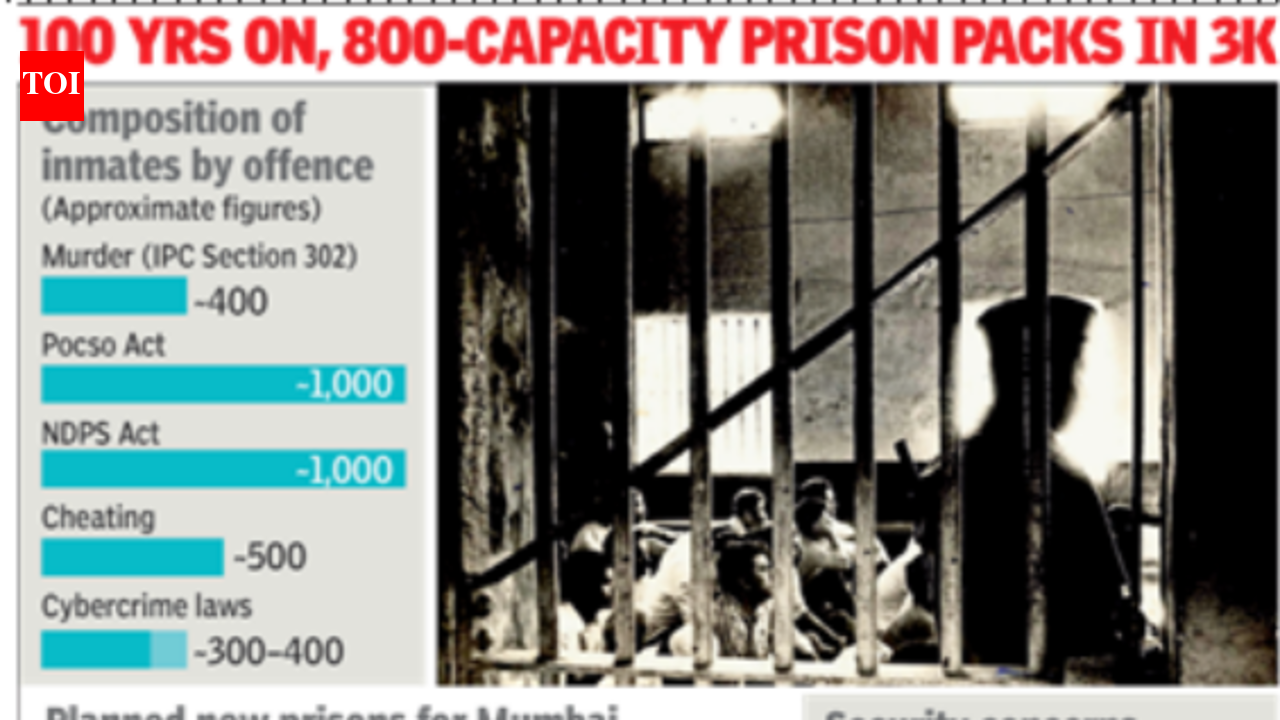
Mumbai: Mumbai Central Prison, more commonly known as Arthur Road Jail, has completed a century housing the city’s most dangerous and controversial residents — from the smuggler barons of the 1960s to the rival gangs who turned the prison into a battlefield in the 1990s, to the present-day white-collar accused who are vocal about the prison’s “inhumane” conditions.Built in 1925-26 to ease overcrowding in Bombay’s colonial prisons at Dongri and Byculla, Arthur Road was named after George Arthur, Governor of Bombay, and the architect of Tasmania’s notorious Port Arthur penal colony. A hundred years later, the prison grapples with the very problem it was created to solve — overcrowding.In the years before Independence, Arthur Road saw some indomitable souls incarcerated behind its walls. Jayaprakash Narayan was imprisoned during the Civil Disobedience Movement in 1932 and again in 1941 for opposing India’s participation in World War II. Mahatma Gandhi’s British disciple Mirabehn spent three months in 1932 after defying colonial orders, while Subhas Chandra Bose was arrested on arrival at Bombay port in 1936 and lodged here.After Independence, it was declared a Central Prison in 1972. During the Emergency, it became a high-security detention facility holding journalists, opposition politicians and activists alongside gangsters under the Maintenance of Internal Security Act (MISA).Prison as BattlefieldAs Mumbai’s criminal landscape evolved, so did Arthur Road.Swati Sathe, former deputy inspector general of prisons, says the assassination of the 12th Chief of Army Staff, General Arun Kumar Vaidya, in 1986 fundamentally changed prison security. “That was the era of the Khalistani insurgency. After General Vaidya’s assassination, the Anda Cells were introduced across Maharashtra’s prisons to house inmates posing the highest security threat.”Arthur Road’s Barrack No. 12 — the prison’s famous Anda Cell — consists of reinforced, egg-shaped compartments measuring 10 feet by 10 feet. Salman Khan, Chhagan Bhujbal and Sanjay Dutt are among its best-known occupants. But its most infamous prisoner was Ajmal Kasab. (“Kasab had a threat against his life from almost everyone inside the prison. The Anda Cell was specially reinforced to make it completely bulletproof and capable of withstanding even rocket launcher attacks. A company of the Indo-Tibetan Border Police was stationed solely to guard him,” Sathe recalls.)The Making of a GangsterThe 1990s transformed Arthur Road into an extension of Mumbai’s gang wars.“I just joined the department,” recalls Satish Srivastav, a senior officer in the prisons department. “Arthur Road was synonymous with gang wars. D-Company, run by Dawood Ibrahim, and the Amar Naik gang dominated the prison.”Superintendent of Arthur Road jail Harshad Ahirrao says prisoners became communally divided after the 1993 Bombay serial bomb blasts, each political party had certain groups in the prison that they actively supported.He adds, “Stabbings were very common. Swords and knives used to be thrown into the prison from the neighbouring slums. After the attack, the weapons were thrown back outside, leaving no evidence.”Gang members stationed outside the prison acted as weapon throwers. On one occasion, even crude bombs were lobbed into Barrack No. 12.The prison yards frequently became extensions of Mumbai’s underworld.In Dec 2002, the Chhota Rajan gang members strangled their own associate, O P Singh, suspecting he planned to defect to Dawood’s syndicate following his transfer to Nashik Jail. A year later, Abdul Sattar Telli assaulted Dawood’s younger brother, Iqbal Kaskar. In 2007, robber John D’Souza was stabbed 14 times, triggering a chain of revenge attacks. Within weeks, the alleged killer, Asgar Ali Mehandi, was hacked to death before hundreds of inmates. In 2010, D-Company lieutenant Mustafa Dossa attacked Abu Salem using a spoon sharpened into a knife, suspecting he was passing information to prison authorities.The greatest challenge, according to Sathe, was that rival gangs were constantly able to communicate with one another. To counter this, gangs were housed in separate wings, isolating each major group and preventing them from interacting.By the early 2000s, authorities separated the city’s major gangs altogether: D-Company members were shifted to Thane, the Amar Naik gang to Kalyan and the Rajan gang to Nashik.For prison officials, however, the greater concern was that Arthur Road had become a recruiting ground for organised crime.“Suppose you are a young man arrested for a petty offence. You’re scared and don’t know what to do. Then a group of inmates befriends you, gives you protection. The leader first assigns you a small task, then something slightly against prison rules, then a small crime. It keeps escalating until you are fully immersed in the life of a mafioso.”Few examples illustrate that transformation better than Munna Jingada.Arrested in 1996, Sayyad Muzzakir Muddasar Hussain, better known as Munna Jingada, entered Arthur Road as an ordinary accused. Inside, he met Ismail Malabari, one of Chhota Shakeel’s closest associates. Malabari recruited him into D-Company, where Jingada became one of the syndicate’s principal shooters before he fled to Pakistan and was later implicated in terror cases.Arthur Road also became the centrepiece of one of India’s biggest terror trials. After the 1993 Bombay serial bomb blasts, more than 100 accused were lodged here and a special TADA court was constructed inside the prison.Ahirrao recalls, “The govt wanted the trial concluded as quickly as possible, but managing both the prison and the court created logistical challenges.”By the late 2000s and early 2010s, members of the Indian Mujahideen arrived after the 2011 Zaveri Bazaar, Opera House and Dadar bomb blasts, which killed 26 people.“They were different,” says Ahirrao. “They were trained for imprisonment. They knew their rights, filed multiple petitions against the prison, understood civil liberties, were media-savvy and knew exactly how to navigate the Indian legal system.”Modern Prison, Old ProblemsWhile its inmates changed, the prison itself modernised.The sparse British-era diet gave way to three cooked meals a day. Prisoners can now spend up to Rs 10,000 a month at the canteen, video-call their families twice a month and use fingerprint-enabled kiosks to track their court cases. Video-conferencing facilities have also reduced the need for physical court escorts, though officials say they remain underused.Despite technological upgrades and changing security arrangements, Arthur Road’s greatest challenge still remains: overcrowding.Former prison officer Rajendra Dhamne says the consequences have hurt some of the more salient features of prison policing.“When I joined in 1986, officers knew prisoners individually. We counselled them, kept in touch with their families and even helped former inmates rebuild their lives after release. We also helped arrange marriages for some. Today, with so many prisoners packed into the jail, that human connection has disappeared.”The official capacity of Mumbai Central Prison remains 800 inmates, unchanged from a century ago. Yet it now houses between 3,300 and 3,600 inmates — more than four times its sanctioned capacity.A 2017 report by the National Human Rights Commission paints a stark picture of life inside the prison. “Prisoners sleep three rows towards the walls of the barrack and another row in between. The prisoners cannot turn right or left and are forced to sleep in the position occupied at the initial stage.”Ahirrao says, “To accommodate more prisoners, we even demolished the passageways and verandahs that the barracks once had.”Arthur Road Jail was built in 1925-26 to relieve overcrowding in Bombay’s colonial prisons. One hundred years later, after witnessing the freedom struggle, gang wars, terrorism and changing patterns of crime, it is still battling the very problem it was created to solve.
