


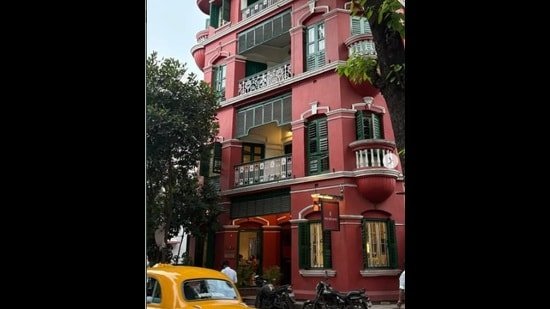
It’s the midday meal rush in Sienna Café, Kolkata, an establishment well-known for its bazaar-to-table menu and its use of local ingredients with a global imagination. But what I love most about the place, that opened in 2015, is where it’s located.
“Before it became home base for the Sienna family, the house at 49/1 Hindustan Park used to be the residence of Nihar Bala Devi, built in 1933, and passed on through three generations of women to her grandchildren,” says Shiuli Ghosh, owner of Sienna. “Although it was in need of some serious r&r, the almost 90-year-old house had a lot of character. Sienna has undergone several transformations through the years, but we have tried to stay true to the original essence of the space.” The enterprise that originally occupied only the ground floor has expanded upwards and now also includes an event space on the first floor.
Despite the changes, the features of the house that are common to many of the buildings in the area — high ceilings, slatted French style windows, ornate cast iron grilles, wooden bars on the ceiling, semi-circular verandahs, and square ventilators with floral cast iron meshes — have been maintained.
“The staircase with its ornate iron railings came with the house, and we tried our best to preserve these old (and well-loved) architectural facets even as we upgraded our space,” says Ghosh. The handmade ceramic mural tiles on the floors and walls, designed and hand-painted by the establishment’s master potter, Bappada at their workshop in Daronda, Santiniketan, add to the character of the space.
This trend of refurbishing old Calcutta homes and turning them into cafes has become popular in the south of the city. The four storey Red Bari that houses a café, co-working space, event space and a bed-and-breakfast has taken a similar approach. Located near the Kalighat Kali temple in an old neighbourhood, the structure, built in the 1920s, has been meticulously restored by the owner, Avantika Jalan, and her husband, John Grams.
“The house had locally been known as ‘Lal Bari’, or the red house, and I knew I wanted to take it back to its roots,” says Jalan. “I wanted people to appreciate its beauty and character and make it relevant again,” she adds.
Solidly constructed, the building did not require a lot of structural repairs. Its first two floors are made from chun-shurki, a durable and water-resistant traditional building material of lime binder mixed with ground burnt brick dust. The upper floors built in the 1930s and forties are of cement. The original shuttered windows have been retained though double layered glass has been incorporated to deaden the noise on the bed-and-breakfast floor.
Jalan had Bengal’s typical kori-borga inspired beams installed in the high-ceilinged rooms of the first three floors, and included track lights for illumination. The beautiful sloping roof of the verandas on the first and second floors were internally reinforced, and the wooden exterior was replicated from old Calcutta buildings. The typical Calcutta red oxide floors on the ground and first levels, the Italian marble in the entryway to the ground floor café, and the intricately patterned cement tile floors of the event space and the bed and breakfast apartment have all been left untouched. The event space on the third floor is highly flexible, with three large, interconnected rooms – one of which has colonial Indo-Saracenic-style arched windows all around, commanding a panoramic view over the neighbourhood.
While such complete and conscious transformations of entire buildings is still rare, many other cafes, from independent chains such as Tribe and 8th Day, to national chains such as Blue Tokai and Roastery and even the Calcutta classic Flurys, have utilised the ground floors of older houses in south Kolkata.
Shilpa Chakraborty, co-founder and partner of Tribe, says she chose an older building for the café’s first outlet near Gol Park because she wanted it to have the feel of a baithakkhana or a traditional Bengali living room.
“The owners of the place were specifically looking for tenants who would try and maintain its character, and I loved its homely look and the huge amount of natural light coming in through the tall doors and windows,” she says. “So, we preserved its layout and designed the café around the house.”
A similar principle drove Grant Walsh, proprietor of the 8th Day café chain. “Our Salt Lake, Ballygunge and Hindustan Park outlets are all residential buildings that we refurbished,” he says. It wasn’t always easy. The transformation of a home near Kolkata’s Vivekananda Park into an 8th Day outlet in 2018 was particularly challenging. “The house was in really good condition, and I happened to be friends with the landlord, but turning something from a bedroom and a bathroom into a café is a big job no matter what,” he says.
At the time, the only café like 8th Day in the area was Sienna. Despite the challenges of the conversion, such as meeting the safety requirements with local authorities’ differing rules for commercial and residential spaces, the outlet with ample parking and al fresco seating is a great hit. Much like Red Bari, 8th Day’s new Ballygunge location has retained the traditional red oxide floors of the original house.
“Transforming older properties into hospitality or retail spaces, as seen in South Kolkata, is a positive trend,” says architect Monica Khosla Bhargava of Kham Consultants. “The buildings are being restored, and the area’s characteristic urban morphology is being preserved. The brick-and-mortar essence of the structures remains intact.”
She adds that it is essential to recognise that this shift in land use changes the neighbourhood’s character as the “para” (Bengali for ‘neigbourhood’) gradually dissolves. “These residential initiatives, alongside the emergence of local cafes and boutiques, can foster the right regenerative atmosphere for a mixed-use neighbourhood,” she says.
Entrepreneur and founder of Calcutta Walks, a heritage walking tour company, Iftekhar Ahsan agrees. “Calcutta has always had this beautiful integration of the commercial and the residential, the spiritual and everyday living all intertwined into one neighbourhood, the para, that we all were so proud of and attached to,” he says.
Ahsan himself has undertaken a similar project called Calcutta Bungalow – a bed and breakfast in north Kolkata, for which he and his team transformed a 99-year-old house into a modern home stay while maintaining the Indo-European features typical of large houses in those areas.
“I am in the business of walking tours, taking people around and seeing the city,” he says. “When I’m looking at all these, I often think about how I’m showing people things that are disappearing. And that led to my realisation that I need to do something a little more permanent – I need to save a house.”
“Adaptive reuse is the way to go for Kolkata’s built heritage,” echoes Tathagata Neogi, heritage expert and co-founder of Immersive Trails, a marketplace for expert-led experiences in India. “Mumbai’s Art Deco precinct got the UNESCO World Heritage tag. I think Kolkata has a rich Art Deco legacy and turning old and semi abandoned spaces into lived spaces is the way to go in order to keep them relevant and the heritage value alive.”
Walsh says the trend is partly a response to the demand for commercial spaces in Kolkata. “Landlords are looking for income and if they move upstairs to a different floor in their house, they ca also meet the demands of India’s thriving economy,” he says.
Walsh believes the nature of Kolkata is also a factor. “People here love to be in each other’s homes, in communities – they just love being together,” he says. “That is better expressed through a residential neighbourhood than through a commercial sector. It’s a reflection of the beautiful communal nature of the city.”
Rush Mukherjee is an independent journalist based in Kolkata.
