


“I think that was Remal, no?”
“No, no. That was Bulbul.”
“But Fani was something else entirely.”
“And you’ve forgotten Mocha.”
The names move around the room, there is disagreement over details, affectionate correction, a collective remembering usually reserved for school friends, former neighbours or distant relatives.
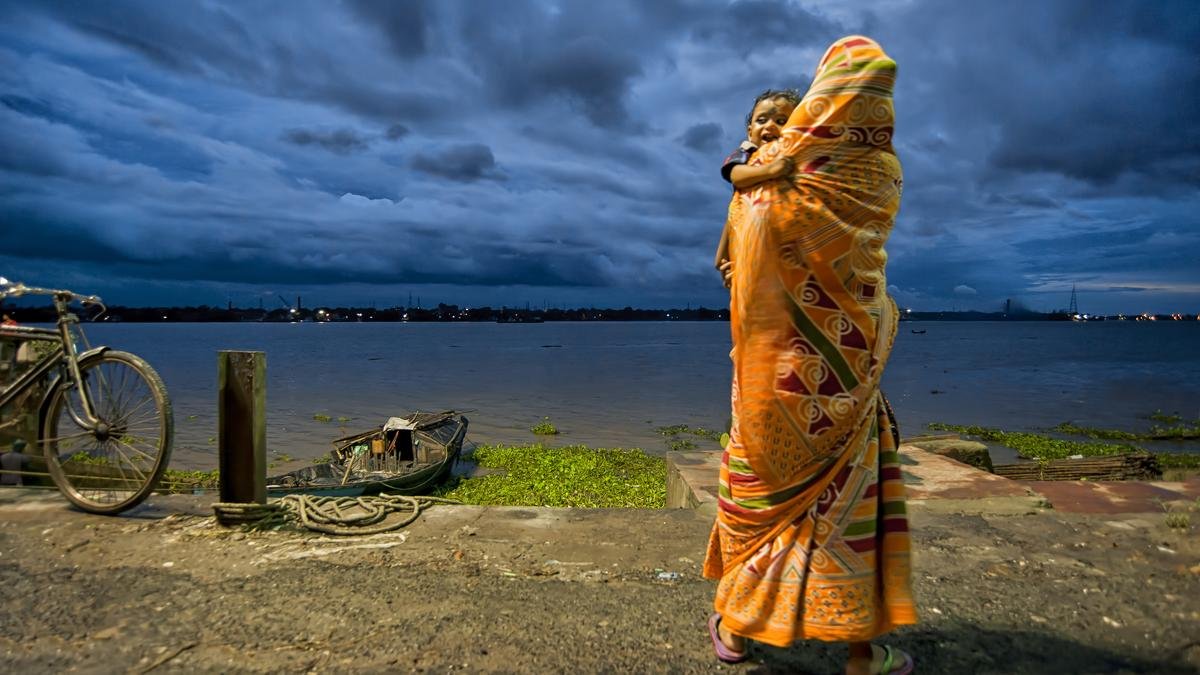
Thunder strikes Kolkata
| Photo Credit:
Chirasree Chakraborty
Except these are not people. They are cyclones – Remal, Amphan, Bulbul, Fani, Mocha.
Names once printed across newspaper front pages and flashed across television screens in urgent red banners. Names attached to storms that snapped trees like matchsticks, tore roofs from homes and sent entire cities scrambling for shelter. Across Bengal, they are remembered as disasters. But for the Kolkata Cloud Chasers they are remembered as encounters.
Chasing cyclone Remal
| Photo Credit:
Chirasree Chakraborty
For the eight members of Kolkata Cloud Chasers, an extreme weather photography group, the calendar is measured less by years than by weather events. Their lives are punctuated by cyclones, squall lines, thunderstorms and kalbaisakhis (summer tempest). They remember where they stood when the horizon darkened, where they lost a signal, where lightning struck nearby, where a forecast proved spectacularly wrong.
For 12 years, they have spent weekends pursuing the very phenomena most people instinctively avoid. While others retreat indoors at the first warning of severe weather, they study radar imagery, fuel their cars and begin driving towards the gathering darkness.
Lightning and rain in Kolkata
| Photo Credit:
Abhishek Saigal
What they seek is difficult to explain to anyone who has not stood before a storm.
Part science, part photography and part obsession, storm chasing demands equal measures of patience and surrender. The atmosphere can be studied, modelled and tracked. Yet it remains stubbornly unwilling to be controlled. A storm can weaken without warning, split into two systems, disappear entirely or arrive with a force beyond prediction.
That uncertainty is precisely what keeps them coming back.
Because every so often, after hours of driving across Bengal’s highways and waiting beside fields whose names barely appear on maps, the sky performs an act of such scale and beauty that language begins to fail.
A jagged bolt of lightning tears across the monsoon sky over Kolkata.
| Photo Credit:
Abhishek Saigal
And for a few fleeting moments, eight people standing beneath a wall of clouds are reminded of how small a human life really is.
Born from a photography club
The eight members first met through the Kolkata Photographer’s Club, a community of roughly 2,500 photography enthusiasts on Orkut in 2009. What united them all was a fascination with weather and the desire to photograph it.
The arrival of Android smartphones around 2009 proved transformative. Early weather applications such as AccuWeather and The Weather Channel suddenly placed satellite imagery and weather updates in people’s pockets.
On March 24, 2014, a WhatsApp group was formed and Kolkata Cloud Chasers was born. As weather technology improved, so did the group’s understanding of atmospheric science. What began as photography increasingly incorporated meteorology, forecasting and field observation.
A dramatic lightning strike cuts through the sky during a thunderstorm. in West Bengal’s Sittong
| Photo Credit:
Chirasree Chakraborty
An eclectic team
The group comes from remarkably different professional backgrounds.
Navigator and Nikon Grand Prix winner Debarshi Duttagupta works in the pharmaceutical industry. Suman Kumar Ghosh is an engineer and the team’s wind-data specialist. Chirasree Chakraborty, who runs a publication business, serves as one of the primary storm trackers. Joyjeet Mukherjee, a debt recovery expert, specialises in lightning photography. Krishnendu Chakraborty works in marketing, while Diganta Gogoi, an expert storm spotter, is a professional photographer. Abhishek Saigal runs a business and is known within the team for photographing lightning. Together, they form a highly coordinated unit.
Team Kolkata Cloud Chasers (KCC)
| Photo Credit:
Special Arrangement
“Eight people have different roles,” says Debarshi. “Chirasree and Suman study wind data, trajectories and weather models. Joyjeet and I work as navigators. Diganta and Krishnendu track the storm. We also have spotters who locate storm cells from a distance because drivers cannot do that while driving.”
A tablet mounted inside the vehicle acts as a mobile command centre. Every member contributes a different skill set, and reaching a storm often depends on all of them working in concert.
Inside the storm hunt
Storm chasing begins days before anyone gets into a car. The team constantly monitors weather models, IMD reports and applications such as Windy and WeatherBug. During the pre-monsoon season, they pay particular attention to conditions developing over Jharkhand’s Chhotanagpur Plateau near Ranchi, where many kalbaisakhis (summer tempests) originate.
According to Debarshi, years of chasing have taught them that Bardhaman functions as a crucial strategic point. From there, they can rapidly move towards Bankura, Purulia, Durgapur, Asansol or deeper into Jharkhand depending on how a storm evolves.
Routes are planned using weather forecasts, traffic conditions, travel time and expected storm movement. Yet even meticulous preparation offers no guarantees.
Speaking of cameras that capture the storms, Chirasree points out that she, Diganta, Abhishek and Joyjeet use a Nikon full frame DSLR. Debarshi has a Sony Mirrorless and Krishnendu uses a GoPro and a Fuji mirrorless. Their Storm and Cloud-chasing Four-Wheelers (SCIF) carry recovery equipment such as winches, tow straps and sand ladders for navigating challenging terrain.
Lightning crackles over rural Bengal.
| Photo Credit:
Debarshi Duttagupta
“Our success rate is only around 20 to 22 per cent. A storm may break apart, disappear entirely or suddenly change direction,” says Debarshi
When a chase succeeds, the team attempts to position itself parallel to the storm system, allowing members to photograph it while simultaneously recording meteorological observations and wind data.
Racing against the weather
One of the least understood aspects of storm chasing is the limitation of weather data itself.
“The data we receive is already at least ten minutes old,” says Chirasree. That delay means storm chasers are effectively pursuing an atmosphere that has already changed by the time they see it on their screens. A cloud formation that appears insignificant on radar may already be rapidly intensifying in reality. Because of this lag, navigation becomes critical.
“We work on probabilities. The navigator’s role is to estimate where the storm will be, not where it was, “Chirasree explains
She adds, “This challenge becomes especially acute with localised thunderstorms and pre-monsoon thundershowers, which remain far more difficult to predict than cyclones. Cyclonic systems can often be tracked ten days before formation. Local storms offer far less warning.”
Lost roads, failed forecasts and long drives, the glamour of storm photography often obscures the reality of storm chasing. “There have been many times when we’ve become lost in nameless villages,” says Debarshi. “We’ve driven through conditions with almost zero visibility. There have been times with no mobile signal and no GPS.” Hours of planning can end without a single photograph.
When a chase fails, the team has developed a ritual of its own. “We stop somewhere, eat good food and come back,” chuckles Debarshi.
Rain clouds gather in the sky.
| Photo Credit:
Diganta Gogoi
The atmosphere remains serious, but the group deliberately keeps its spirits light.
Safety before spectacle
Every chase begins with an escape plan. Before anyone steps out of a vehicle, the team identifies evacuation routes. Cars are parked facing the direction of departure. Keys remain in the ignition. When the group takes photographs, at least one member remains solely responsible for monitoring lightning activity and changing conditions.
The reason? Chirasree explains, with a glint in her eye, “In those moments you go into a trance. The awe of nature can make you forget that you may need to run,” says Chirasree.
Chasing cyclone Bulbul
| Photo Credit:
Chirasree Chakraborty
The dangers are real. Chirasree has received electric shocks through upward streamers. Team member Abhishek Saigal was also struck by lightning and temporarily lost sensation below his waist.
“Even after taking precautions, the possibility of getting struck by lightning remains,” says Debarshi.
Why they refuse to monetise the chase
Storm chasing is expensive. Cameras, communication systems, weather-monitoring equipment, recovery gear and vehicles are all funded personally by members.
Despite accumulating years of field observations and weather data, KCC has maintained a strict policy: the data will never be sold.
“We decided long ago that we would never monetise this passion,” says Debarshi.
Rain clouds over West Bengal’s Singur
| Photo Credit:
Suman Kumar Ghosh
During the off-season, the team compiles its observations into presentations on lightning safety, cloud formation and climate change, which they deliver at schools, colleges, Rotary clubs and other institutions. Many organisations have offered payment but the group has consistently declined. “We believe the moment money enters the equation, it dilutes the passion.”
More than a team
Over the years, the members have become something closer to family. “We’ve known each other for almost twenty-five years,” says Chirasree. What keeps them returning is not the photograph itself but the experience of encountering something immense. After hours of driving and tracking, there are moments when a towering storm cell finally emerges on the horizon.
“You feel very small in front of nature. Your existence feels almost insignificant. The clouds are rumbling, the thunder is cracking, and you realise how tiny you are in comparison. It’s risky, but that feeling is priceless,” says Chirasree.
Orange lit skies colour the horizon.
| Photo Credit:
Suman Kumar Ghosh
