


When Rafael Nadal was seven years old, he believed his uncle Toni could do anything — even make it rain.
A young Rafa was playing his first tournament against an 11-year-old opponent who was much bigger and stronger than him. Toni told him not to be scared, and assured him that if he was losing badly, the rain would magically come down.
Rafa didn’t start well. He went down 1-0, then 2-0 and then 4-0, losing both his early service games. But then he broke back for 4-1, held serve for 4-2 and broke again for 4-3, to claw his way back into the match. That’s when the rain started falling. While they were waiting for the skies to clear, Rafa frantically sought out Toni. “Stop the rain,” he said. “I think I can beat him.”
Fifteen years later, in 2008, Rafa — older, wiser, ranked No 2 in the world at the time and already a four-time French Open champion — was playing his third straight Wimbledon final against Roger Federer. He had lost to Federer the previous two years and had just blown a two-set lead when a thunderous downpour disrupted the match. Toni went to find Rafa in the locker room to try and cheer him up ahead of the fifth and final set but couldn’t think of anything meaningful to say.
After a few minutes of silence, Rafa looked up at him and grinned: “You can stop the rain, Toni. I’m not going to lose today.” (And he didn’t.)
THE NADAL WAY
There are many ways to be a champion. Some sporting icons build their legend on pure grace and technical perfection. Nadal’s great rival Federer was one of those. No one in history has looked better playing their sport than the Swiss maestro did while playing tennis. You could’ve placed him in a classical concert, in a dance recital or on a fashion runway, and his fluid forehand and whiplash backhand would have fit right in.
There are others whose hunger propels them to solve any problem thrown at them. Nadal’s biggest hurdle in his later years, Novak Djokovic, was one of those. Serve wide or serve straight, hit high top-spins or scorching shots close to the net, outpace him or outlast him, he would still somehow find a way to best you with his guile and his uncanny ability to neutralise his opponent’s advantage.
And then there are those like Nadal who are all heart. For whom there is no pain threshold, no mental bock, no emotional barrier. One may injure them, crush them or hurt their pride, but they’ll still come roaring back, because they can push themselves further than most others can. If they fall short, they blame themselves for not doing enough. When they triumph, they believe they could have done better.
A new Netflix documentary, Rafa, captures the life, times and mindset of sport’s most resilient champion. Nadal won 22 Grand Slams, two more than Federer and two less than what Djokovic is now sitting on. He is the only player to be ranked No 1 in the world in three different decades: he first climbed the pinnacle on August 18, 2008, and last occupied the summit on February 2, 2020.
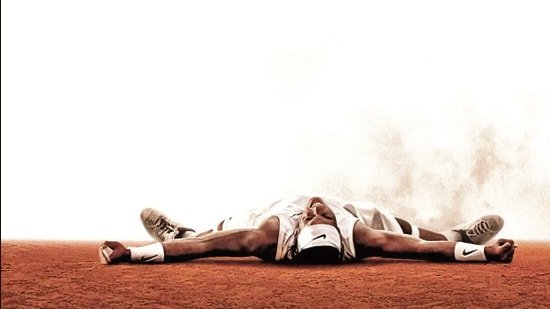
His crowning achievement was winning 14 French Open titles between 2005 and 2022 for a 112-4 (95.6%) win-loss record at the most gruelling of Grand Slams. There has been no greater combination in any sport ever than Rafael Nadal and the red clay of Roland Garros.
But the documentary goes beyond the numbers to demystify Nadal as a champion for whom the struggle was paramount. Unlike those who may revel in victories or achievements, his solace came from pushing himself to gain every extra millimetre. “People thought I was a winner,” Nadal says. “I’m not a winner, I’m a competitor.”
BEAUTIFUL, BRILLIANT, BREAKING
Nadal was seen as a specimen of the perfect sporting physique through most of his career. The pirate pants ended just above bulging calves. The cut-off T-shirts enhanced his beefy biceps. The hybrid headband-bandana allowed caveman tresses to frame his forehead. It was a bohemian persona that went perfectly with his gladiatorial style of play.
But beautiful and brilliant as he may be, beneath the veneer, Nadal was breaking.
He suffered from Muller-Weiss syndrome, a rare degenerative condition that impacts the navicular bone and leads to debilitating pain in the mid- and hindfoot. Nadal discovered it in 2005, as an incidental finding after he broke his left foot at the Madrid Masters.
He’d won just one French Open title at the time, and had to contend with the idea of surgery that could mean he would never play competitive tennis again. Determined to find another way, he treated the condition with a specialised insole that took some stress away from the boat of the foot, paired with pre-match nerve block injections that reduced the pain.
Still, he hurt in each of the 1,308 matches he played, and over the countless hours of practice, first with Uncle Toni as his coach from 1993 to 2017 and then with Carlos Moya, until he retired in 2024 as a 38-year-old.
Wearing the insole for 19 years impacted other parts of Nadal’s body. Tendinitis in his knee was the most agonising direct consequence. There were also abdominal tears, back pain and hip flexor injuries. The constant use of painkillers, meanwhile, caused small perforations in his intestines. But his passion was always stronger than the suffering.
What Nadal got in return for not giving up was showcasing to the world what only he could: the heavy forehand topspin that sent the ball back at over 3,000 rpm, the wide kick-serve that opened up the court, the relentless targeting of his opponent’s backhand (even if the backhand belonged to Federer), and the ability to chase anything down (even if it was one of Djokovic’s sliding open-stance cross-courts).
Most of all, for a person who always felt he could have pushed harder, he eventually got to leave the sport with his head held high. For, Grand Slams titles and win-loss records aside, Rafa knew that he’d always given it his all. That he’d never saved anything for the swim back. That, Uncle Toni’s magical powers notwithstanding, he never really needed the rain.
(The views expressed are personal)
