


‘UT now getting Rs 500 crore, Rs 1,000 crore projects’
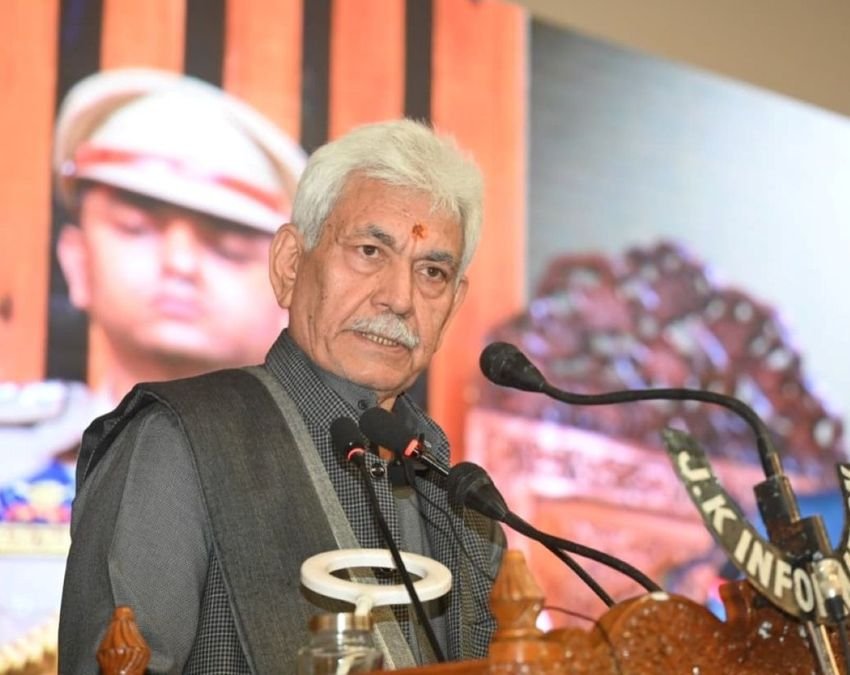
Srinagar, Jun 13: Lieutenant Governor Manoj Sinha on Saturday highlighted Jammu and Kashmir’s economic transformation, saying the Union Territory has experienced significant industrial growth in recent years. He said the industrial policy introduced in 2021, with the support of the Government of India, provides incentives worth Rs 28,400 crore and has created a conducive environment for private investment.
“Before 2021, private investment in Jammu and Kashmir stood at around Rs 14,000 crore. Today, for the first time since Independence, projects valued at more than Rs 500 crore and Rs 1,000 crore are being established in the Union Territory,” the LG said, addressing a gathering at an event organised by the Mahamana Malaviya Mission in Kashmir.
Sinha said thousands of industrial and business units have been established across J&K, while the startup ecosystem has witnessed substantial growth. He informed that nearly one-third of the 4,300 registered startups in Jammu and Kashmir are based in the Kashmir Valley, reflecting the entrepreneurial potential and aspirations of the region’s youth.
The Lieutenant Governor further said that Jammu and Kashmir has emerged as a leading performer under the Prime Minister’s Employment Generation Programme (PMEGP), despite accounting for only one per cent of the country’s population. “For the last three years, J&K has ranked number one in PMEGP implementation, surpassing all other states and Union Territories,” he said.
He also commended educational institutions and teachers in Jammu and Kashmir for their innovative implementation of the National Education Policy since 2020, describing their efforts as exemplary. Referring to the flexibility introduced under the NEP, he highlighted initiatives such as “Design Your Own Degree”, which are intended to provide students with greater academic freedom and choice.
The LG said India’s sustained economic growth, despite global financial uncertainties, reflects the resilience of its development model and the enduring relevance of leaders such as Malaviya, whose ideas on industrialisation, skill development and self-reliance continue to influence the nation’s progress.
Addressing the gathering, the Lieutenant Governor said the vision of Mahamana Pandit Madan Mohan Malaviya continues to inspire India’s pursuit of self-reliance, innovation and inclusive growth.
He said the integration of education, culture and modern science is vital for building a developed Jammu and Kashmir and a stronger nation.
The LG commended efforts to digitally preserve and promote the thoughts and teachings of Pandit Madan Mohan Malaviya, saying the initiative would help extend his ideals to audiences across the globe. He described Malaviya as a visionary statesman whose contributions transcended the challenges of his era and laid the foundation for India’s educational, industrial and cultural advancement.
“Malaviya’s vision of nation-building through education was embodied in the establishment of Banaras Hindu University in 1916 and in his commitment to nurturing engineers, scientists, agricultural experts and scholars capable of contributing to a prosperous and self-reliant India. More than a century ago, Malaviya advocated an education system that integrated science, technology, spirituality, culture, agriculture and vocational training—an approach that finds resonance in the National Education Policy (NEP),” he remarked.
Sinha added, “Culture, values and modern science together can build a developed India, a self-reliant India and a developed Jammu and Kashmir,” the Lieutenant Governor said, adding that ongoing reforms in the education sector are aimed at translating Malaviya’s vision into reality.
