


What forms can rebellion take on a fast-sinking desolate island?
Inspired by Banishanta, a real-life “floating” brothel settlement in Bangladesh, Tahmima Anam’s new novel, Uprising (Penguin Random House), is set on a fictional strip of land rapidly being reclaimed by the sea. It is mainly women and children trapped there, in routines marked by despair. Then, a teenager arrives from the mainland.
Kusum Khan once marched against the Dictator. Now, she forces the island’s inhabitants to face a bitter truth: No one is coming to save them. She incites revolt against the settlement’s brutal order, challenging the tyranny of the ruthless Amma who heads it.
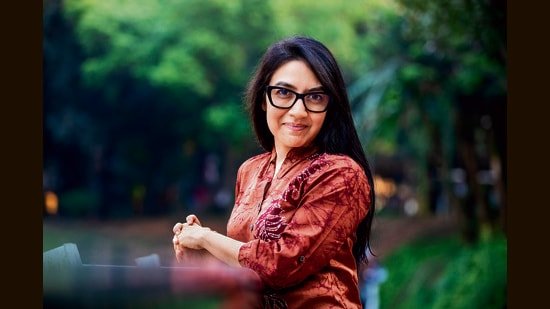
“This book turned out to be more harrowing to write than anything I had written before,” says Anam, 50. The women endure lives of entrapment and indignity, in makeshift homes where their sons are typically sent away to be adopted and their daughters, by the age of 10, know the future that awaits them.
Why this setting, for her novel of civil unrest and rebellion? Because it is a way to represent what is truly at stake, through the eyes and lives of some of the subcontinent’s most marginalised, says the London-based Bangladeshi author. “When I first heard of the floating brothel about 15 years ago, I could hardly believe it was real. It seemed so unlikely, like something one would read in a novel: a remote island beset by storms and cyclones, home to 100 women and their children, each trapped, in one way or another.”
***
So, what would renewal look like, in a world like this?
The real-world student-led Monsoon Revolution of July 2024, which ousted Bangladeshi prime minister Sheikh Hasina, planted the seed of the plot in Anam’s mind, she says. In the novel, the protagonist Kusum is radicalised by her participation in a student-led youth movement, and holds on to those ideals when she finds herself enslaved on the island.
It isn’t so much a story about the power of one, the author says, as the power of collective protest. When Kusum first attempts to mobilise them, the women have the same questions as most oppressed people…
If not Amma, who?
What guarantee do they have that they won’t end up worse off?
What if they stand up to her and lose?
What if they win, and there is no way forward, nowhere else for them to go?
Eventually Kusum realises that the question isn’t how they can break free and flee, but how she can help drive change right where they are. “This is eventually a story of the triumph of freedom over adversity, and the power of revolution,” Anam says.
***
The climate crisis serves, in a way, as a dark antagonist.
Which is fitting, given that Bangladesh stands to lose more than perhaps any other non-island nation, in the first ravages of life after 1.2 degrees of warming. This is a country where 80% of land area consists of low-lying floodplains; where the coast is under threat, as are freshwater sources, agriculture, livelihoods and the economy at large. And where climate migration is already an ongoing crisis.
In Uprising, the fictional island serves as a microcosm of this reality. Just “20 huts long and four huts wide”, it is getting smaller and poorer, as the waters rise. “The fact that the very land they live on is unstable heightens all the other inequalities they face,” Anam points out. But then that is our shared reality, she adds.
***
Does she believe children will help lead the change, as they do in her tale?
In her novel, they are the catalysts: curious, optimistic troublemakers, whose dreams are simple — an extra pair of shoes, rice three times a day, a day spent reading — and whose unrest, underpinned by those dreams, is real.
“I believe in the power of uprisings,” Anam says, “and every uprising requires idealism, whether it springs from despair, hope or the optimism and innocence of young people.”
Revolution shaped her, as a child and as an adult, she adds. Anam was born to journalist Mahfuz Anam and human-rights activist Shaheen Anam, who formed part of the country’s guerrilla resistance against military rule at the time of the 1971 Bangladesh Liberation War. After 1971, her parents worked with Unesco (the United Nations Educational, Scientific and Cultural Organization), which meant she grew up across Paris, New York and Bangkok, among other cities. She returned to Dhaka at 15, where her father co-founded The Daily Star newspaper. “I was raised on a diet of politics, secularism and feminism with parents whose whole being is shaped by moral purpose,” she says.
Her previous novels have spotlit some of this history. Her first, A Golden Age (2007), grew out of the interviews she conducted for her PhD thesis in anthropology at Harvard University, and tells the story of the Bangladesh War of Liberation through the eyes of one family. It won her the Commonwealth Writers’ Prize for Best First Book, among other awards.
The Good Muslim (2011) and The Bones of Grace (2016) followed, making up a trilogy that traces three generations of the fictional family as they navigate ideological shifts, crises of identity, and personal struggles mirrored by the struggles of a newly independent country.
With Uprising, Anam says she feels transformed, with a voice that is less constrained and more willing to speak in tones of hope, anger and frustration. “I found it incredibly liberating to put in the voices of these women the unspeakable truths about women’s bodies, so often the subject of shame and taboo,” she says. “I want to tell people, if those experiencing the worst cruelties can find a way to rebel, then anyone can.”
(Click here to read an exclusive excerpt from Uprising.)
