It is a night sometime in the mid-1960s, Greenwich Village, New York City. The air in the Cafe Au Go Go on Bleecker Street carries the residue of spilled beer, cigarette smoke, and the rebellious zeitgeist of that era. A young woman with a battered acoustic guitar finishes her set. Across the room, a slight figure with an Afro and a guitar that seems to grow from his shoulder watches with the intensity of a hawk. He approaches, pulls up a barstool, and plays along with her.
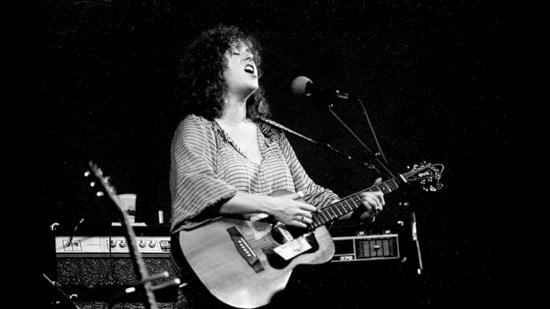
McIlwaine (1945-2021) performs in Chicago in 1980. Leave the slide guitar to the men, she was told. Instead, she played with a ferocity that was, at least for a while, impossible to ignore. She died five years ago this June. (Getty Images)
This is not yet Jimi Hendrix. He is still Jimmy James, playing small rooms with his band, the Blue Flames. But he has found something in this woman’s music that compels him — that rare, undefinable quality that makes one musician recognise another not merely as a peer but as a co-conspirator. Ellen McIlwaine, red-headed, Nashville-born, Japan-raised, plays the slide guitar like she is squeezing something precious from the instrument, and she sings with a voice that shifts the way fickle weather shifts — sudden, but unstoppable.
That night in the Village is like a microcosm of Ellen McIlwaine’s entire life story: she was the one the great ones came to, and yet the world never quite came to her.
Greenwich Village in the 1960s was the seismic epicentre of American music. You could find Muddy Waters and John Lee Hooker at the same venues where Joni Mitchell and Richie Havens worked out new ways of expressing themselves through song. Nina Simone owned any room she entered. The Village Voice listed gigs at the Bitter End, the Gaslight, and Cafe Wha. Into this world arrived Ellen McIlwaine— born in Nashville in 1945 but raised as the daughter of a Presbyterian missionary in Japan, which gave her something few American musicians possessed: an ear shaped by genuinely foreign music, by US Armed Forces radio and hymns in a country where the blues had not yet been. And, later when she absorbed everything else — the Delta, Chicago, rock and roll — they arrived as one more exotic experience among many.
It made her syncretic before she had a word for it. It is why, later in her career, she could scat in Japanese syllables over a slide guitar groove without it sounding like a stunt. The idioms had always been equally hers, equally adopted, and transformed. She landed a six-month residency at the Cafe Au Go Go for a dollar fifty a night. She opened for Odetta, Richie Havens, Mississippi John Hurt— the reigning gods of the Village scene. And somewhere along the way, as word of her talent spread, the music industry came calling with its verdict: put down the guitar, they told her. Just sing. Be a pop singer. Leave the slide to the men.
Ponder that for a moment. Here was a musician whom Jimi Hendrix had sought out across a crowded room, whose slide technique left fellow guitarists quietly slipping out the back door of clubs, whose voice spanned four octaves and bent genres at will— and the industry’s considered response was to ask her to become decorative. To reduce herself to a microphone stand. The guitar, apparently, was not hers to claim. She did not comply. What she did was play. On slide guitar, she was ferocious in a way that had no precedent in a woman — and few precedents in anyone. Taj Mahal, who would go on to become one of the great blues guitarists of his generation, wrote of her death in 2021 that she was “the very first contemporary female musician that I heard play it all, sing it all, slide, and do it solo”. He remembered watching guitarists creep out of clubs when
she played because they “just couldn’t take the heat.” Her voice was a four-octave instrument unto itself: she could summon Bessie Smith’s ferocity, or float into something closer to gospel ecstasy, or scat in Japanese syllables with the fluency of someone for whom linguistic boundaries were simply non-existent.
She took Stevie Wonder’s Higher Ground — already a rolling, muscular funk workout — and moved the keyboards entirely onto the slide guitar. The effect is astonishing: the instrument does something it should not be able to do, becomes something other than itself. Fatboy Slim would later discover Toe Hold while crate-digging and sample its fiery groove for a generation who had no idea they were hearing a forgotten master. She covered Blind Faith’s Can’t Find My Way Home in a version that some consider superior to the original— richer, more haunted, stripped to its core. Jack Bruce of Cream played bass on one of her albums. She performed in Woodstock’s cultural orbit. She opened for Bill Withers.
None of it added up to the fame it should have. Record stores filed her under “folk” because she played acoustic guitar, failing entirely to register the electric fury she could unleash. Radio programmers could not categorise her, because she moved between acoustic blues and psychedelic rock and gospel and Latin rhythms and those Japanese melodic inflections without staying still long enough to be boxed. This breadth, in a man, would have been called genius. As a woman, it made her difficult to market. She moved to Canada in the 1980s, eventually settling in Montreal, where she continued to record and perform for devoted followers. In her later years, she drove a school bus to make ends meet — the Goddess of Slide, steering children through suburban streets while most of the world remained oblivious to what those hands had once done.
In 2024, Canadian director Alfonso Maiorana completed the documentary Goddess of Slide: The Forgotten Story of Ellen McIlwaine. It had the feeling of a second act in the making — a Searching for Sugar Man moment, a resurrection story in which a documentary brings belated justice to a forgotten artist who finally gets to watch the world understand what it missed. Except there is a crucial difference, and it breaks your heart. Sixto Rodriguez was alive and mowing lawns in Detroit when the cameras found him. McIlwaine died of cancer in 2021, just months after filming began. Maiorana responded by doing something extraordinary: he carried her ashes with him through every interview — so that she remained, in some sense, present for the telling of her own story.
The documentary is luminous and grief-stricken. For those outside its CBC Gem broadcast geography, some enterprise and a VPN will serve you well. What you will find, on the other side of that small effort, is a woman who was told to put down her guitar and just sing. Who spent the next five decades refusing to put it down. Who played with gods, and was a goddess herself, and drove a school bus, and is now— too late, and not too late— being remembered.
She deserved arenas. She got a school bus.
Start with We the People. Then play Higher Ground. Then segue to Can’t Find My Way Home. Then, if you have any justice in you, find the rest.
(Email sanjoy.narayan@gmail.com. The views expressed are personal)