


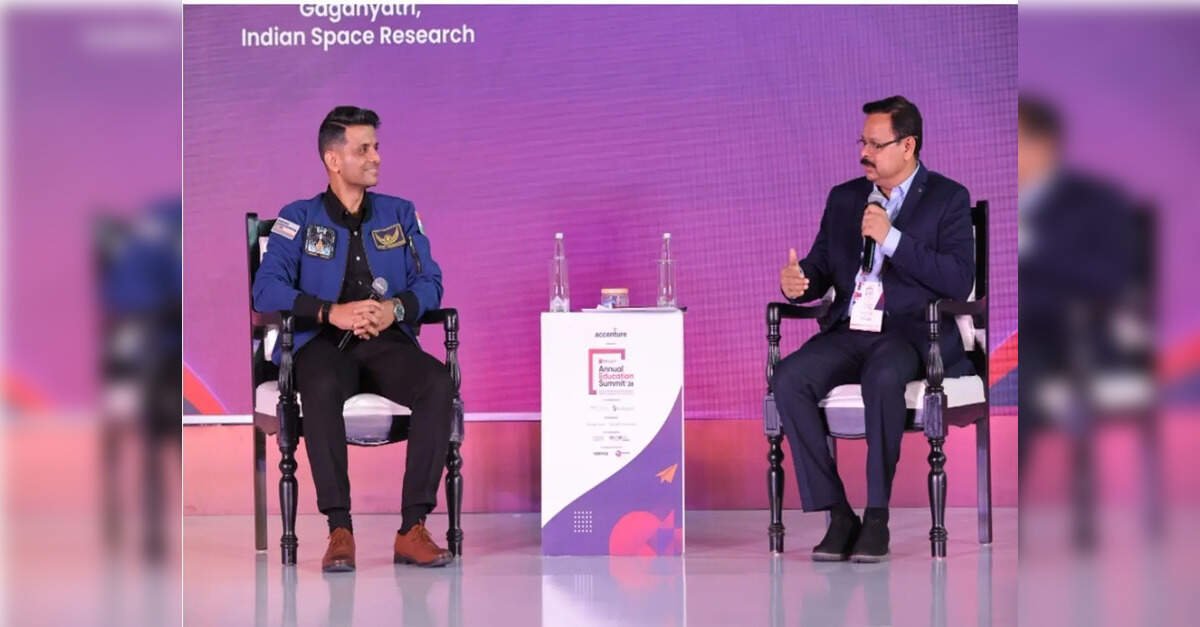
India’s education system must help students expand the scale of their ambitions and prepare them to pursue difficult goals with persistence and purpose, Group Captain Shubhanshu Shukla, AC, Test Pilot, Indian Air Force, and Gaganyatri, Indian Space Research Organisation (ISRO), said on Friday.
Speaking during the fireside chat “From Classroom Curiosity to Space Missions” on Day 2 of the third edition of the ETEducation Annual Education Summit 2026, organised around the theme “India’s Education Revolution: For the World, With the World,” Shukla said India’s young people possess the talent and capability to compete globally, but education must encourage them to think more boldly about what they can achieve.
“In terms of talent and skill, we are second to none,” Shukla said. “The place where we fall short is the scale and the audacity of our dreams.”
In conversation with Sudhakar Rao, Director, ICFAI Group, Shukla reflected on how experiences in aviation and space reshape one’s understanding of identity, responsibility and perspective.
Describing what it feels like to see Earth from outside the planet, he said the experience fundamentally changes how people understand their place in the world.
“The minute you step outside the planet, the first thing that I realised was that this is your home,” he said.
According to Shukla, viewing Earth from space reinforces both the interconnectedness of humanity and the need to think beyond individual success.
Bringing the discussion back to education, he said students often receive encouragement to perform but not always enough support to imagine possibilities beyond conventional pathways.
He argued that schools must preserve children’s natural curiosity and prevent ambition from shrinking into a narrow pursuit of marks, rankings and predictable careers.
A major theme of the conversation was the role of educators and everyday influences in shaping aspirations.
Asked about role models, Shukla said the people who shaped him most were not distant public figures but individuals who interacted with him regularly.
“My real role models have been people who were accessible to me,” he said.
He added that teachers often leave lifelong influence because students remember not only lessons but also encouragement and belief.
Reflecting on his own journey from becoming a fighter pilot to a test pilot and eventually a Gaganyatri, Shukla said persistence has been the single most important quality across achievement.
“The ability to continue to do something for a very long time without getting disheartened, without giving up, is the single most important thing,” he said.
He said young people should recognise that success rarely follows a single path and that resilience matters more than immediate outcomes.
Shukla also challenged the way educational success is often defined.
“It is more important to be useful for society than to come first in your class,” he said.
According to him, education systems must create learners who contribute meaningfully to communities rather than measure success only through scores and rankings.
The conversation also explored the symbolism behind the white swan chosen by Shukla’s crew as a zero-gravity indicator.
He said the swan represented peace and joy in many cultures and symbolised discernment in the Indian tradition — an idea that he believes is especially relevant for students today.
“We are living in an age of distraction,” he said.
Students, he argued, must learn to distinguish between what genuinely contributes to growth and what pulls attention away from meaningful goals.
Sharing reflections on life in space, Shukla also described the physical and mental adjustments required during and after missions, including adapting to microgravity and rebuilding ordinary movement patterns after returning to Earth.
Returning to the theme of perseverance, he referenced a simple lesson from popular culture. “There is no one path or one way that you can succeed,” he said. “Just keep swimming. Don’t give up.”
Shukla’s remarks brought the education conversation back to first principles: curiosity, courage and persistence. As India prepares learners for a rapidly changing future, his message was that classrooms should not only produce capable students, but also young people willing to dream bigger and stay the course long enough to turn those dreams into reality.
