


A Ramachandran, who passed away in 2024 at age 89, passionately encouraged artists to “develop a visual language and grammar of their own” when he was alive. Anyone who struggles to understand what that means should look at his own work. There’s plenty of it. Ramachandran painted for seven decades – oil paintings, sculptures, watercolours, drawings, miniature paintings, and illustrations – and has reinvented himself multiple times, developing two distinct styles.

Or, they should drop in to the Vadehra Art Gallery in London, where the Kerala-born artist is being celebrated with a major retrospective of more than 30 works.
Take a look at Gestures, a triptych made in 1966. It’s an unsettling intense image, painted across three large panels. In it, distorted, bloated, headless bodies appear trapped, suspended, or burdened by an invisible weight. Only their hands – half clenched, dropped in anguish, reflect some kind of emotion; struggle, vulnerability, perhaps even defeat. The work is done in earthy browns, dark reds, black, and muted flesh tones. It’s an altogether heavy, dramatic atmosphere. And because there are no other distinguishing details, figures feel universal, allowing viewers to connect with broader themes of suffering, oppression, and alienation.
Much of Ramachandran’s earlier work is like this – charged with socio-political tension, with irony and black humour just under the surface.
The turning point – one that splits his style in two distinct halves – is his massive painting Yayati, created just after the after the 1984 anti-Sikh riots, which he witnessed up close. He went from being preoccupied with depicting human anxiety to reducing that anxiety by showcasing beauty, positivity and the natural world.
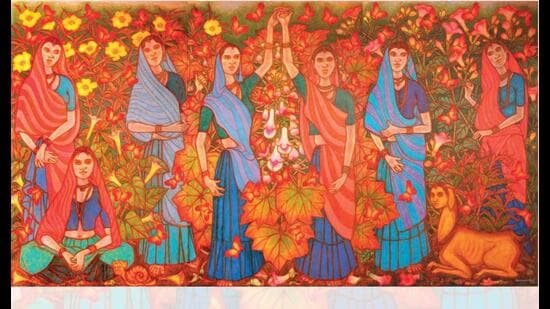
A good example is The Monsoon Flowers, made in 2014. It’s packed with life: Flowers bloom everywhere, butterflies float through the space (there’s even deer resting in the corner), and there are women in blue, pink, and turquoise saris. It’s joyful, vibrant, and immersive, but crucially harmonious. It’s a world where humans and nature appear inseparable; every element is alive and interconnected.
These two artworks reveal Ramachandran’s extraordinary journey as one of India’s greatest modernists. And yet, in both styles, it’s easy to see how committed he has remained to storytelling. One can almost feel the whiff of the ocean breeze and warmth of the sun’s rays in his naturescapes. The women in his works have elongated, dignified forms that recall miniature and folk art. He seems equally inspired by temple murals, folk traditions, and Rajasthani and Bhil traditions. In his larger-than-life canvases (stand close, you feel like you’re inside them), there are hints of vanishing village life, mythological tales, and Indian plants. Those who look for more details are often rewarded in an unexpected way: Ramachandran often paints himself in his later works, sometimes asleep inside a flowerbud, sometimes grinning from the corner, even as an angel. It’s a conscious, deliberate way of looking at the world with hope, made especially poignant, given that it was born out of one of India’s darkest moments.
Sapna Karn’s multidisciplinary work tells news stories through textiles, especially discarded fabric
The views expressed by the columnist are personal
From HT Brunch, June 13, 2026
Follow us on www.instagram.com/HTBrunch
