


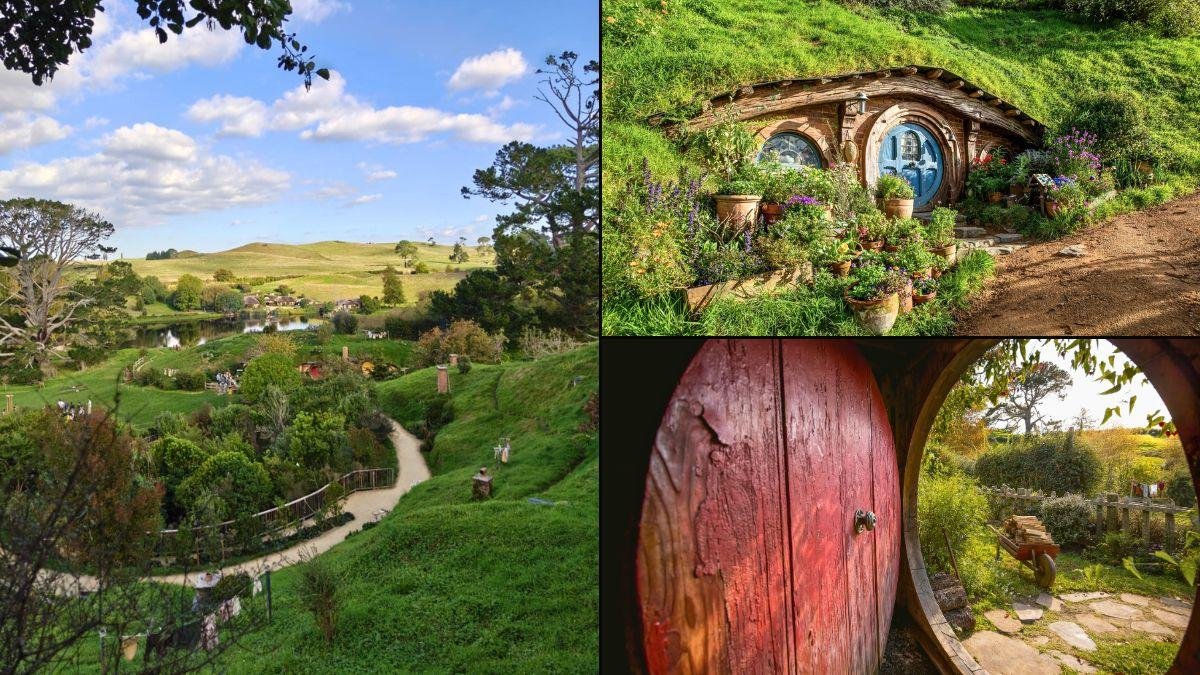
Long before I had any working sense of the industrial miracle of cinema, I was effectively dropped straight into Middle-earth by two parents who decided that one of my earliest cultural inheritance would be The Lord of the Rings. The strange thing about those early childhood memories is how they often feel suspended in a dream-like melange of images detached from chronology. Yet the impeccable clarity with which I could recall the rattle of Gandalf’s cart rolling in the Shire, the curl of smoke from Bilbo’s pipe or the serene image of Frodo reading under a tree, blurred the lines between scenes I had watched and memories of a place I felt I had actually once occupied. Which is why, when the universe presented me with the chance to travel halfway across the planet to a very special sheep farm in New Zealand, it felt like every decision in my life had been bending toward this single once-in-a-lifetime opportunity to fully realise those half-realities. So I accepted the premise with full awareness of how unreal it sounded and allowed myself the small indulgence of framing it exactly as it deserved to be framed: I was going on an adventure.
For both J.R.R. Tolkien’s seminal high fantasy novels and Peter Jackson’s Oscar-winning adaptations, The Shire is where it all began. When Jackson went looking for it in 1998, the place needed to feel untouched by time, which is how a helicopter survey over Waikato landed his team on the Alexander family’s sheep farm — a 1,250-acre spread near Matamata. Legend has it that location scout David Comer, dropped in unannounced and interrupted an important rugby match to pitch a fantasy film to the owner, Ian Alexander, and somehow that conversation led to nine months of construction beginning in 1999. The New Zealand Army was drafted in to cut roads and move earth while crews built Hobbit-hole façades into the hills and planted gardens. When filming wrapped, the set was meant to disappear, but weather stalled the teardown and those leftover fragments nudged the site into public tours by 2002, and eventually into a full rebuild when Jackson returned for The Hobbit film trilogy; this time using permanent materials and obsessive detail so nothing would need to be faked again. Hobbiton now sits a couple of hours from Auckland, as one of New Zealand’s most sought after experiences that thousands travel across the world to visit, every year.
A bird’s-eye view of the Shire from Bag End at Hobbiton, New Zealand
| Photo Credit:
Ayaan Paul Chowdhury
At Hobbiton, everyone gathers at the Shire’s Rest before being loaded onto green buses that cover the short drive to the set. The landscape outside already looks like it has been graded for a film, blue sky held steady over clean rolling hills with sheep scattered across in clustered specks of white. A screen at the front flicks on and Peter Jackson appears to introduce the site.
Our little fellowship steps off at a small entrance marked by a wooden Hobbiton sign, and our guide Paul gathers us with a quick question about who had seen the films. Though a few hesitate, he shrugs it off with the assurance that plenty of people arrive with no context and still leave thoroughly satisfied. He leads us down a narrow path which was the exact route where Gandalf enters the Shire and where Frodo meets him on that slight incline, arms folded; Paul pauses to let us complete the line, “You’re late”.
The path opens, and it hits me — I’m actually here. The Shire sprawled before me in all its glory, a wooden signpost beside a tended garden pointing to East Farthing, West Farthing, and Tuckborough. Hobbit Holes cut into the hills on either side with colourful round doors. The ground rose in as series of ascending terraces so more dwellings appeared as my eye moved upward, until it reached the hilltop where Bag End overlooks the rest. In total, Hobbiton features forty-four Hobbit Holes across twelve acres of the Alexander farm, and each dwelling tries to live up to Tolkien’s original vision for the Shire-folk from The Hobbit — “In a hole in the ground there lived a hobbit. Not a nasty, dirty, wet hole, filled with the ends of worms and an oozy smell… it was a hobbit-hole, and that means comfort.”
First look at the Shire at Hobbiton, New Zealand
| Photo Credit:
Ayaan Paul Chowdhury
Every hole is cut into the hillside with round doors, deep-set windows, and garden frontage. The structure of Hobbiton draws heavily from the rural English Midlands Tolkien grew up in, particularly Worcestershire and Warwickshire, and that influence carries through in how the Shire is organised into old county divisions called Farthings.
Some of the many Hobbit Holes featured at Hobbiton, New Zealand
| Photo Credit:
Ayaan Paul Chowdhury
Paul explains that most Hobbit Holes are exterior builds only, since interiors were constructed separately on soundstages in Auckland, with a small number of fully realised holes added later for visitors. The scaling on site follows Tolkien’s proportions, while the films achieved their larger look through forced perspective and duplicated set sizes. Once you step closer the façades featured specific occupational cues through the letterboxes and props marking each home.
Frontage decor from outside the Hobbit Holes at Hobbiton, New Zealand
| Photo Credit:
Ayaan Paul Chowdhury
We wind our way upward along the same contours the camera traces towards Bag End, set above everything else with a clear line of sight across the village. Bilbo’s round green door is framed by a simple fence plastered with the iconic sign that reads “No admittance except on party business”. The frontage is littered with details that map directly onto the opening stretch of Fellowship of the Ring where Gandalf and Bilbo pass time with Old Toby while trading old stories and blowing smoke ships through smoke rings.
Bilbo’s Hobbit Hole in Bag End at Hobbiton, New Zealand
| Photo Credit:
Ayaan Paul Chowdhury
The path leads back down into the centre of the Shire where the ground opens into a wide clearing used for gatherings, with a tall maypole set to one side wrapped in long ribbons that are still used during events at Hobbiton, and opposite it stands the Party Tree, a towering Monterey pine positioned beside the lake, identified during the original location scouting as the natural centrepiece for Bilbo’s “eleventy-first birthday”.
The maypole juxtaposed against the Party Tree Monterey pine at Hobbiton, New Zealand
| Photo Credit:
Ayaan Paul Chowdhury
As the walk reaches its final stretch, the focus narrows toward Bagshot Row, and at the centre of that cluster we find an unmistakable yellow door framed by pretty climbing roses that spill over the entrance. Paul recalls the closing moments of The Return of the King, where good ‘ol Samwise Gamgee returns with Rosie Cotton and their children, steps inside, and shuts the door on the entire Middle Earth journey. While Sam’s home remains an exterior build, the two neighbouring holes on Bagshot Row boast fully realised interiors developed later as part of the expanded visitor experience.
Samwise Gamgee’s Hobbit Hole in Bagshot Row at Hobbiton, New Zealand
| Photo Credit:
Ayaan Paul Chowdhury
The round door opened with a soft push and I stepped straight into the Proudfoot home (“Proudfeet,” as Bilbo’s cousin Odo snaps in the films). At last that boundary had given way, revealing rooms scaled, furnished, and detailed to reflect daily Hobbit life. “The door opened on to a tube-shaped hall like a tunnel… very comfortable, without smoke, with panelled walls, and floors tiled and carpeted” — the space is held together exactly as Tolkien writes it in The Hobbit, built into the hill with curved walls and low beams.
A look inside the Hobbit Hole at Hobbiton, New Zealand
| Photo Credit:
Ayaan Paul Chowdhury
I moved through a curved passage into a bedroom where a four-poster bed is tucked against the arc of the wall with embroidered cushions, while books and dried flowers adorn the shelves and a little closet space with neatly folded clothes. Further in there’s a bathroom with a low copper tub and a small wooden commode. Walking into the kitchen and dining room, the entire arrangement felt ready for supper, with a wooden table already set, plates and spoons laid out, jars of preserves lined up behind it, copper pots and pans hanging within reach, and shelves of faux food stocked up in the pantry. Just off this main space a small study tucked itself into the curve of the wall, with a writing desk crowded with loose papers, ledgers, and ink bottles, and shelves stacked with worn out books and folded maps.
A look inside the Hobbit Hole at Hobbiton, New Zealand
| Photo Credit:
Ayaan Paul Chowdhury
Everything around the place is scaled to Hobbit proportions and open to touch and interact with. I sit at the table for a second, run my hand along the surface, look out through the round window set deep into the wall, and around me people do the same in their own way, some leaning by the hearth, and a few standing still with wet eyes they are not trying to hide. The space had bridged the distance between the fantasies we carried in our collective memory and something tangible we could finally move through.
A look inside the Hobbit Hole at Hobbiton, New Zealand
| Photo Credit:
Ayaan Paul Chowdhury
We stepped back out through the rear door and the path took us past the working mill and across the small bridge toward the last stop, the Green Dragon Inn. Inside, the tavern is held up by large timber beams, and features uneven floors, heavy wooden tables, a fireplace, and walls lined with tankards and small details that suggest years of use. Paul reminds us a choice of the house brews made exclusively for this place is included in the tour, and I go straight for the stout (which came in a smaller mug than the Hobbits would approve of, but was delicious nonetheless).
Scenes from the Green Dragon Inn at Hobbiton, New Zealand
| Photo Credit:
Ayaan Paul Chowdhury
Leaving the Shire really put Bilbo and Frodo’s choices into perspective since leaving something this beautiful always seems to cost you a little part of yourself. I had slipped my copy of Frieren: Beyond Journey’s End into my bag before my pilgrimage to the Shire, as a tribute to the kind of stories Tolkien had set in motion, but it also felt fitting to be carrying around a story about what comes after the adventure. Now back from my own, I finally understand why Bilbo still felt the pull of the road long after he had returned, because once you’ve stepped out and seen what lies beyond the familiar, the memory keeps asking for another turn.
Frieren makes her pilgramage to Hobbiton
| Photo Credit:
Ayaan Paul Chowdhury
Now, in the thick, unmoving heat of a record worst Delhi summer, I catch myself thinking of Sam crouched beside Frodo on the ashen slopes of Mount Doom, trying to hold him together as the world quite literally burns around them:
“Do you remember the Shire, Mr. Frodo? It’ll be spring soon, and the orchards will be in blossom; and the birds will be nesting in the hazel thicket; and they’ll be sowing the summer barley in the lower fields; and eating the first of the strawberries with cream. Do you remember the taste of strawberries?”
All I’m left with now is the bittersweet melancholia that it was real, it happened, that I went there and came back again.
This writer was in New Zealand on the invite of Tourism New Zealand
