


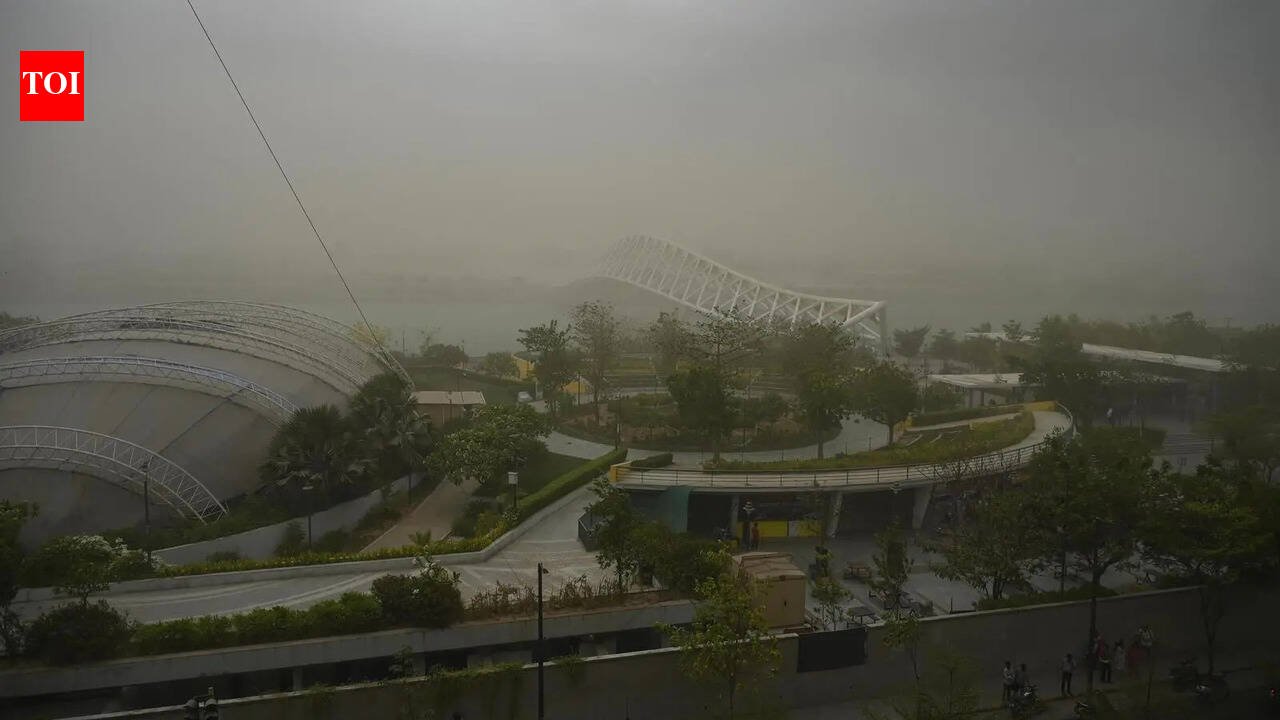
Ahmedabad: The city’s air quality is no longer a winter problem. New data from the Ahmedabad Municipal Corporation shows the city remained above national PM10 limits for seven straight months, extending well beyond the traditional winter pollution period. Even peak summer temperatures failed to bring meaningful relief.Between Nov 2025 and May 2026, the city-wide average concentration of PM10 — coarse particulate matter comprising dust and airborne debris — remained above 100 micrograms per cubic metre (µg/m³) every month. The figure is significant because anything above 100 µg/m³ exceeds the National Ambient Air Quality Standards (NAAQS). Ahmedabad has now breached that limit continuously for seven months.The city’s PM10 levels reached their highest point at 152.68 µg/m³ in Nov 2025. Six months later, the average remained elevated at 111.68 µg/m³ in May 2026 even though intense summer heat traditionally helps disperse dust and improve air quality.Pirana continued to record the highest pollution levels among the city’s monitoring stations. PM10 concentrations stood at 219 µg/m³ in Nov 2025 and remained at 140 µg/m³ in May 2026. However, the problem is no longer limited to industrial belts.
Pirana continued to record the highest pollution levels among the city’s monitoring stations
The Airport area recorded PM10 levels of 193 µg/m³ in Nov 2025, while Vatva witnessed a sharp spike to 164 µg/m³ in Feb 2026, likely linked to local industrial activity. Chandkheda, too, remained heavily polluted, recording 133 µg/m³ as recently as May 2026.More concerning is the spread of poor air quality into Ahmedabad’s rapidly developing western neighbourhoods, traditionally considered less exposed to industrial emissions. Isro-Bopal, one of the city’s fastest-growing residential corridors, recorded PM10 levels of 142 µg/m³ in March 2026 and remained above 130 µg/m³ throughout much of the preceding winter. Satellite Road near Isro-SAC, a major residential and commercial zone, touched 129 µg/m³ in Feb 2026. Neither of these areas falls within the city’s industrial belt, indicating that pollution has become more geographically widespread.The situation becomes even more worrying when finer particles are examined. PM2.5 — microscopic particles capable of penetrating deep into the lungs and entering the bloodstream — recorded a city-wide annual average of 44 µg/m³ in 2025-26, up from 36 µg/m³ a year earlier.For five consecutive months, from Nov through March, monthly PM2.5 concentrations never fell below 60 µg/m³ and peaked at 64.93 µg/m³. India’s annual safe limit for PM2.5 is 40 µg/m³, meaning Ahmedabad exceeded the prescribed threshold for the year.While the AMC has introduced measures to curb emissions, including mandatory air-quality sensors at 100 construction sites and the relocation of ready-mix concrete (RMC) plants, the data indicates that these interventions have yet to deliver measurable improvements at the city level.Another challenge has emerged on the public participation front. The earlier online mechanism that allowed residents to report pollution hotspots is no longer functional, effectively removing a direct channel for citizens to flag localised sources of pollution. This comes even as monitoring systems continue to identify areas with persistently poor air quality.The data paints a troubling picture: Ahmedabad’s air pollution is no longer a seasonal episode tied to winter conditions. It is increasingly becoming a year-round public health concern, affecting industrial, commercial, and residential areas alike.148
