


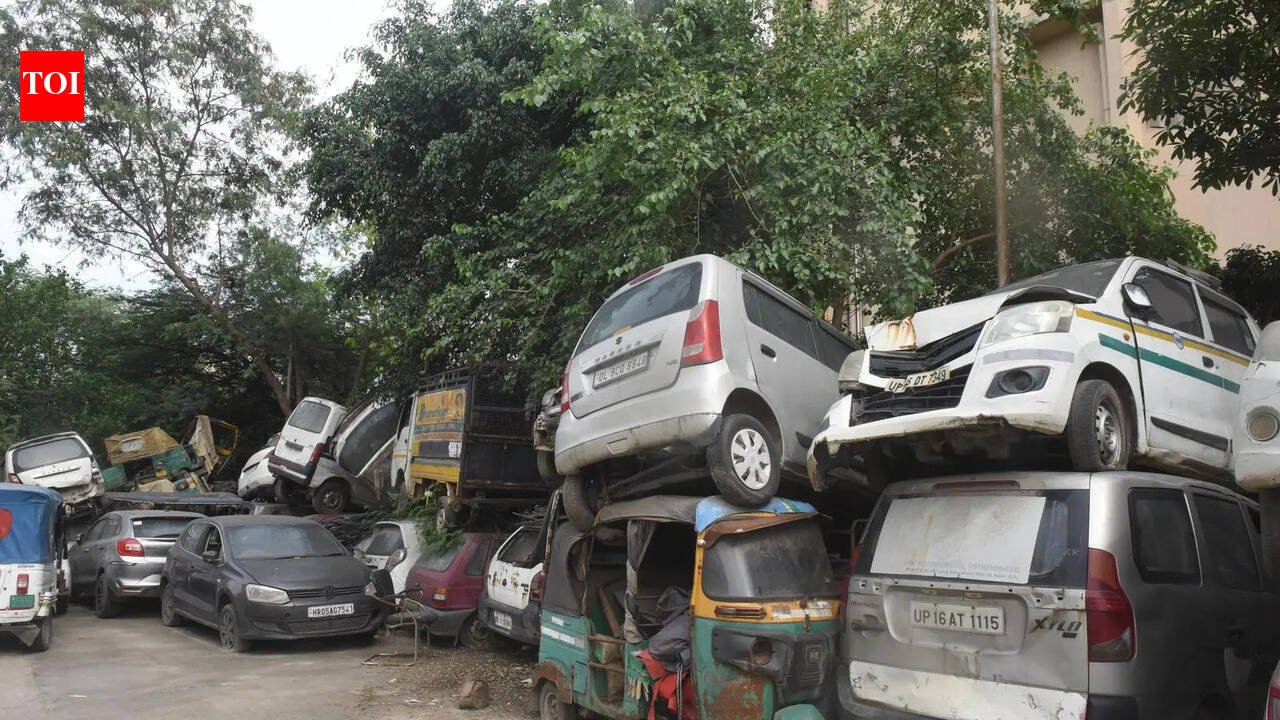
Knowledge Park police station
From evidence to scrapA senior official told TOI that dedicated junkyards to store seized vehicles existed in Sector 62 but it can no longer accommodate the increasing volumes of vehicles.The conditions do not support long-term parking. Most vehicles are seized in working conditions, but left in open areas without protective cover. Continuous exposure to sun and rain leads to rusting, damaged interiors and mechanical failure. Tyres deflate, engines seize and parts often go missing over time.A police official recalled a high-end car seized in a financial fraud case. “It was in good condition when it came. Now, it’s barely worth anything,” the officer said.Apart from financial loss, authorities also point to environmental and safety concerns. Stagnant water inside vehicles can lead to mosquito breeding, while accumulated scrap increases the risk of fire and rodent infestation.
Knowledge Park police station
Auctioning seized vehiclesOfficials said that a structured process is followed after vehicle seizure.First, the vehicle is recorded as case property, with details such as engine and chassis numbers documented. Nearly every police station has dedicated personnel to keep track of case property, referred to as the malkhana in-charge. These personnel verify ownership through registration databases, and efforts are made to contact the registered owner.A formal notice is then issued, asking the owner to claim the vehicle within a specified time after completing legal formalities. If the vehicle is linked to a criminal case, police must seek permission from the court to dispose of it.Once clearance is obtained, authorities issue public notices about unclaimed vehicles. A departmental committee reviews each case to decide whether the vehicle should be returned, auctioned or scrapped. In 2025 alone, GB Nagar auctioned or disposed of 4,775 seized two- and four-wheelers, according to official data accessed by TOI.The vehicle is then evaluated to determine its reserve price. Most auctions are now conducted online through e-auction platforms, where registered bidders participate. After the sale, the proceeds are deposited with the govt and ownership is transferred or the vehicle is dismantled.Police officials said the delay in auctioning seized vehicles is due to a combination of legal and administrative factors.Many vehicles are linked to ongoing court cases. As case property, they cannot be disposed of until the court permits it. Even when a vehicle is no longer required as evidence, formal clearance is necessary.Tracking down vehicle owners is another challenge. In several cases, records are outdated, ownership has not been transferred properly, or vehicles carry fake number plates, making identification difficult.The process also requires issuing notices to owners and, in some cases, publishing public advertisements, giving them time to claim their vehicles. Only after this period can further steps be taken.Officials also point to earlier delays caused by centralised auction systems and procedural approvals. Though some reforms have been introduced, bottlenecks remain. Additionally, poor condition of vehicles and their association with criminal cases often result in low buyer interest during auctions.Police departments have started taking steps to address the issue, including decentralising the auction process and conducting periodic drives to identify vehicles that can be disposed of.“In the past few months, we have tried to speed up auctions,” an officer said. “But clearing the old backlog is a gradual process.” In some instances, courts and local authorities have also directed large-scale clearance following complaints about congestion and safety risks.
Surajpur police station
Loss to exchequer, strain on policingExperts said delays in disposal lead to significant financial losses, as vehicles depreciate rapidly when left unused. “A vehicle worth several lakhs can lose most of its value within a few years if kept in the open,” advocate Bhati said, adding that timely auctions could generate substantial revenue.The impact is also visible on policing. Officers said overcrowded premises make it difficult to move official vehicles and manage daily operations efficiently.There are also concerns about public perception. Legal experts said the condition of police stations reflects on governance. At the same time, planners warn that cluttered compounds can pose safety risks, including fire hazards and blocked access routes.“Firstly, all zones should have a separate parking lots to keep the vehicles. Faster court clearances, dedicated storage facilities outside police stations, regular auctions and better tracking systems could help address the problem,” Bhati added.
Bisrakh police station
The transport department has set up a dumping ground for overage vehicles at Sector 62D Park in Noida
Knowledge Park police station
