


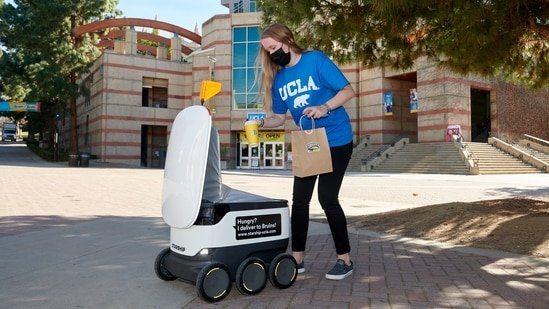
If you live in San Francisco, you may often get a glimpse of the future—commuting in a self-driving taxi, say. In Milton Keynes? Not so much. But the English city, halfway between Oxford and Cambridge and best known for an abundance of roundabouts, is the place to go if you want to see a world without delivery drivers. It is one of the largest markets for Starship Technologies, an Estonian startup which claims to have cracked the problem of getting robots to deliver groceries more cheaply than people can.
Designers of delivery robots face challenges familiar to those that confront developers of robotaxis. Starship has had to build a sensor array that its six-wheeled couriers, each the size of a beer cooler, can use to guide themselves along the pavements come rain or shine. And that hardware must feed into an artificial-intelligence model which can autonomously take the best route, and carry on even if the connection to a data centre is cut off.
In some ways, though, delivery robots have it easy. With a 35kg robot travelling at 6kph (4mph) tops, safety is less of a worry than it is with a two-tonne car going at 110kph on a motorway. And a slightly bumpy ride won’t hurt a pizza.
That said, whereas robotaxi firms can leave car design to carmakers (and most do), robocouriers have no such option. Starship has by now created several generations of vehicles. As a result, it has enough data to optimise newer models for resilience and repairability. Gains can come from unexpected places, says Ahti Heinla, a co-founder (who also co-founded Skype, an internet video-call service bought by Microsoft for $8.5bn in 2011). Starship’s latest batch of robots charge wirelessly, for instance, which is speedier and reduces wear on the charging ports.
After 12 years of such incremental improvements, Mr Heinla says, the cost of each delivery is now “significantly less” than that of paying a human to do it. Starship is aiming for a cost of less than £1 ($1.34) per delivery. “It’s not quite there yet, but not very far away,” Mr Heinla says.
In 2018 the company had 127 robots, driving 116,000 kilometres in the year. By 2025 it had 2,414 robots, covering 5.2m kilometres. Along the way, the company says, it has reduced human interventions per kilometre by seven-eighths. Even so, at its scale rare problems, such as a robot failing in the middle of a street, add up. (The solution? A simple back-up computer designed purely to get it to the other side.)
The little six-wheelers might soon change how cities look. Could they also make people feel a little more kindly about AI? Probably not, especially if you are an out-of-work delivery driver. Then again, in Finland, Starship’s biggest market, a director of the startup’s supermarket partner has had to urge sympathetic passers-by not to lift the robots out of snowdrifts when they get stuck—lest they hurt themselves coming to the rescue.
