


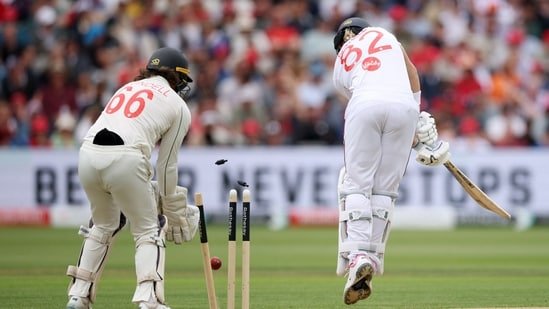
Thirty-five wickets in three days. England all out for 140. New Zealand dismissed for 113 in the first innings. Balls keeping low from one end and climbing awkwardly from the other.

What should have been a celebration of Lord’s 150th Test has instead turned into a debate over the quality of the pitch, with former England captains Michael Vaughan and Michael Atherton delivering scathing verdicts on the surface used for the England-New Zealand clash.
Vaughan, writing in his column for The Telegraph, described the wicket as a “shocker” and said it was among the most difficult batting surfaces he could remember seeing in England.
‘Lord’s pitch has been a shocker’: Vaughan
“Sadly, the Lord’s pitch has been a shocker,” Vaughan wrote. “We haven’t had a pitch like this in England for a long time. I’m racking my brains as to when. There was one at Edgbaston in 2000 against the West Indies, where the ball was spitting off a length…”
The former England captain argued that the issue was not simply bowler-friendly conditions but the unpredictable nature of the surface itself. “It has been up and down, with inconsistent bounce from the very first ball. There has been lavish late seam movement, and the ball far too dominant. I have actually felt sorry for the batsmen, and glad that I didn’t play on many pitches like this.”
Atherton offered a similarly blunt assessment during Sky Sports’ coverage of the match, calling the Lord’s surface unworthy of such a historic occasion.
“It’s a poor pitch, it’s a substandard pitch, particularly for a landmark 150th Test,” Atherton said.
The former England captain pointed to the dismissal of Jacob Bethell as an example of the inconsistent bounce that has dominated discussion throughout the match. “There has been too much inconsistent bounce. The one that Jacob Bethell got was an unplayable ball. If you see that on day five, I don’t mind so much. Pitches are supposed to change and deteriorate through the course of the game, and a bit of uneven bounce on day five is fine. But if you’re getting that before 100 overs of the game and you’re getting that on day two, that’s not good.”
Atherton added that batters generally accept swing and seam movement in English conditions, but excessive vertical movement from the surface creates a different challenge.
“Batters will back themselves against swing and sideways movement. Up and down movement is more difficult. So that is not ideal for the first two days of a game.”
While Atherton acknowledged that overcast conditions had assisted bowlers, he maintained that the pitch itself remained the central concern. “The overhead conditions and the atmospherics have an impact. They had an impact on the first day because it was very, very bowler-friendly atmospherics on the first day and in patches on the second. But to answer your first question, yeah, poor pitch.”
