


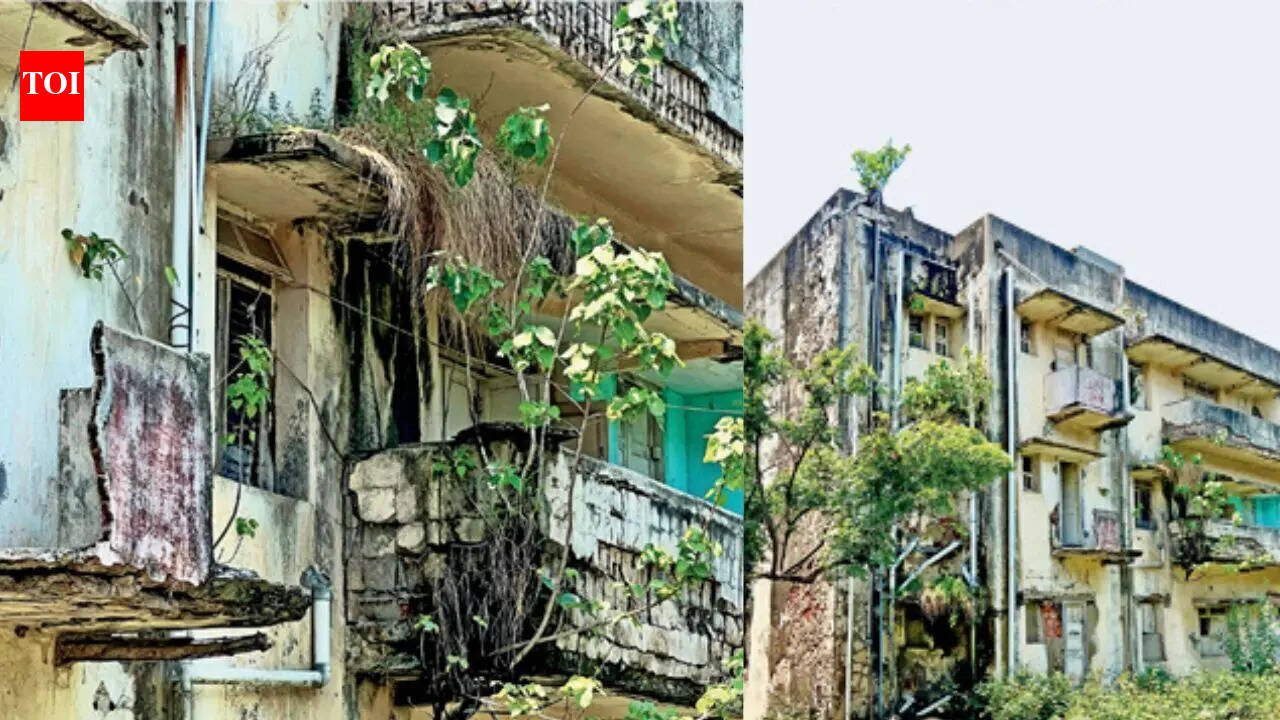
CHENNAI: Ownership disputes, lack of consensus on redevelopment, and bureaucratic delays have kept several unsafe buildings from being razed, more than a year after Greater Chennai Corporation (GCC) identified them for demolition. Ahead of every northeast monsoon, GCC officials survey and identify dilapidated structures and issue notices to owners. In 2025, the civic body identified 337 unsafe buildings, including private properties, corporation-owned structures and buildings belonging to other govt departments. Of the 130 GCC-owned dilapidated buildings identified, 105 have been demolished. And 69 of 128 private structures flagged as unsafe, have been razed so far.
Several independent houses and apartment blocks that are more than 50 years old remain standing along stretches such as Ambattur Estate Road, 14th Main Road in Anna Nagar’s Shanthi Colony, Mint Street in George Town and parts of Besant Nagar. In some of these TN Housing Board apartments, owners live abroad and have rented out the flats, complicating redevelopment efforts. Even though the latest building rules permit redevelopment with the consent of two-thirds of apartment owners, implementation is challenging.
B Kannan, secretary of T Nagar Residents Welfare Association, who lives in a 24-flat apartment built on 4.5 grounds in 1972, said the redevelopment of his residential land fails to attract builders despite being technically viable. “We are eligible for redevelopment. We get a 1.5-times increase in FSI from the existing 650 sqft units and a builder can construct up to 36 flats. But at current market rates of around Rs 20,000 per sqft, even a flat of less than 1,000 sqft would cost at least Rs 2.4 crore. The road a doining our apartment permits only an 18.3m high structure. Builders do not find such projects lucra-tive and prefer the outskirts, where sales are faster and layouts offer better amenities,” he said.
The five-km Ambattur Estate Road stretch from Thirumangalam to Ambattur, one of the city’s longest TN Housing Board corridors developed in the 1980s, illustrates the challenge. While redevelopment began around 2010, many apartment blocks remain occupied despite balconies partially collapsing, reinforcement steel bars being exposed and compound walls having collapsed.JMSNagarjunan,formersecretaryof Tamil Nadu Bank Employees Association, said the most common hurdle in redeveloping dilapidated apartments is the lack of consensus among residents.“Anna Nagar West Extension has a large number of TNHB apartments from the 1970s. Yet many continue to live in precarious conditions. Many owners are settled in the US, making communication and decision-making difficult,” he said.As per Tamil Nadu building rules, owners of buildings older than 30 years must obtain a fresh structural stability certificate every three years, or at the interval specified in the previous certificate. The certificate, issued by a competent engineer, is to be vetted by GCC’s town planning dept. However, officials acknowledge that the civic body lacks the manpower and resources to enforce compliance across the city. In George Town, residents of some houses that were served notices over structural stability concerns have approached courts, arguing their buildings remain safe. The corporation has also identified 79 unsafe buildings belonging to other govt departments and has urged the respective agencies to take action.GCC commissioner G S Sameeran said a significant number of unsafe structures remain stuck in litigation. “Many are tied up in court cases and ownership disputes. We will demolish them shortly once the legal issues are resolved,” he said.
