


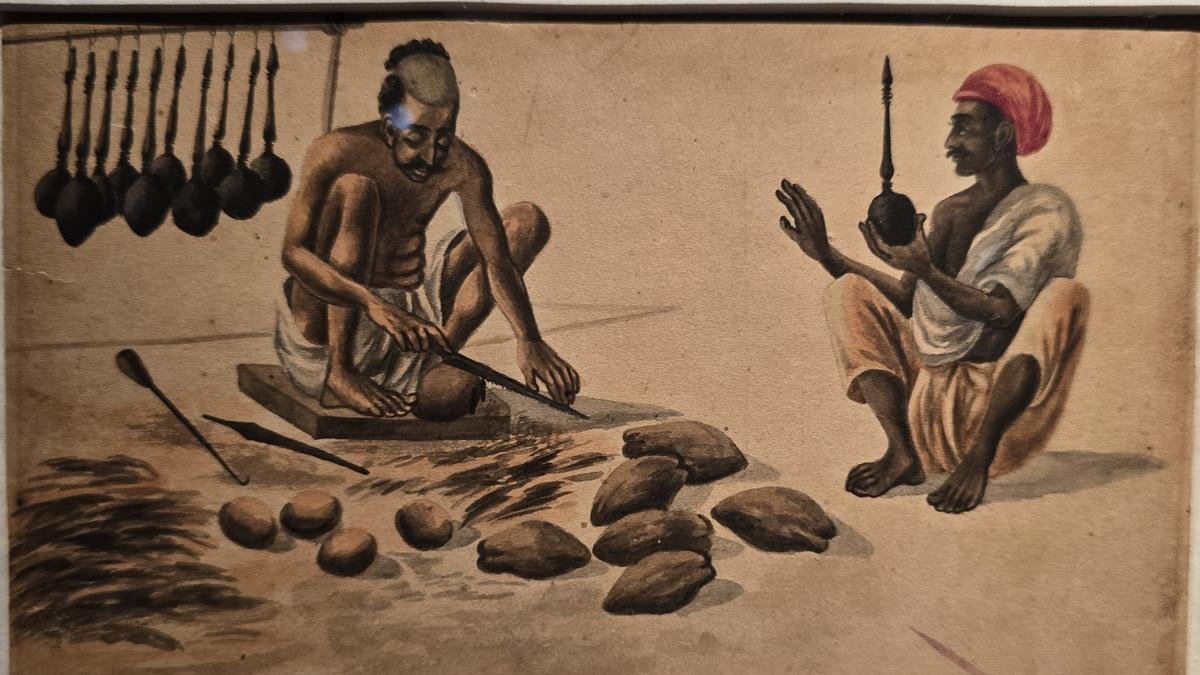
Picture watercolours on imported paper, in delicate brushwork on pale, bare backgrounds, and the stark image of two men in dhotis working in a distillery. Or a woman, dressed in blue-and-yellow ghaghra and dupatta, dancing in a palace hall while the musicians play. These artworks are part of an 18th-century Indian painting tradition known as Patna Kalam.
It was a pre-photographic visual documentation of the daily lives of ordinary people, featuring vegetable sellers, blacksmiths and servants fetching groceries, among others. Last December, Patna Kalam paintings were part of an exhibition at the Bihar Museum Biennale 2025, where it witnessed a renewed interest. Which begs the question: why is an art built to capture daily life now surviving only behind glass?
Hidden away in storage in art colleges, or confined to private collections and the archives of the British Museum and the Victoria & Albert Museum, London, the nearly lost Patna Kalam was reintroduced via the Patna Kalam: Ek Virasat exhibition held at Patna Museum between December 2025 and February 2026, and a workshop for keen students. Art enthusiasts agree that if not for such interest from the State government, they would have had to travel outside India to see this art tradition. Apart from the Patna Museum paintings, the exhibition featured works lent by Sanjay Kumar, a Dhanbad resident and descendant of the famous Patna Kalam painter Hulas Lal.
Patna Kalam artworks at Bihar Museum.
| Photo Credit:
Sumit Saurabh
The regional art style “employed the technique of the Company School of Painting, with distinct characteristics intrinsic to Patna city — its people, culture and day-to-day life,” says INTACH’s (Indian National Trust for Art and Cultural Heritage) Patna chapter convenor Bhairav Lal Das. In it, Mughal miniature detail blended with European naturalism. Art teacher Dinesh Kumar elaborates that Patna Kalam is bereft of any ornamentation; there’s no play of light and shadow, or any background. Think of a purdah-nasheen woman peeking from her palanquin’s red curtains, painted in gouache on mica (also called sunmica or abrak). Or a roadside baniya (grocer) sitting and weighing seeds or pulses.
Patna Kalam painting at Patna Museum.
| Photo Credit:
Kavita Kanan Chandra
Patna Kalam painting at Patna Museum.
| Photo Credit:
Kavita Kanan Chandra
Patna Kalam painting at Patna Museum.
| Photo Credit:
Kavita Kanan Chandra
Happy with the response and pleasantly surprised by the interest in the workshop, Bihar Museum’s director general Anjani Kumar Singh now hopes to find good art trainers to impart technical skills and help create contemporary Patna Kalam.
Patna Kalam paintings at Planet Patna.
| Photo Credit:
Sumit Saurabh
Patna Kalam painting at Planet Patna.
| Photo Credit:
Sumit Saurabh
Patna Kalam painting at Planet Patna.
| Photo Credit:
Sumit Saurabh
At Patna University’s College of Arts and Crafts, workshop participants were glued to administrative officer Chanchal Kumar’s Patna Kalam, a reference photobook of paintings. Ironically, the original paintings remained locked in trunks in the same premises, inaccessible to the public. Last July, Aditya Jalan, great-grandson of businessman and art connoisseur Dewan Bahadur Radha Krishna Jalan, opened Planet Patna, a private museum with a large collection of Company Paintings, including Patna Kalam.
“My great-grandfather was passionate about objects of historical significance; he even purchased Napoleon’s bed on a trip to Europe in 1935,” says Aditya, adding that his father, Bal Manohar, exchanged colonial-era stamps for the Patna Kalam paintings. The museum at another site is open to all — with an entry fee of ₹100 — unlike the locked museum at his home, which is one of Patna’s iconic landmarks for art lovers, the century-old Quila house, better known as the Jalan House.
Mildred Archer’s book ‘Patna Painting’.
Mildred Archer’s book ‘Company Paintings’.
Tracking the art’s rise and fall
Tracking Patna Kalam’s evolution, British art historian Mildred Archer referred to the Mughal miniature paintings of the 16th-17th centuries in her 1948 book Patna Painting, in which she acknowledges Radha Krishna Jalan’s contribution to the art form and his vast private collection that attracted eminent visitors and artists. Archer noted in her book that with the collapse of the Mughal empire, artists migrated from the Delhi court to Company settlements, from Lahore (Pakistan) to Murshidabad in West Bengal. An Anglo-Indian style of painting thus emerged, known as the Company art or bazaar art. Those in Murshidabad flourished under the Nawab’s patronage but had to flee after the Battle of Plassey (1757). The artists came in waves to Patna city from 1750, sowing the seeds of Patna Kalam by 1760. However, Bihar Museum’s Ashok Kumar Sinha says that Patna Kalam precedes Company Paintings, and existed even in 1720 in Patna.
The first major reference to Patna Kalam appears in the 1943 monograph, ‘The Patna School of Painting’, by British barrister and art collector P.C. Manuk, and published in the Journal of the Bihar Research Society. While investigating Mughal miniatures, he discovered the paintings of Shiva Lal, whose grandson, Ishwari Prasad Verma, an artist with a few Patna Kalams to his credit, provided much information. Early painters (1790 onwards) included Sewak Ram and Hulas Lal, who pioneered ‘firka’ sets, a series of snapshots of the city done in naturalistic style. Cousins Shiva Lal and Shiva Dayal Lal led the Patna workshop tradition, creating paintings from 1815-40. With the advent of photography, high demand for cheap lithographs by Charles D’Oyly in Europe, and dwindling patronage, Patna Kalam began to fade into oblivion.
Patna Kalam vs. Tikuli
Back in April, Bihar Museum displayed Hidden Treasures of Tikuli Art. Like Patna Kalam, the 800-year-old Tikuli painting tradition, too, originated in Patna. This traditional craft, which gets its name from the tikuli or bindis women wear, is seen in home décor, coasters, and trays, and is known for its bright colours, fine detailing, and use of enamel paint on hard surfaces. Revived in the mid-20th century, Tikuli survives to this day, unlike Patna Kalam, which was lost after Independence. “Patna Kalam has the influence of Mughal art, Rajasthani miniature painting and European style, while Tikuli art is influenced by Patna Kalam, Rajasthani miniature painting and Mithila painting,” says Tikuli artist Ashok Kumar Biswas, who was awarded the Padma Shri in 2024.
Sporadically, people have attempted to document Patna Kalam. For instance, Padma Shri awardee Shyam Sharma, former principal of Patna’s College of Arts and Crafts, has authored the book Patna Kalam (2011, Lalit Kala Academy).
Sanjay Kumar, who comes from an illustrious line of Patna Kalam artists, says, “My grandfather Shyam Bihari Lal pursued Patna Kalam paintings till his end.” Several paintings of his ancestral family are at the Metropolitan and Victoria & Albert Museum in London, and at the Patna Museum.
Hope in contemporary stories?
Ashok Kumar Sinha, deputy director of Bihar Museum, hails Patna Kalam as Bihar’s heritage. He says, “We have plans on dedicating a gallery to exhibit Patna Kalam paintings permanently there. Just as we took Sita’s exhibition, Vaidehi Sita, in 2024, to several Indian states and abroad, we may do something similar for the Patna Kalam paintings, which many people are not aware of.”
Jitendra Mohan, a Fine Arts professor who conducts Patna Kalam workshops, recalls a childhood that featured the heritage art and wishes that more time were invested in it. “I live in Patna city, where Patna Kalam originated, and I grew up seeing it in my neighbourhood, visiting the houses of acclaimed artists Mahadeo Lal and Ishwari Prasad Verma, and museums like Jalan House,” says Mohan, who observed in the workshops that the “fresh artists” (young students) performed better than, say, the Madhubani folk artists, in drawing human figures, with appropriate measurement and colour scheme that is required for Patna Kalam paintings.
A Patna Kalam painting by Santosh Kumar at a workshop by INTACH Patna Chapter.
| Photo Credit:
Sumit Saurabh
A Patna Kalam painting by Kajal Ojha at a workshop by INTACH Patna Chapter.
| Photo Credit:
Sumit Saurabh
Besides the Bihar Museum, INTACH has organised nine workshops on Patna Kalam since 2023, across different venues, so awareness is spreading. Student Anurag Kumar Verma wants to pursue Fine Arts and keep practising Patna Kalam. Patna-based arts and culture enthusiast Rachana Priyadarshini, who participated in the INTACH workshops, says, “From copying to incorporating contemporary elements, to drawing freehand, and observing architecture and people, we are on the right path.”
Contemporary Patna Kalam.
| Photo Credit:
Special arrangement
Patna Kalam painting by Anurag Kumar Verma at a workshop by INTACH Patna Chapter.
| Photo Credit:
Kavita Kanan Chandra
Patna Kalam painting by Anurag Kumar Verma at a workshop by INTACH Patna Chapter.
| Photo Credit:
Sumit Saurabh
Patna, today, is far more chaotic; street paintings are not possible for they require peace and space for nuanced art. Aditya Kumar Singh, an architect and part of the Urban Sketchers global artists community in Patna, says that sketching a contemporary building takes him half-an-hour while a Patna Kalam painting takes three days to make with full dedication. Singh is doubtful about its sustenance, but Lal Das says that INTACH will provide incentives for budding artists and build a good bank of Patna Kalam paintings through workshops to promote and sell them.
Patna Kalam design by Sunita Prakash.
| Photo Credit:
Special arrangement
Meanwhile, block-printing textile designer Sunita Prakash, through her company Bandhani, has trained women to paint traditional arts, including Patna Kalam, on fabric, held exhibitions, and has sold pieces.
The writer searches for positive stories across the country.
