


What does it take to secure a top rank in one of India’s most competitive entrance examinations? According to the highest-ranked candidates in JEE Advanced 2026, success has less to do with chasing marathon study schedules and more to do with concept clarity, confidence, consistency and a willingness to confront weaknesses rather than avoid them.
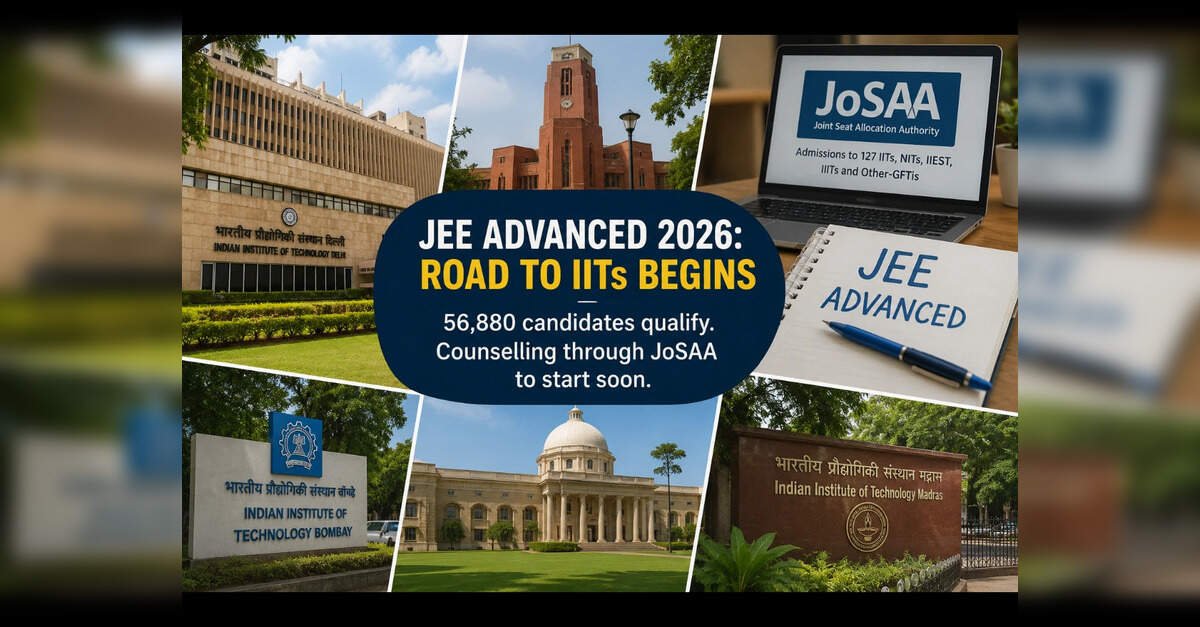
The JEE (Advanced) 2026 results, declared on Sunday, saw 56,880 candidates qualify out of 1,79,694 candidates who appeared for both papers. Overall, 1,87,389 candidates had registered for the examination, while 10,107 of the qualified candidates are female. Shubham Kumar of the IIT Delhi zone topped the Common Rank List (CRL) with 330 out of 360 marks, followed by Kabeer Chhillar and Jatin Chahar. Arohi Deshpande emerged as the highest-ranked female candidate with CRL 77 and 280 marks.
While the toppers come from diverse backgrounds, from a hardware shop owner’s family in Bihar to a village in Rajasthan and a family of doctors in Delhi, their preparation journeys reveal strikingly similar themes.
The common thread: Fix weaknesses, don’t avoid them
One lesson repeatedly echoed by this year’s highest-ranked candidates was the importance of identifying and working on weaknesses rather than focusing only on strengths.
For AIR 1 Shubham Kumar, who hails from Gaya in Bihar, disciplined revision and continuous self-improvement formed the backbone of his preparation. The son of a hardware businessman, Shubham had earlier secured 100 percentile in JEE Main before topping JEE Advanced. He spent around six to eight hours daily on self-study, revised topics taught in class on the same day and regularly focused on improving weak areas. Preparing for JEE often brings pressure, he said, but students must learn to use it positively. “I never let pressure become a weakness. I turned every challenge into motivation.”
A similar approach was adopted by AIR 3 Jatin Chahar, who comes from Village Goth in Rajasthan’s Jhunjhunu district. The son of a BSF personnel, Jatin focused on understanding concepts in depth, analysing mistakes in mock tests and steadily improving weaker areas rather than chasing marks. A participant in multiple Olympiad camps, he believes success is built through small daily improvements. “Success isn’t achieved by a single day of hard work; it’s the daily small efforts that lead to great results,” he said.
The same message was echoed by Delhi’s Darsh Sikka, who secured a place among the country’s top 10 rank holders. In an exclusive conversation with ETEducation, Darsh offered perhaps the simplest advice for future aspirants: “Don’t keep any weak subject. Prepare all the subjects at the same level and go for the exam in a relaxed manner. If you go into the exam with a lot of stress, it affects your performance.”
Darsh admitted that he never expected to secure a top-10 rank. “Even till the last day of the exam, I thought I would be in the top 50 or top 100. I never expected a top-10 rank,” he said. The son of two doctors, Darsh chose engineering over medicine because of his long-standing interest in mathematics. Chemistry proved to be his most challenging subject, largely because of weaker fundamentals in earlier years. He said repeated revision and the support he received from teachers during his preparation at Allen helped him strengthen his concepts and improve in the subject.
Confidence and exam temperament matter as much as preparation
If there was one theme that distinguished AIR 2 Kabeer Chhillar’s preparation journey, it was confidence. “The most important thing to score well, after knowledge of the syllabus, is confidence in one’s capabilities,” Kabeer told ETEducation.
The Gurugram student, who had earlier secured a perfect 300 out of 300 score and AIR 1 in JEE Main, said he expected to be among the top rankers based on his mock-test performance. In fact, he was fairly certain about securing AIR 2 after checking the provisional answer key. “I felt good upon seeing my rank, but I was pretty confident I was getting AIR 2 from the provisional answer key, so it wasn’t a really special moment,” he said.
Kabeer also highlighted a factor often overlooked by aspirants, exam temperament. While subject knowledge remains essential, he believes students must also learn how to perform under pressure. “JEE 2027 aspirants should remember to work seriously on exam temperament along with their subject-specific skills,” he said.
His response also offers an interesting perspective at a time when AI tools are increasingly being used by students. Unlike many aspirants who rely on chatbots and online searches, Kabeer preferred seeking help directly from teachers. “I preferred to talk to my teachers if I had any doubts and didn’t really use AI or Google for answers,” he said.
Study quality over study-hour records
The experiences of this year’s top performers also challenge one of the most persistent myths surrounding JEE preparation that success requires studying for exceptionally long hours every day.
The study schedules of the rankers varied considerably. Shubham typically devoted six to eight hours a day to self-study, while Jatin studied around seven to eight hours daily. Kabeer followed a structured routine that balanced study sessions with breaks, walks and time with friends. Darsh’s preparation involved longer study days, but he too emphasised conceptual understanding and revision over simply accumulating hours.
Rather than highlighting extreme schedules, all four rankers repeatedly pointed to similar factors: conceptual clarity, regular revision, detailed analysis of mock tests, confidence and a conscious effort to improve weak areas. Their experiences suggest that quality of preparation matters far more than maintaining headline-grabbing study-hour records.
The ambitions of the toppers also reflect the continuing attraction of Computer Science among India’s highest-ranked engineering aspirants. Shubham plans to pursue Computer Science at IIT Bombay, while Kabeer has chosen Computer Science Engineering at IIT Bombay. Darsh is evaluating IIT Bombay and IIT Delhi for a Computer Science programme, while Jatin hopes to pursue engineering before eventually joining the civil services.
Congratulating successful candidates, Prof Kamal Kishore Pant, Director of IIT Roorkee and Chairman of the Joint Admission Board (JAB), said qualifying JEE Advanced reflected “dedication, perseverance and academic excellence”.
“I extend my heartfelt congratulations to all candidates who have qualified JEE (Advanced) 2026. This achievement is a testament to their dedication, perseverance, and academic excellence,” Pant said, encouraging qualified candidates to participate in the JoSAA 2026 counselling process.
As counselling begins, the journeys of this year’s top rankers offer an important takeaway for the next batch of aspirants: success in JEE Advanced may demand hard work, but the highest ranks are often built on strong fundamentals, self-correction, confidence and consistency rather than sheer study hours alone.
