


There is a playbook, well-documented and repeatedly tested, that hostile networks, both domestic and foreign, deploy across the developing world when they cannot win at the ballot box.

The objective is never to win a single argument. It is to manufacture a permanent sense of national unease, a slow and creeping suspicion that the country is failing, its leadership is corrupt, and its institutions are broken beyond repair. India, to its credit, has proven harder to break than most.
Having failed to defeat Prime Minister Narendra Modi across three consecutive electoral mandates, these forces have shifted their attention to a softer target: the smartphones of young Indians who form their political opinions almost entirely through social media.
What appears to be a meme page is very often something far more deliberate. Recognising that gap between appearance and intent is the first act of resistance.
The countries in India’s neighbourhood offer the sharpest and most sobering lessons in what happens when these operations go unchallenged.
In Sri Lanka, a coordinated social media campaign transformed genuine economic frustrations into a revolutionary moment. Mobs stormed the Presidential Palace, the elected government fell, and an economy that had been growing collapsed into chaos, with foreign-funded civil society networks feeding that narrative at every stage.
Bangladesh followed a near-identical script in 2024, when an organic student protest was systematically captured by external amplifiers and converted into a full-scale political transition, ousting a government that had delivered two decades of growth.
Nepal has cycled through manufactured crises for over a decade, keeping one of Asia’s most resource-rich nations perpetually distracted from its own potential.
The formula is identical every time: identify a grievance, give it a catchy face, flood social platforms until the narrative feels like national consensus, and then harvest the instability that follows.
India is now facing a calibrated version of this formula, aimed squarely at its large and digitally active youth population.
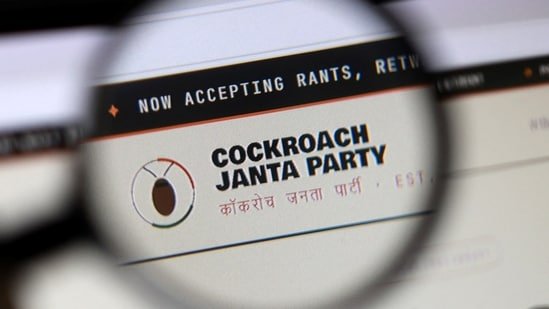
The most visible recent example is the so-called ‘Cockroach Janta Party’ (CJP), an Instagram-centric campaign that has gained rapid traction in recent weeks.
Its founder, Abhijeet Dipke, is a Boston-based strategist who held official responsibilities in the Aam Aadmi Party’s social media and communications work between 2020 and 2023, including work reportedly connected to former AAP leader Manish Sisodia. While Dipke has distanced himself from those affiliations, the background raises legitimate questions about whether CJP is functioning as a digital instrument of organised opposition, using satire as cover for a larger political project.
The page’s own publicly available Meta audience insights tell a revealing story: only 30% of its followers are under the age of 25, flatly contradicting its claim of being a spontaneous Gen-Z uprising. The actual follower profile reflects a carefully cultivated base of older, politically engaged users. That is the fingerprint of directed political communication, not grassroots youth anger.
What these disruptors are ultimately betting against is the reality of India’s trajectory.
This is the only major economy in the world that has consistently clocked GDP growth above 7% and is widely projected to sustain that pace through the decade. The transformation on the ground is neither invisible nor abstract. Highways, airports, digital public infrastructure, and rural connectivity have materially changed the lives of hundreds of millions. Schemes such as PM-KISAN and Mudra have created genuine economic pathways for those who had none a generation ago. Declining poverty, rising digital access, and a thriving startup ecosystem are not government talking points. They are figures documented by the World Bank, the IMF, and independent rating agencies.
It is this growth story, and the national confidence it is building, that the coordinated campaigns are designed to interrupt.
India’s youth are not just witnesses to this story. They are its next chapter, and the policy architecture being built today is specifically designed for them to step into.
The India AI Mission, launched in 2024 with a dedicated public compute corpus, is positioning the country as a serious player in the global artificial intelligence race. A rapid expansion of data centre capacity is drawing some of the world’s largest technology investments to Indian cities. Production Linked Incentive schemes in electronics and semiconductors are creating industrial depth that did not exist a decade ago. Startup India has supported tens of thousands of ventures, and the pipeline of young founders building for Bharat and the world continues to grow.
These are funded, operational, and accessible opportunities.
A nation that spent more than three centuries under foreign rule, watching its wealth systematically drained and its ambitions deliberately suppressed by colonial powers, rebuilt itself from that point to become the world’s fastest-growing major economy.
That journey should make India’s youth the most discerning consumers of information in the world.
The forces trying to manufacture doubt about India’s future are, in many cases, descendants of the same strategic interest that never wanted India to rise in the first place.
The threat is institutional in scale and must be answered institutionally.
According to government statements during Operation Sindoor, foreign-linked networks have deployed large numbers of fake accounts on Indian social media, designed to pass as Indians of every caste, community, religion, and region, spreading misinformation and amplifying divisions to push Indians toward internal conflict. India needs a dedicated social media monitoring and rapid response cell equipped with advanced analytics to identify and counter these campaigns in real time.
A cross-functional task force must compel platforms to label AI-generated content and take down coordinated fake account networks using technology that already exists on these platforms and is simply not being applied.
A country that designed and scaled a digital payments system used by half a billion people, and administered one of the largest vaccination drives in human history, has every capability needed to build this infrastructure. The forces trying to pull India back have always underestimated it. They are making that mistake again.
(The author, MBA from IIM Lucknow, is National Member, Policy Research Training at Bharatiya Yuva Janata Morcha, youth wing of the BJP. Views expressed in the article are his personal.)
