


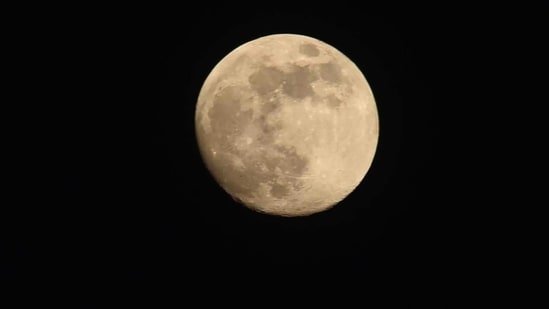
Full Moons hold a special place in Vedic astrology, where the Moon is closely linked with emotions, memory, instincts, and the inner world. But astrologers say Adhik Jyeshtha Purnima is not an ordinary Purnima.

Its rarity comes from timing.
What makes Adhik Jyeshtha Purnima unusual?
This Full Moon falls during Adhik Maas, an additional lunar month that occurs only once every few years in the traditional Hindu calendar. Because of that, the event is often viewed through a different spiritual and astrological lens.
Also Read Once in a blue moon is getting real after two years for skywatchers and astrology followers
“In Vedic astrology, the Moon governs the mind, emotions, memory, instincts, and emotional stability. Every Purnima naturally intensifies lunar energy, but when the Full Moon falls during an Adhika maasa, its influence is believed to become more inward, reflective, and spiritually charged,” says Vedic astrologer Acharya Shashi Dharan Nair.
In simple terms, this is not the kind of Full Moon that is traditionally connected with action, visibility, or outward achievement. Instead, it is often associated with slowing down and paying attention to what is happening within.
Also Read A US spiritual expert explains the symbolism of this weekend’s rare blue moon
Why does an “extra month” exist in the first place?
The phrase “Adhik Jyeshtha” speaks for itself.
“Adhik” means extra, while “Jyeshtha” refers to the lunar month. Unlike the regular monthly cycle, Adhik Maas appears roughly every 32 to 33 months to help bring the lunar and solar calendars back into balance.
Because it does not occur every year, anything tied to this period naturally gains a sense of rarity.
In many traditional belief systems, Adhik Maas is treated differently from other months. It is not usually seen as a period focused on expansion, status, or material pursuits. The emphasis tends to shift toward prayer, reflection, and reviewing one’s path.
Also Read May 2026 Full Moon: What you need to release this Blue Moon, according to your zodiac sign
Why do astrologers see this Full Moon as spiritually significant?
For followers of Vedic astrology, the combination of a Full Moon and Adhik Maas carries symbolic weight.
A Full Moon already represents heightened lunar influence. Add that to a month traditionally linked with introspection, and the result becomes less about external milestones and more about emotional and spiritual awareness.
According to Acharya Nair, Adhik Maas has long been associated with self-review and karmic balancing. That idea makes Adhik Jyeshtha Purnima stand apart from a regular lunar event.
Many people use such periods for quiet practices, prayer, journaling, meditation, or simply taking stock of their emotional landscape.
What do traditional texts say about Adhik Maas Purnima?
The significance of this Full Moon is also reflected in Hindu scriptures.
Astrologer Acharya Nair points to texts such as the Skanda Purana, Padma Purana, Narada Purana, and Bhavishya Purana, where the Purnima of Adhik Maas is referred to as Sarva Siddhi Dayini Purnima, meaning the Purnima believed to grant all achievements.
Within these traditions, the phrase is linked with devotion, spiritual effort, and inner alignment.
Whether approached through astrology, faith, or cultural tradition, Adhik Jyeshtha Purnima remains one of the more uncommon lunar moments of 2026. Its meaning, astrologers say, lies not in dramatic predictions but in the quieter themes of reflection, emotional clarity, and spiritual pause.
Disclaimer: The article is based on an expert’s interpretations. Readers are advised to seek professional help for future predictions.
