


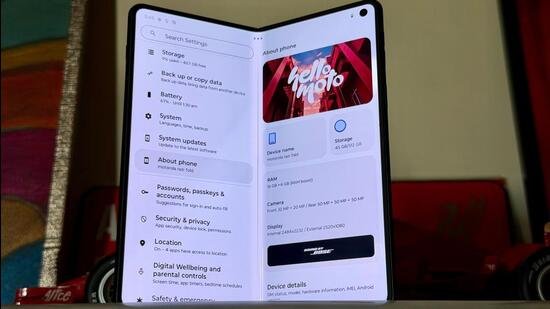
The very fact that Motorola took its time to enter the book fold style foldable phone category is a positive sign. Clearly (and as the proof of the pudding lies in eating it, as they say) the effort with the Motorola Razr Fold seems to have paid off because the desired refinement benchmark looks likely achieved. The proof of using the phone certainly seems to suggest that. To the different degrees that Motorola’s efforts with the Razr Fold may imply, the Google Pixel 10 Pro Fold should be very worried, the Vivo X Fold5 should be quite worried, and the Samsung Galaxy Z Fold7 may occasionally look over its shoulder. That in a way, should give you a fair idea of an evolving foldable phone hierarchy at this moment.

The Motorola Razr Fold is priced at ₹1,39,999 onwards, and the spec choices include 12GB memory with 256GB storage or 16GB memory with 512GB storage. In comparison, the Galaxy Z Fold7 starts at around ₹1,74,999, while the Vivo X Fold5 costs ₹1,49,999. Both also potentially benefit from discounts and cashback offers linked to certain payment modes. But you can see Motorola’s efforts to deliver that value potential, which I’d mentioned earlier. The fact that it’s a collection of the newest hardware defining the spec sheet helps, at least until the rivals get generational updates in the months ahead.
The little things really matter. The Razr Fold is powered by the Qualcomm Snapdragon 8 Gen 5 chip. The 8.1-inch foldable display is just about the biggest in this category, with Samsung’s 8-inch display real estate not too far behind. The key to the Motorola Razr Fold’s screen is its peak rated brightness of 6200 nits, which is more than double the Galaxy Z Fold7’s 2600 nits and still significantly higher than the Vivo X Fold5’s 4500 nits. The support for the Moto Pen Ultra stylus should add value for some, though I didn’t get the chance to test that specific accessory yet. The Razr Fold has Wi-Fi 7 which means connectivity future-proofing is quite well sorted.
Turns out, the Razr Fold has a lot of world firsts going for it. This is the world’s first foldable with Bose tuned speakers. The world’s first foldable with Corning’s Gorilla Glass Ceramic 3 protection. The cover screen has a very usable 6.6-inch footprint, And matches the Vivo foldable in terms of battery capacity, a 6,000mAh silicon-carbon pack. If I’m not entirely wrong, the Razr Fold surpasses the Vivo X Fold5’s wireless charging speeds too, 50-watt as against 40-watt, while competitive on the 80-watt wired charging speed. All this, while maintaining the sort of thickness ballpark as the Galaxy Z Fold7, though the Razr Fold is significantly heavier. That said, hold this up, and this feels rather balanced.
In terms of colour, what you see here is the Pantone Blackened Blue (it seems more black than blue to my eye, but that is immaterial). I quite like the resemblance of the back panel (when the Razr Fold is folded) with the camera layout and overall aesthetic to the Motorola Signature and the Motorola Edge 70 Pro. The choice of finish also means it’s great news for grip, which is crucial of a phone of this category. Motorola has engineered a stainless steel teardrop hinge that they say reduces screen stress on every fold and unfold moment.
The 50-megapixel troika of a wide (this is specifically the Sony Lytia 828 sensor), ultra wide and 3x periscope cameras returns typically Motorola-esque photography brilliance. The Razr Fold is genuinely the best book style foldable is photography is a primary use-case. So much so, I’d peg Motorola’s choice of hardware and the image processing tuning in the same range as the Ultra phones—the Xiaomi 17 Ultra, the Vivo X300 Ultra and the Oppo Find X9. That is no mean feat to achieve with such ease and poise. Foldables generally, since their inception, have been comparatively on the photography front.
If you spend some time tweaking the Razr Fold’s camera app to be exactly as how you’d like it to be, that makes it fairly easy to effortlessly get photos which look stunning. Particularly impressive are the dynamic range, the blast of well distinguished colours that you’d almost immediately appreciate and portrait photos which do the background blur better than many phones can manage (the accuracy of the differentiation around the head/hair, in particular). I could point to focus that sometimes takes a momentary stock of the scenario before locking in, and a very apparent colour distortion in the sky in some photos.
Crowning off a successful first generation for the Razr Fold is excellent battery life. The silicon-carbon composition has been a game changer for smartphones, but it doesn’t mean optimisation is any less important—and that’s where Motorola has clearly done a fantastic job. Lighting up (and very brightly too, when you need that) a large foldable display and a very usable cover screen, and still returning significantly higher screen usage time than any of the other foldables under the same usage load, is impressive.
With the Snapdragon 8 Gen 5 chip, lots of memory and an impressive layering of the Moto AI suite (which gets Google Gemini and Microsoft Copilot integrations), Motorola sorted the basics of a flagship experience before building the foldable experience with the brightest display in the entire ecosystem by far, and the most prolific camera system, also by far. While the conventional approach to foldables has been specs first, Motorola has taken top-notch specs and woven a very impressive experience around them—be it the design and fine elements, typically minimal and on-point software layers, and performance that will hold the Motorola Razr Fold in good stead for many years to come. Suddenly, the book style foldable space has some competition. Maybe sleepwalking won’t be an option for rivals anymore.
(Vishal Mathur is Technology Editor for Hindustan Times. When not making sense of technology, he often searches for an elusive analog space in a digital world.)
