


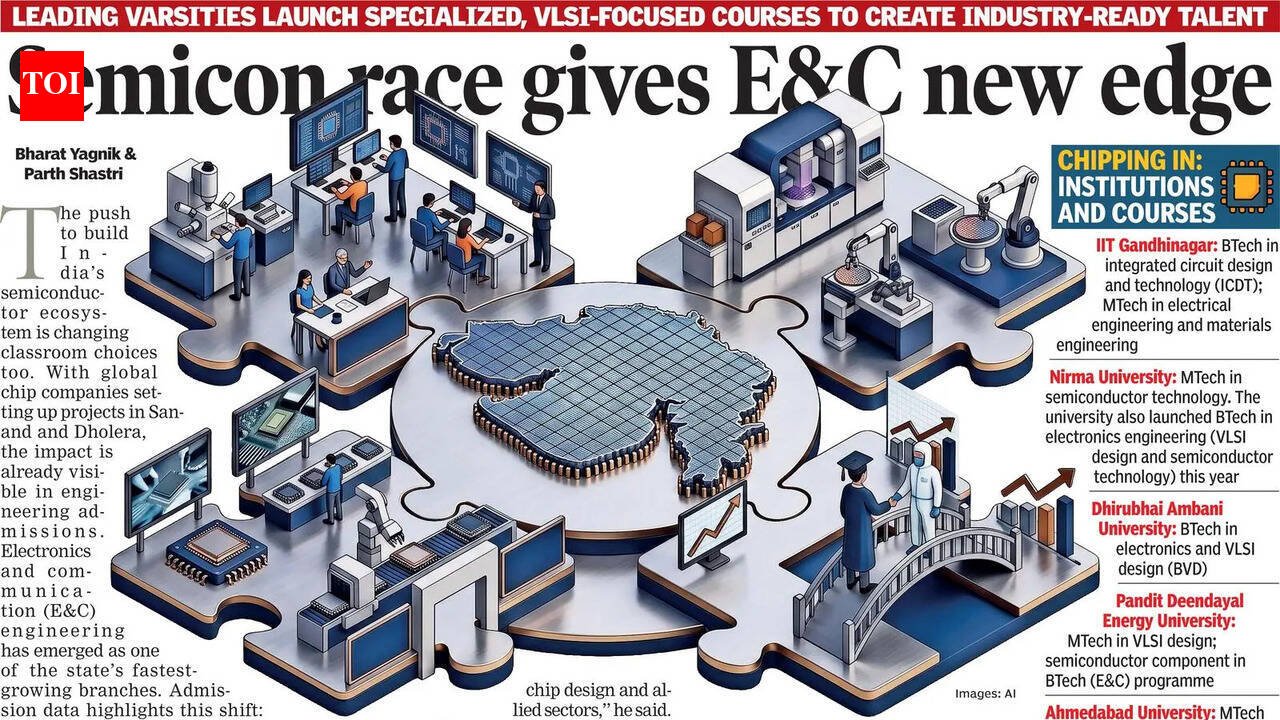
Logo: Mission AdmissionAhmedabad: The race to build India’s semiconductor ecosystem is now changing classroom choices too. With global chip companies setting up projects in Sanand and Dholera, the impact is already visible in engineering admissions. Electronics and communication engineering has emerged as one of the state’s fastest-growing branches. Admission data highlights this shift: E&C seat occupancy recorded over 70% in both 2024 and 2025, a dramatic climb from 63% in 2023 and a dismal 39.4% in 2022.The growing interest comes alongside major investments under the Union govt’s Rs 76,000 crore India Semiconductor Mission (ISM), which aims to strengthen domestic chip manufacturing and reduce dependence on imports.In Feb this year, Micron Technology established India’s first semiconductor assembly, test, marking and packaging (ATMP) facility in Sanand. Tata Electronics is simultaneously developing the country’s first advanced semiconductor fabrication unit for 300mm chips in Dholera. Several other companies entering the sector have turned Gujarat into one of India’s key semiconductor destinations.The direct impact of this development is the boost for colleges offering E&C engineering courses. The admission surge has been especially strong in govt and grant-in-aid colleges. Of the 1,578 E&C seats in govt colleges, nearly 91% were filled in 2025. Grant-in-aid colleges recorded an even higher occupancy of 94.2%.Dr Nilay Bhuptani, principal of LD College of Engineering and member secretary of the Admission Committee for Professional Courses (ACPC), said the semiconductor industry has significantly changed student preferences. “E&C is now second only to computer engineering and related branches in terms of merit preference. Students can clearly see long-term career opportunities emerging in semiconductors, chip design and allied sectors,” he said.Colleges and universities are quick to ride the trend.Nirma University this year launched a new undergraduate programme in semiconductors after witnessing a strong response to its postgraduate course in the field. R N Patel, dean of the faculty of technology and engineering at Nirma University, said the increasing industry demand encouraged the university to introduce specialised training at the undergraduate level as well.Many engineering institutes are also redesigning existing E&C programmes by introducing modules in semiconductors, VLSI, and chip design to align students with industry needs.For students, the timing appears ideal.Jeevansh Singh, a Class 12 student who scored 92% in board exams, said he plans to pursue E&C engineering and later specialise in VLSI (very large-scale integration or the process of embedding thousands to billions of transistors onto a single silicon semiconductor microchip).“My father is an engineer, and I want to continue in the same field. The industry provides ample work opportunities both in India and abroad. With the industry taking shape here, beginner’s luck will be on our side,” he said.“The surge in interest towards E&C engineering is closely linked to India’s semiconductor push. Of the 12 major semiconductor projects announced nationally, six are in Gujarat and accounts for nearly 72% of the total investment value. Semiconductor manufacturing is still a relatively new space for India, and until recently, students were largely unaware of the opportunities in manufacturing roles. With anchor investors’ presence in Gujarat, there is now a clear understanding that scaling a semiconductor ecosystem requires a strong talent pipeline. Institutions such as PDEU, GTU, and Nirma University introducing VLSI-focused courses have further strengthened industry-academia alignment. Better pay prospects, strong career growth and rising awareness have all contributed to E&C emerging as a preferred branch again,” said Sudhir Naik, head (mid-west region), India Energy Storage Alliance (IESA).BOX1E&C engg admission trendYear Seats Filled up %2025 5,009 3,533 70.5%2024 4,671 3,350 71.7%2023 4,305 2,714 63%2022 4,488 1,768 39.4%2021 4,620 2,623 56.8%
