


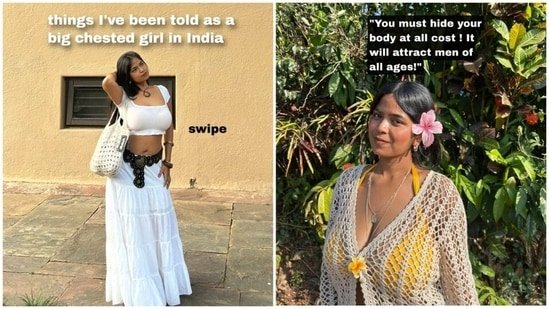
In a social media landscape often curated for perfection, digital creator Piyali Roy is pulling back the curtain on the unsolicited scrutiny women face in India. In a candid Instagram post shared on May 25, Piyali detailed a list of comments she has received, ranging from so-called well-meaning medical advice to overt sexual harassment. Also read | 43-year-old unmarried Indian woman living alone gets honest about being single by choice: ‘In love with my freedom’
Her post, titled ‘Things I’ve been told as a big-chested girlie in India’, serves as a sharp critique of the constant surveillance women’s bodies undergo in public and private spaces. “People have been judgmental towards me (intentionally or unintentionally), and here are some small glimpses,” Piyali wrote in her caption.
The myth of concern
One of the most striking anecdotes Piyali shared involved a stranger’s attempt to medicalise her appearance. While waiting for a washroom at a public museum, Piyali — then only 19 — was approached by an older woman. “A lady in her 40s looked at me, top to bottom, and blurted, ‘Beta (my child), you should see a doctor,'” Piyali recounted. When Piyali questioned the remark, the woman pointed at her chest and claimed, “They are too big. It could be a sign of some disease.” Piyali noted she was simply wearing a black top at the time.
The burden of modesty and unsolicited advice
Piyali’s testimony highlights a pervasive culture of moral policing where clothing choices are scrutinised under the guise of decency. She revealed that she is frequently told: “I don’t think you should wear it. It’s too revealing. Doesn’t look decent on you.” Or “Maybe cover it up with a shirt or something.” And even: “You must hide your body at all cost! It will attract men of all ages.”
Even when visiting the beach, the scrutiny persists. Piyali shared a comment directed at her swimwear: “Isn’t that bikini too much?! You should probably wear a tank top to the beach.” Beyond modesty, Piyali is often pressured to alter her physical form. When asked, ‘Have you considered reduction?’ Piyali’s standard retort remains sharp: “Are you going to pay for it?”
Combatting ‘sexualisation and harassment’
The content creator also shared screenshots of her direct messages (DMs), illustrating what she describes as ‘never-ending sexualising and harassing’. The messages range from demands for ‘bra and panty fit checks’ to backhanded compliments about her weight, such as, “You would’ve looked so much hotter if you reduced your belly fat a little bit.”
Piyali was equally blunt about the impact this has had on her personal life and her view of relationships. Addressing the common trope, ‘Oh, your partner must be so lucky’, Piyali responded: “All my ex-partners have complained about them for being too big. Part of the reason why I hate men.”
The ‘goddess energy’ response
Despite the barrage of negativity, Piyali maintains a stance of radical self-acceptance. When asked by people how she remains ‘so confident’ despite the criticism, her philosophy is rooted in internal validation. “My answer is: there’s nothing wrong with me not being confident about. I live in goddess energy,” she stated. Also read | Sakshi Sindwani replicates Alia Bhatt’s Cannes look amid ‘brutal’ online scrutiny: ‘I’m being called ugly a lot’
Piyali concluded her post with a fiery warning to those who cross her boundaries: “So from now on, anyone who comments on my body negatively, I’ll take out my pepper spray and spray it on their eyes. Your eyes don’t deserve me.”
‘All of them are just jealous’
The response to Piyali’s post has been overwhelmingly supportive, with many women echoing her experiences of being ‘policed’ in public. “You’re so pretty! All of them are just jealous,” one Instagram user commented. Another wrote: “Who cares about their opinions anyway? They act as if they would pay for the surgery or something. We love a beautiful queen!” Comments on her post ranged from ‘the real diva’ to ‘you are so beautiful just as you are’.
Piyali’s Instagram post underscores a growing movement among Indian creators to reclaim the narrative around body image, shifting the focus from ‘fitting in’ to demanding respect and bodily autonomy.
Note to readers: This report is based on user-generated content from social media. HT.com has not independently verified the claims and does not endorse them.
This article is for informational purposes only.
