


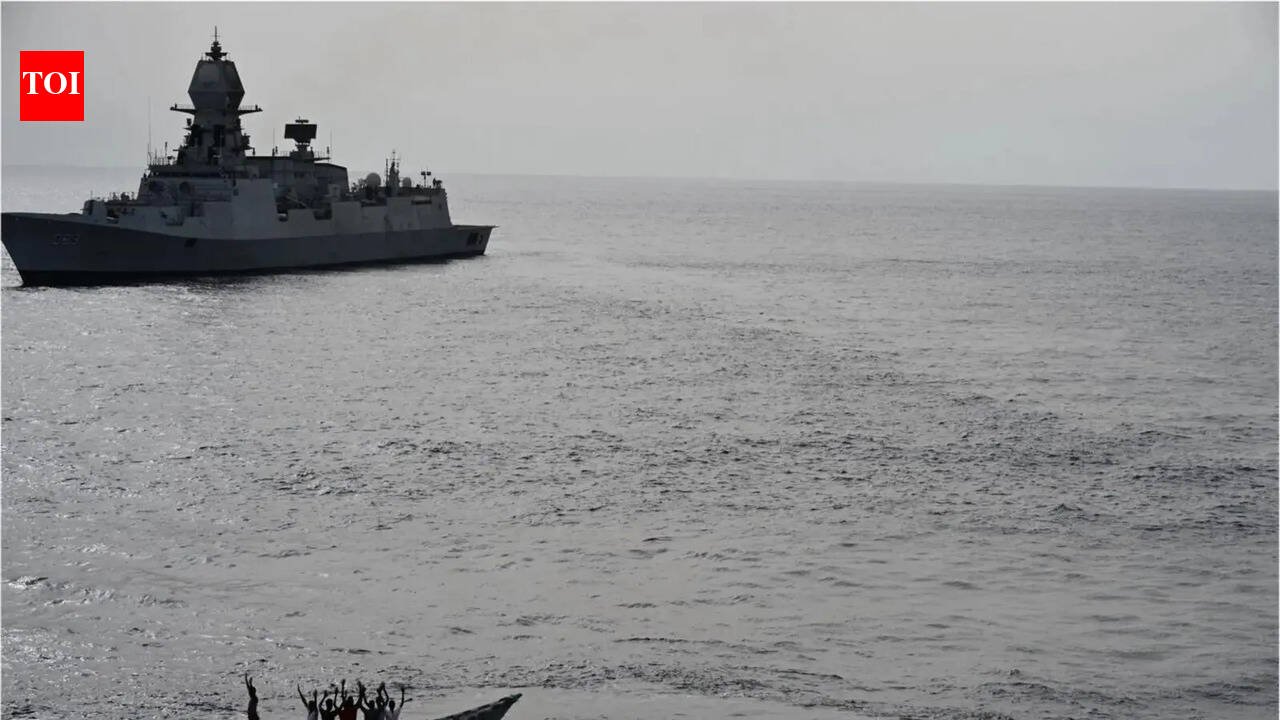
NEW DELHI: The Indian Navy on Wednesday successfully foiled a suspected piracy attempt near merchant vessel MV Mashallah 1 in the Western Indian Ocean, once again underlining India’s growing maritime surveillance and rapid response capabilities in one of the world’s most strategically sensitive sea routes.The operation was carried out by Indian Naval Ship (INS) Kolkata, which is currently deployed in the Western Indian Ocean near the Gulf of Aden as part of the Navy’s anti-piracy mission. Acting swiftly on inputs regarding suspicious pirate activity close to the merchant vessel, INS Kolkata launched an immediate investigation to neutralise the potential threat.
The warship deployed its onboard helicopter for aerial surveillance while boarding teams conducted operations at sea to verify the situation and secure the vessel. The timely response by the Indian Navy ensured the safety of MV Mashallah 1 and prevented what could have escalated into a piracy attack.Following the incident, the Indian Navy reiterated its commitment to protecting commercial shipping lanes, countering piracy and maintaining secure maritime routes in the region. India has maintained a continuous anti-piracy presence in the Gulf of Aden since 2008, with naval deployments playing a key role in escort missions, surveillance and emergency interventions.
At the centre of Wednesday’s operation was INS Kolkata, one of the Indian Navy’s most powerful and technologically advanced warships. Commissioned in August 2014 by Prime Minister Narendra Modi, the vessel is the lead ship of the indigenously designed Kolkata-class guided missile destroyers under Project 15A.Built by Mazagon Dock Limited in Mumbai, INS Kolkata represents a major milestone in India’s indigenous naval manufacturing programme. Measuring 164 metres in length and nearly 18 metres in width, the destroyer has a full-load displacement of around 7,400 tonnes and is among the largest warships built in India.The ship is powered by a Combined Gas and Gas propulsion system featuring four reversible gas turbines, allowing it to achieve speeds exceeding 30 knots. Its onboard electrical systems generate nearly 4.5 megawatts of power, enough to illuminate a small town.INS Kolkata is designed for multi-dimensional warfare and carries a formidable range of weapons and surveillance systems. It is equipped with medium-range and short-range guns, anti-aircraft and surface missiles, advanced air and surface surveillance radars, and a bow-mounted sonar system for anti-submarine operations.One of the defining strengths of the destroyer is its highly integrated digital combat architecture. The vessel operates sophisticated indigenous systems including the ATM-based Integrated Ship Data Network (AISDN), Auxiliary Control System (ACS), Automatic Power Management System (APMS) and Combat Management System (CMS).The AISDN functions as the ship’s central information highway, linking data from sensors and weapon systems in real time. The ACS enables remote monitoring and control of onboard machinery, while the APMS manages the ship’s complex power distribution network. The CMS integrates battlefield information from the ship’s own sensors as well as external platforms through an indigenous data-link network, significantly enhancing maritime domain awareness.The warship also reflects India’s push for defence indigenisation. A large number of its core systems and equipment have been sourced domestically, helping establish a strong local industrial ecosystem for future naval programmes. Indigenous systems onboard include the Combat Management System, Auxiliary Control System, Automatic Power Management System, Foldable Hangar Doors, Helo Traversing System and the HUMSA NG sonar system.INS Kolkata can operate two helicopters, including Seaking or Chetak aircraft, giving it extended surveillance, reconnaissance and anti-submarine warfare capability across vast maritime zones.Apart from combat capability, the ship has also been designed with crew efficiency and comfort in mind. Modular accommodation and ergonomically designed galley compartments support its complement of around 30 officers and 300 sailors during long deployments at sea.As the lead vessel of the Kolkata-class destroyers, alongside INS Kochi and INS Chennai, the ship represents the next generation evolution of the Delhi-class destroyers inducted during the late 1990s. Conceived by the Indian Navy’s Directorate of Naval Design, the class has emerged as a symbol of India’s expanding blue-water naval ambitions and indigenous defence capability.
