


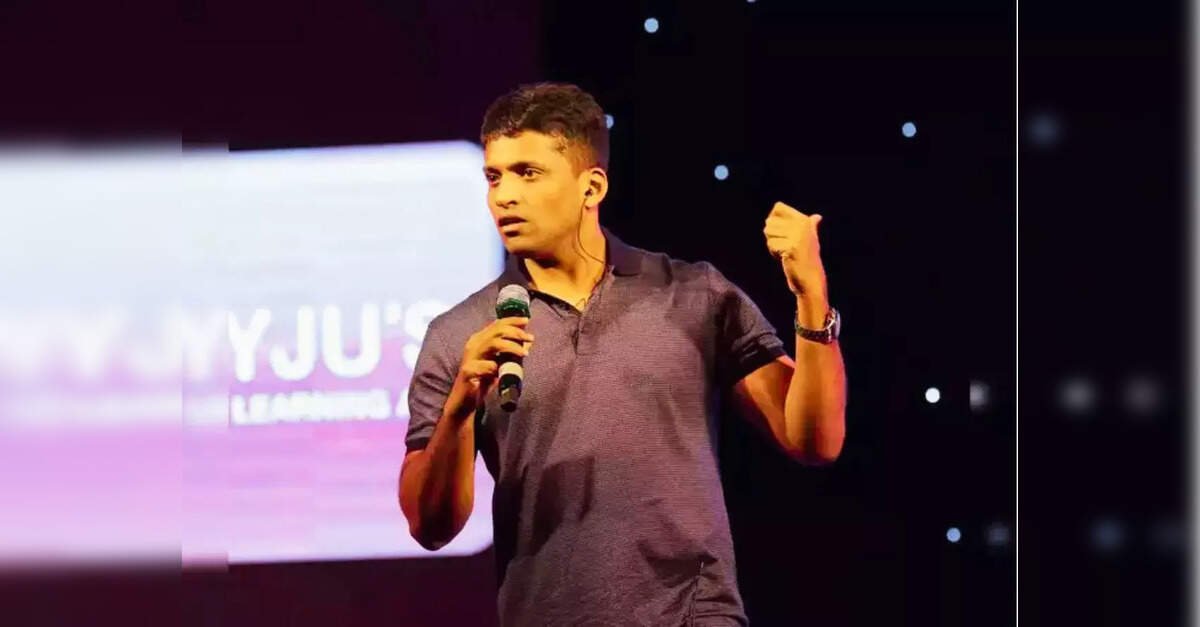
New Delhi, A Singapore court sentenced Byju Raveendran, founder of Byju’s, to six months in jail for contempt of court over alleged non-compliance with disclosure orders, but the entrepreneur said the ruling was “procedural,” denied wrongdoing and that he planned to appeal.
The ruling marks the most serious legal setback yet for the founder of Byju’s, once one of India’s most valuable startups, which has been battling investor disputes, debt litigation and operational turmoil following a sharp post-pandemic downturn.
The court ordered Raveendran to surrender himself to authorities, pay legal costs of Singapore dollar 90,000 (USD 70,500) and produce documents relating to his ownership of Beeaar Investco Pte, a Singapore entity that held shares in an affiliated company.
It was not immediately clear whether Raveendran was in Singapore at the time of the order.
His lawyers said they are contemplating an appeal against the decision and applying for stay of the order.
The case was brought by a subsidiary of Qatar Investment Authority, which invested in Byju’s during a funding round as the company was grappling with layoffs and mounting financial pressure.
The contempt proceedings add to broader legal battles surrounding Byju’s, including ongoing litigation in the United States where lenders are seeking to recover losses tied to a USD 1.2 billion term loan.
In a statement issued after the ruling, Raveendran said settlement discussions with lenders and investors, including GLAS Trust and QIA, were already nearing conclusion and described the latest legal action as an unnecessary escalation.
“The parties have also acknowledged that there has been no wrongdoing on my part or on the part of the other founders,” he said.
He said the Singapore ruling was “a procedural contempt of court order” linked to disputes over document disclosure and “not a finding of fraud, dishonesty, or wrongdoing on the merits.”
Raveendran added that he had chosen “resolution over confrontation” and said he intended to challenge what he described as a “false and one-sided narrative.”
Founded as Think & Learn Pvt Ltd, Byju’s became one of India’s highest-profile technology startups during the pandemic-era boom in online education, attracting backing from global investors and at one stage reaching a valuation of USD 22 billion before a steep collapse in growth and finances.
“The lenders, including GLAS Trust and QIA, as well as other stakeholders, have been in discussions with the founders and other parties. A settlement has been agreed in principle, with only a few residual minor issues left to be finalised between certain parties. I have no role in those remaining issues,” Raveendran said, expressing disappointment that the recent Singapore court matter was pursued and reported in a manner that creates a misleading impression about him.
This, especially at a time when all key parties have almost concluded the settlement discussions, he claimed.
“As part of the settlement discussions, the parties have also acknowledged that there has been no wrongdoing on my part or on the part of the other founders. That is why it is deeply unfortunate that this matter is being used to create a contrary public narrative at this sensitive stage,” he said.
He went on to state that he had not been actively contesting several court proceedings in recent months precisely because “the parties were working towards a comprehensive settlement.”
“Against this backdrop, the decision by QIA to continue pressing this matter appears to be an unnecessary pressure tactic at a sensitive stage of the settlement process,” he said. “Today’s Singapore court matter is a procedural contempt of court order, arising only from disputes over document disclosure in ongoing proceedings – not a finding of fraud, dishonesty, or any wrongdoing on the merits.”
Raveendran said he has been directed to appear on June 15 and that appeal options are available.
“I have always maintained that I acted in good faith and in the best interests of Byju’s, its employees, students and stakeholders. I have also placed on record that neither I nor any of the founders personally received any portion of the disputed funds, and that the funds were used for legitimate business purposes,” he aid.
“Even today, my priority is to support a constructive resolution and avoid saying anything that may affect the ongoing settlement process. However, I cannot allow a false and one-sided narrative to go uncontested and I strongly reject any such incorrect portrayal.”
