


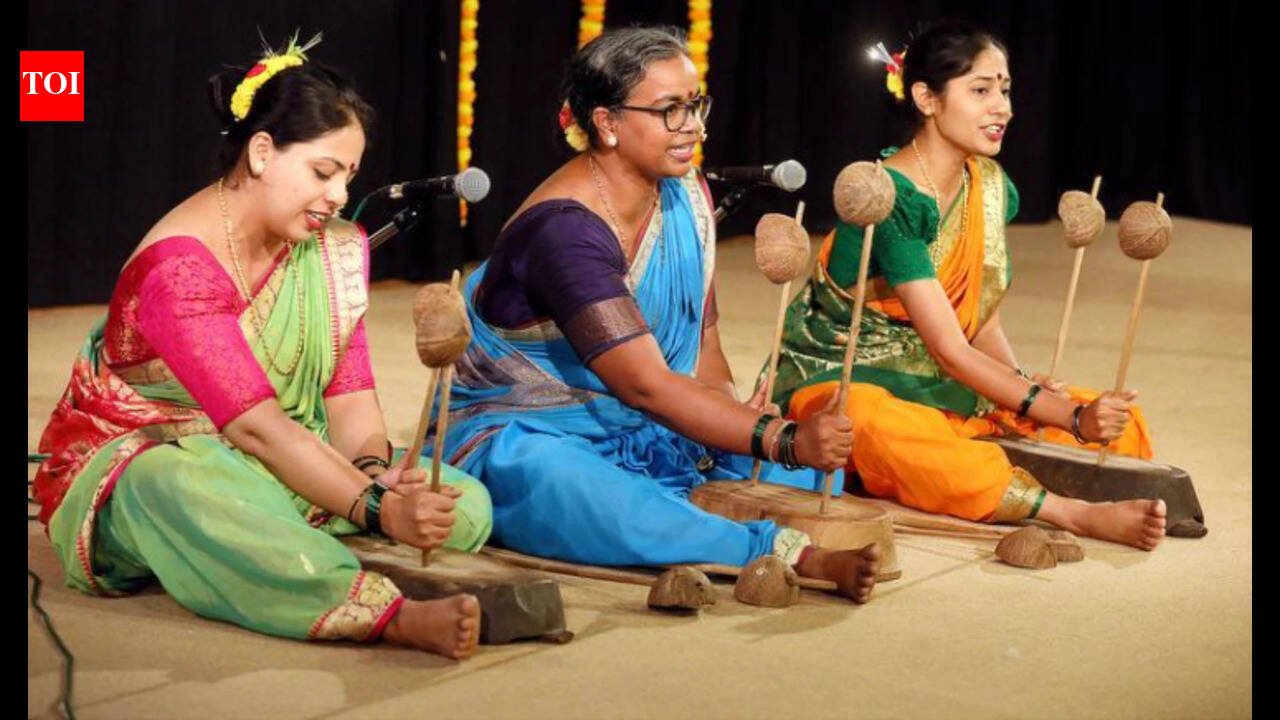
Panaji: A newly married woman longing to visit her maternal home was repeatedly denied permission by her mother-in-law, and was instead instructed to water cattle. Frustrated, the young woman completes the impossible task within minutes, astonishing the household and revealing rebellion hidden within the folk narrative.Such were the anecdotes that audiences watched during the Dovali Maand folk performance being sung in rhythm with coconut-shell instruments.‘Gudulya Kani’ from Canacona and ‘Dovali Maand’ from Sattari are two folk art forms on the verge of extinction. The last surviving artistes of Gudulya Kani too performed on Thursday evening to exhibit their art on World Cultural Day. They gave a glimpse into a tradition where rituals and storytelling were inseparable from community life.Veteran performer Kamlakar Mahalsi described Gudulya Kani as a night-long oral performance tradition on mythology.Performed around the period of Parivartani Ekadashi after Ganesh Chaturthi, the storytelling sessions traditionally gathered entire villages together. “People from whole village would gather to listen. It wasn’t only performance, it was community life,” said Mahalsi.The gudulo, a symbolic crafted object created using local materials including leaves, bamboo, sticks and agricultural produce, was part of the ritual and artistic process. Women prepared ritual items and food while performers narrated stories involving kings, deities, animals, forests and village life.The narratives frequently explored themes of survival, hunger, morality and the relationship between humans and nature.Folk songs referenced animals, birds and spirits, revealing how deeply ecological understanding was woven into oral storytelling traditions.“For cultural practitioners, the revival of such forms is becoming increasingly urgent as oral traditions struggle against shrinking performance spaces and changing entertainment habits,” he said.Yet both Gudulya Kani and Dovali Maand continue to survive because of community memory and living archives that are now preserving histories, emotions and ecological wisdom that modern society risks forgetting.“Many folk art forms are disappearing into oblivion,” folk scholar Poornima Kerkar said while reflecting on Dovali Maand.Traditionally practised in parts of Sattari, Bicholim and Pernem, Dovali Maand combines folk singing with rhythmic percussion created using simple household objects.The dovali, fashioned from coconut shell and fitted with a bamboo handle, was once an essential utensil in Goan kitchens.“In those times, people did not have a ‘use and throw’ mentality,” Kerkar said. “These objects were companions in daily life. People developed emotional and spiritual relationships with the things that sustained them.”The performance tradition transformed these domestic tools into musical instruments and carriers of memory. Songs sung through Dovali Maand expressed devotion, gratitude, humour and family relationships.“The life of people was once closely connected to soil, forests and nature,” said the folk scholar Kerkar while adding that,“These traditions came from that relationship.”
