


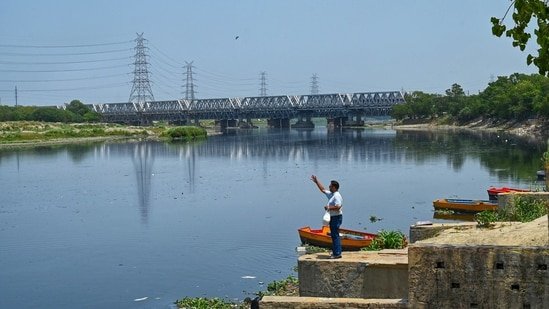
A proposal to divert 500 cusecs of water from the Ganga to the Yamuna, moved last year as part of the Centre-monitored project to rejuvenate the Yamuna, faces significant feasibility hurdles and will likely remain in cold storage, according to a senior Delhi government official.

The senior government official, who did not wish to be named, said the Uttar Pradesh irrigation department has communicated that the diversion plan was found to be not feasible at the current stage as several areas between Eastern Yamuna Canal and Delhi are in extremely poor state and will not be able to carry the water, besides a shortage of raw water in Ganga system during the summer lean season.
Why the plan may not come to be
“The Ganga system does not have additional water to spare. The canal system is damaged at various locations and will not be able to carry this water to Delhi anytime soon. We are not considering it as part of the projects to improve the environmental flow on a short-term basis. The project may be revived in later years, but at the current stage, it appears to be in cold storage,” the official explained.
The development was confirmed by another government official, who, on condition of anonymity, said the focus will now remain on projects approved by the National Mission for Clean Ganga to set up a dedicated conveyance system to carry highly treated wastewater from Coronation Pillar and Yamuna Vihar to Wazirabad.
“UP is not willing to provide this additional water. Our efforts will now focus on internal projects such as Okhla, Coronation Pillar, and Yamuna Vihar. We will keep trying to get additional raw water from UP in exchange for treated wastewater as well,” the official said.
Yamuna’s water quality
The Yamuna’s water quality deteriorates sharply downstream of Wazirabad, as untreated sewage and industrial waste enter the river. Experts and agencies such as the Delhi Pollution Control Committee (DPCC) and the environment department have pegged this requirement for the Yamuna at 23 cubic metres per second (cumecs), but current flows hover around 10 cumecs.
The 22km stretch of Yamuna in Delhi, from Wazirabad barrage to Okhla barrage, is less than 2% of the river’s total length, but accounts for nearly 76% of the total pollution in the river, a Yamuna monitoring committee report noted.
Citing the action plan approved by the central government, HT reported last year that agencies had proposed using a series of stormwater drains and nullahs to make these diversions upstream of the Wazirabad, after which the Yamuna becomes severely polluted.
The proposed intervention said that around 500 cusecs of water needs to be diverted from Roorkee to the Eastern Yamuna Canal via the Deoband feeder branch. This additional 500 cusecs of water was expected to be added to the Yamuna at three points. First diversion near Bhaisawala through Katha nalla (storm water drain).
A second diversion of 350 cusecs will be made at Baraut via the Baraut stormwater drain. Third diversion of 100 cusecs at Jawali near Loni, which was to finally end up near Wazirabad. The plan stated that the water will flow through the Yamuna and, after passing through Delhi, will be lifted again through the Agra canal. The only condition was that the DJB would not use this additional water for its own use; otherwise, it would defeat the entire purpose.
