


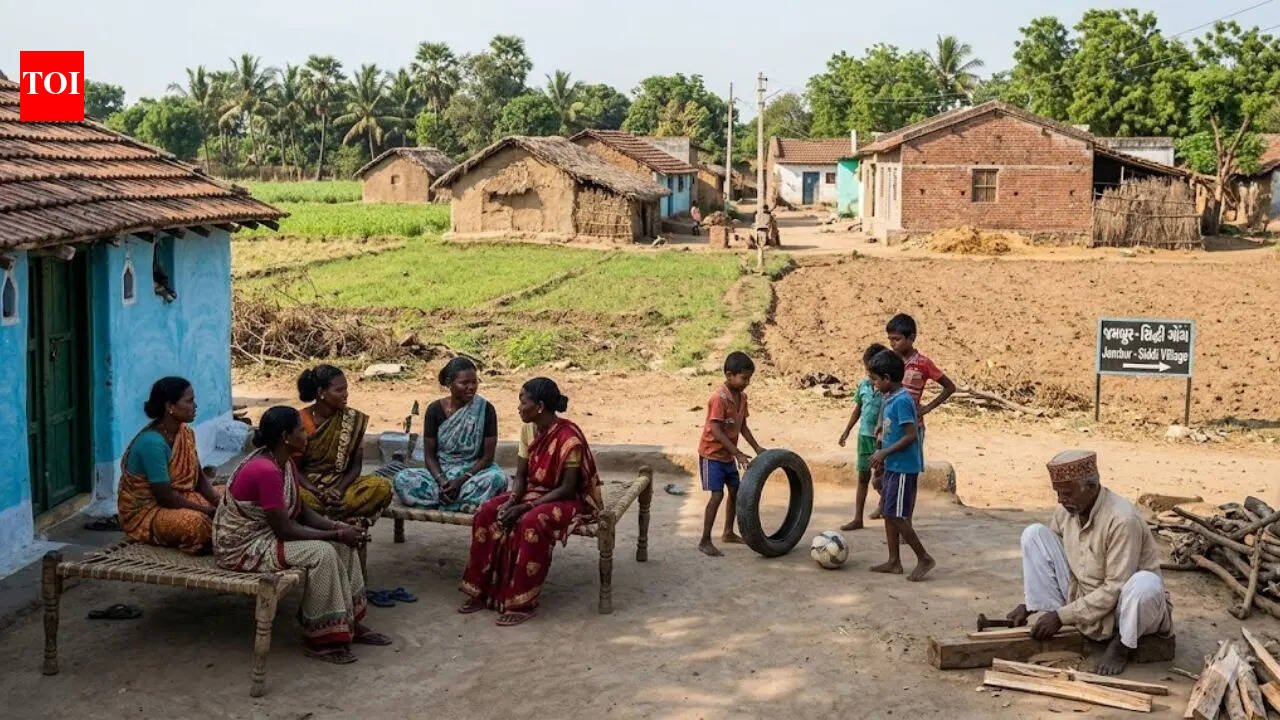
In parts of western India, small communities still carry traces of an African past that arrived centuries before modern migration debates or contemporary ideas about identity. The villages are not separate states or isolated colonies in the literal sense, yet certain settlements in Gujarat and Karnataka are closely associated with the Siddi people, whose ancestry can be traced to East Africa. Daily life in these places looks unmistakably Indian at first glance, with local languages, regional food, village routines, religious festivals, but fragments of older histories remain visible in music, physical features, oral traditions and community memory. The story is less about a lost homeland and more about adaptation across generations, where African origins became woven into the social and cultural fabric of India over several hundred years.
How the African village of India traces its origins to the Siddi community
The movement of Africans into the Indian subcontinent happened gradually and through different routes rather than through a single migration event. According to research published by the University of Kent, titled “The Ethnomedical System of the Siddis of Gujarat, India: The dynamics of healing in an African diaspora community,” many Africans reached India between the medieval and early modern periods through Indian Ocean trade networks, military recruitment and slavery under various rulers. Some arrived as sailors or merchants, while others were brought forcibly through Arab trading systems that connected East Africa with ports along western India.Several African-origin individuals later rose to positions of political influence. Historical records mention military commanders, nobles and administrators of African descent serving in the Deccan Sultanates and other kingdoms. Their status varied widely depending on time and region. Some communities eventually settled permanently in forested or rural areas, marrying locally and forming distinct populations over generations.The term “Siddi” itself is believed to have evolved through older honorific titles used in the Islamic world, though different spellings and interpretations exist across historical accounts. In India today, Siddis are mainly concentrated in Gujarat, Karnataka, Maharashtra, Telangana and parts of Hyderabad.
Jambur, the African village of India near Gujarat’s Gir forest
The village most frequently described in popular reporting as an African village of India is Jambur, located near the Gir forest region in Gujarat. The settlement became widely recognised because a large number of residents have visible African ancestry while continuing to live within a strongly Gujarati cultural environment. The village is not culturally detached from its surroundings. Residents speak Gujarati, participate in regional customs and are integrated into broader village economies. Yet visitors often notice differences in facial features, hair texture and musical traditions that distinguish the Siddi population from neighbouring groups. The contrast has attracted researchers, tourists and documentary filmmakers for years, sometimes reducing a layered community history into a visual curiosity. Music and dance remain among the strongest surviving links to African heritage. The “Dhamal” performance tradition, involving drums and rhythmic movement, is frequently associated with Siddi cultural expression. Though shaped by centuries in India, scholars have pointed to similarities with East African performance styles and ceremonial rhythms.
Life, religion and identity in the African village of India
Religious identity among Siddis varies. Some communities are Muslim, others Hindu, and some Christian. This diversity reflects the different political environments and local societies they became part of after arriving in India. Over time, regional customs blended with inherited practices, making it difficult to separate what is African, Indian or later cultural adaptation. According to a study published in Mekal Insight, titled “Tribal Development in India: A Case of Siddi Community”, the Siddi population has historically faced economic and social marginalisation despite its long presence in India. Many families continue to live in rural conditions with limited access to education, formal employment and land ownership. In several regions, they are officially recognised under the Scheduled Tribe status, intended to support communities facing structural disadvantage. The question of identity can also become complicated for younger Siddis. Some embrace African ancestry openly, while others describe feeling suspended between categories, visibly different from neighbouring populations yet culturally Indian in almost every practical sense. Researchers studying the community have noted how outsiders often focus heavily on appearance while overlooking the depth of assimilation that has taken place over centuries.
How African ancestry still survives in India’s Siddi community
Unlike more recent migrant groups, many Siddis cannot trace direct family connections back to specific African regions. The historical journeys were fragmented, and records from slave trading periods were often incomplete or absent altogether. What remains instead are scattered cultural markers preserved through oral traditions, songs, ritual practices and community storytelling. As per the University of Kent research, genetic and historical studies generally connect Indian Siddi populations with Bantu-speaking groups from East Africa, particularly regions around present-day Mozambique and neighbouring coastal areas. Yet the passage of time has altered those connections substantially. The community’s present identity was formed inside India rather than outside it. In villages associated with Siddi populations, everyday concerns tend to revolve around employment, schooling, migration to cities and social mobility rather than historical reconstruction. African ancestry exists there as lived inheritance rather than museum history.
