


The footage is old, grainy and prophetic. The year is 1998 and the setting is the Holywood golf course near Belfast. A local BBC reporter asks Northern Ireland’s top young prodigy what his ultimate dream is. “To turn pro and win all the Majors,” replies the nine-year-old.

“And would you like to win them all in the same year?” the reporter asks indulgently, trying hard to keep the humour out of his voice.
“Yeah,” young Rory McIlroy chuckles back.
Some sporting dreams are destined to come true. For a while, McIlroy’s was one of those.
He turned pro as an 18-year-old in 2007; won his first title on the European Tour in 2009; got his maiden victory on the PGA Tour in 2010; won his first Major, the US Open at Congressional, in 2011; and the British Open and PGA Championship in 2014.
By the time he went to the 2015 Augusta Masters, he was one title away from being the sixth player in history and the second youngest after Tiger Woods to win all four Majors (even if not in the same year).
Some sporting dreams are destined to end in heartbreak. As McIlroy tried over and over, came close but failed repeatedly, it seemed like the Masters crown would forever remain elusive. Even the other Majors stopped being kind to him. He continued to triumph around the world, but remained winless at all four over the following decade.
By 2024, he was 35 and it seemed like the quest was over; the career Slam was not to be.
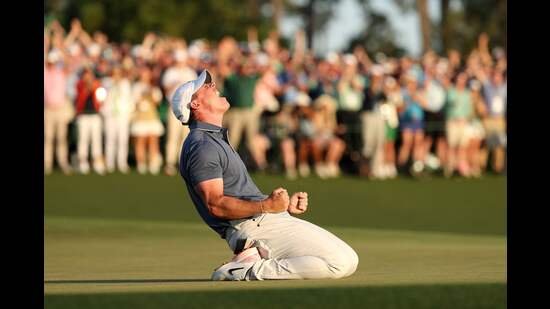
Then, on his 17th attempt at Augusta, last summer, something happened.
A new documentary, Rory McIlroy: The Masters Wait, chronicles the rise, fall and redemption of the world’s most-loved golfer in the post-Tiger era. It recounts how a bucktoothed young boy said he’d win it all, how his career began like a fairy tale, how the story suddenly turned sour, and how McIlroy conquered his demons to eventually win the Masters in 2025 and fulfil the promise he had made to himself.
“Welcome to the club, kid,” Tiger texted a relieved Rory, minutes after he’d put on the green jacket.
Last month, the monkey off his back, the 36-year-old won the Augusta Masters a second time, becoming only the fourth golfer ever and the first since Woods in 2002 to claim back-to-back victories at the world’s most prestigious golf tournament.
AN ELITE CLUB
The four modern Majors took shape in 1934, with the setting up of the Masters at the Augusta National Golf Club in Georgia through the efforts of the resident golfing don of the era, Bobby Jones.
While the other three Majors (US Open, British Open and PGA Championship) move between a set of venues, the Masters has been held on the same course for 92 years. This permanence makes the tournament the first among equals.
Golf’s first career Slam was completed in 1935 by Gene Sarazen, the son of Sicilian immigrants, who grew up in a New York suburb. Sarazen started out as a caddy, who realised he could hit longer and truer than the patrons he assisted.
At the second Masters, Sarazen, then 36, made an impossible 232-yard double eagle on the 15th hole on his way to the title. It was nicknamed “the shot heard around the world”; the bridge on the 15th at Augusta has since been renamed Sarazen Bridge.
It would be 18 years before the next career Slam. Ben Hogan, the son of a blacksmith from Texas who also caddied his way to a golf card, won his first Masters in 1951 and completed the set of four at the British Open in Carnoustie, in 1953. Derailed midway through his career by World War 2 (in which he served in non-combat roles, for over two years), and by a near-fatal car accident, he was 40 at the time.
Hogan was such a superstar that, by then, Sidney Lanfield had already directed a biopic on his life: Follow the Sun (1951), starring Glenn Ford and Anne Baxter.
The next two career Slams came in quick succession: Gary Player at the 1965 US Open, and Jack Nicklaus at the 1966 British Open. Player won the Masters three times, and Nicklaus is a record six-time champion. Player was named South Africa’s sportsperson of the century in 2000. Nicklaus, nicknamed Golden Bear, is considered the greatest golfer of all time (arguably alongside Woods). He won 18 Majors (against Woods’s 15), a record that may never be broken.
Three decades later, Tiger Woods became the youngest player to win a Major in the modern era, the youngest to complete the career Slam, as a 24-year-old at the British Open in 2000, and the only person in history to hold all four titles simultaneously (three in 2000 and the Masters in 2001). So, instead of a Grand Slam, it’s called the Tiger Slam. He won his last Masters in 2019, as a 43-year-old.
It is this elite club that McIlroy joins, as the sixth entrant.
When Woods won his first Masters in 1997, Rory, not yet eight, was glued to his television back home in Holywood, Northern Ireland. He says he remembers “a lot” of what happened that day. “I watched it all. He shot 40 on the front nine on Thursday, came back in 30, and then just completely blitzed the field after that. I remember him hitting a wedge into 15 both days on Friday and Saturday. Yeah, it was just a complete masterclass.”
More than anything, he remembers how it made him feel — like he too wanted to win it all. Though it took a while, he got there. And the second Masters win last month proves he isn’t done yet.
(The views expressed are personal)
