


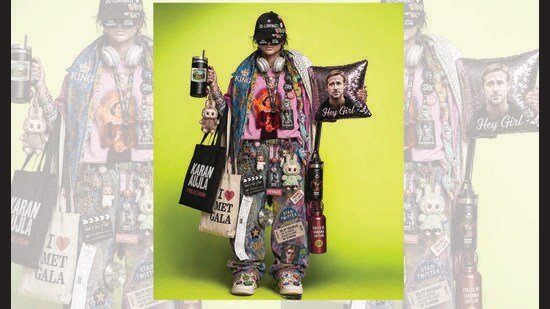
Quick, how many of these references do you recognise? “That stupid Canadian wolf bird.” “It’ll pass.” “You can’t make a Tomlette without breaking some Greggs.” “Jeetu from Videocon”. If you got even one, congratulations: Your fandom is niche enough for someone to make money off.
Merch, in the pre-internet era, was straightforward: The Metallica logo on your tee, the Backstreet Boys poster on your bedroom wall, F.R.I.E.N.D.S splashed across a cap, a lightsaber replica if you could afford it. Now, the connections run narrower, but deeper: An ultra-specific line from S5, a throwaway visual gag, a reference only binge-watchers would get. It’s on a tote, T-shirt, mug, keychain, bumper sticker, even a prayer candle. And it means everything to the right 12 people and absolutely nothing to everyone else.
Some global and Indian brands have official deals with Marvel, Disney, DC, Netflix and the like to produce themed merch. Most don’t. So, much of micro merch lives in a legal grey zone – lines of dialogue, character traits, episode titles, and set design motifs are often not copyrighted, making them easy to lift and riff on. Many manufacturers, however, keep the references just vague enough, the artwork just altered enough, to stay on the right side of a takedown notice.
When the gay hockey romance Heated Rivalry exploded online last year, official merch featured the couple’s Boston Raiders and Montreal Metros jerseys. Fun, but predictable. Etsy, meanwhile, filled up with “I am coming to the cottage” candles and air-fresheners – fans know exactly what that signals. For Bollywood, there are now small-batch tote bags, featuring a chandelier and the words: “Shanti Priya – are you there?” Those who’ve enjoyed reruns of Om Shanti Om will get it.
It’s an odd time for merch to go niche. We’re no longer watching the same satellite TV shows, single-screen blockbusters or music countdowns. The internet has fractured fandom into smaller, hyper-online communities that communicate through screenshots, Reels, deleted scenes, Tumblr jokes and Reddit threads. Someone deep in The Pitt discourse may sound completely unhinged to a Bridgerton fan. There are K-pop armies, regional rap scenes, Aujla and Diljit die-hards. So, the merch marks the tribe.
The souvenirs of our short-lived obsessions aren’t always polished, cheap or even strictly licensed. But they capture the moment, until the next one comes along. And in that moment, there’s money to be made. Take a look.
Logo motion
Merch is older than even your Sholay-loving grandpa. The first collectibles rolled out in 1878, when Jasper Fremont Meek, a printing-press operator, slapped a shoe brand’s logo on a burlap bag, creating the OG tote. Over decades, people have bought everything from Beatles lunchboxes and KISS-branded coffins to the replicas of the whistle from Titanic and Moaning Myrtle decals for the commode.
But nobody’s interested in obvious references anymore, says Karan Singh, founder of RKSD Design Studio. “Even the era of wearing Nike or Adidas logos is fading. People want clothes that reflect their obsessions and sense of humour.” IYKYK merch rules; if it’s got irony, callbacks and jokes mined from the depths of the internet, even better. “If you go in the comments section of any viral reel, so much of what people say is meme material,” says Singh.
The business moves fast. FX never anticipated that their 2022 show, The Bear, would be so successful. They didn’t work merchandise into their budget. So, unofficial “Yes Chef” T-shirts sold out on Etsy, Amazon and Meesho even before the season finale aired. By the time S2 rolled around and FX planned official merchandise, they knew exactly that kind of inside references sold best.
Turn on the fans
Micro merch is so successful now, big brands are taking notes. In July 2025, the internet performed one of its favourite tricks — turning irony into affection. Himesh Reshammiya, once mocked for his cap and nasal twang, was suddenly cool again. Millennials crowned him Lord HR and declared Tandoori Nights a classic. Reshammiya leaned in, naming his tour Cap Mania and featuring a giant cap on stage. Merch brand Faultline Apparel released T-shirts featuring Reshammiya and the line: “The nights just aren’t Tandoori anymore.”
Most niche merch has a life of barely a month or two. “A meme T-shirt creates conversation, but it only gets worn once or twice,” says Singh. “After that, it’s relegated to a nightsuit.” The only way for manufacturers to turn a profit is to log into the internet and anticipate the next viral moment.
Anubha Saxena, co-founder of The Banyan Tee (which sells Emily in Paris, The Big Bang Theory and other pop-culture merch) says her team spends hours on Pinterest boards and fan forums, trying to identify which moments audiences will latch on to. Before a design goes live, they beta-test with customers. Will Emily in Paris fans respond to slogans such as “Are you okay? You look like you lost a follower”? Or is it too on the nose? Not everything sells. “Shows such as Superstore and Seinfeld have dedicated fans, but there isn’t necessarily one quote people want printed across their chest.”
Pulkit Raheja, who co-founded merch brand Garrari, says his team tracks internet culture in real time: Which lyric is being screenshot, which artist interview is turning into memes, which concert announcement is dominating Instagram stories. When Diljit Dosanjh dropped this epic line at the 2023 Ambani wedding: “Hogi Rihanna, hogi Beyoncé, saddi toh Kareena hegi”, Garrari quickly released a T-shirt that said “Hoega Bieber, hoega Travis, sadda taan eh hi hai Diljit”. It sold out. But there’s no merch around Yo Yo Honey Singh. “This just isn’t his moment,” says Raheja.
Insider trading
Garrari’s tees retail at around ₹600. “If a design is popular, you can sell almost 50–60 a day,” says Raheja. For Saxena, a design is a bestseller if it shifts 1,000 pieces. Most brands print small batches because they never know when fandom tides will turn. “If we start getting 30–35 orders for the same design daily, then we maintain stock,” says Raheja.
AI has made the creative process quicker. “Earlier, I had to sketch everything,” says Singh. “Now I can generate rough concepts faster and experiment more.” Designers get a good deal overall, says Miriam Mohan George, a 26-year-old illustrator who collaborates with the merch brand Frankly Wearing. Her most popular design is of the 2024 Malayalam hit Aavesham. “I made a couple of Japanese chibi-style artworks, and they blew up,” she says. “I got orders from outside India too.” It pushed her to build a full catalogue of chibi-inspired Malayalam cinema illustrations. It still brings in ₹10,000–12,000 a month in royalties.
Frolic Saga began designing clothes inspired by Rakesh Bedi’s Dhurandhar character, after Bedi’s daughter requested them to. Their tees featuring Jameel Jamali and the line, “Syaana ho gaya hai mera bacha” went viral. Then, a copyright-infringement notice arrived from the film’s studio. “I had to discontinue it,” says founder Puneet Kumar. Their workaround: To not advertise their catalogue, but just do custom orders based on fans’ designs, quotes and memes.
“In most cases, only the logo is under copyright,” says Raheja. Micro merch doesn’t want that anyway. The Banyan Tee avoids using recognisable characters, fonts and imagery, and plays into the fandom’s vibe, working with artists on Redbubble and Threadless where necessary. One of their T-shirts simply has a switch on it, with the words, “Humanity Switch”. That’s a reference to The Vampire Diaries, but without the show’s actual intellectual property.
And every once in a while, a fleeting moment decides it wants to linger. A summer hit becomes a classic. A limited series spawns a universe. A re-stream finds new believers. It’s why Miriam gets those royalties: “Totoro feels almost like Mickey Mouse at this point. Loved by both children and adults.” And sometimes, a pop-culture reference captures the spirit of the time. Why else are they still making T-shirts that say, “Directed by David Lynch”?
From HT Brunch, May 23, 2026
Follow us on www.instagram.com/htbrunch
