


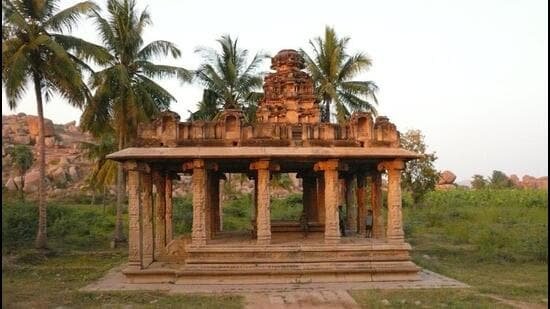
The Archaeological Survey of India (ASI) discovered a buried Vijayanagara-era temple near the Hazara Rama Temple in Hampi, Karnataka, unearthing a buried Vijayanagara-era temple featuring rare elephant sculptures and a brick-built shikhara.

The discovery occurred near the southern gate wall of the Hazara Rama Temple during ongoing restoration work. The buried structure measures 4.30metres by 4.25metres.
The visible structures include a brick-built shikhara and the top of a sanctum sanctorum. ASI officials speculate walls over 10feet high may still be intact underground, pointing to an entire ancient temple that survived centuries of burial since the fall of the Vijayanagara empire in 1565.
The structure has been tentatively identified as a Jain temple, though further excavation will confirm this.
K. Ramakrishna Reddy, Archaeological Superintendent of the ASI Hampi circle inspected the site and confirmed all recovered sculptures will be preserved and restored.
Also Read:Lessons from Hampi for the tourism sector
“This will help reopen the pages of the Vijayanagara empire’s past glory,” said V. Virupakshi, state general secretary of the State Tourist Guides Association.
ASI also announced a major modernisation drive for the UNESCO-listed Ajanta and Ellora caves in Maharashtra.
Its Chhatrapati Sambhajinagar circle, which oversees 78 monuments across eight districts of Maharashtra drew a comprehensive plan to modernise the Ajanta and Ellora caves.
At Ajanta, boulder stabilisation work is underway to prevent rockfalls that threaten the caves’ ancient murals and carvings.
Additional pollution-free e-buses are being deployed on the four-kilometre stretch between Ajanta T-Point and the base of the caves to ease peak-season crowding. Road repairs and tree-trimming along the approach are also being carried out.
At Ellora, dedicated police outposts will be established inside the complex to improve security, check unauthorised hawking and remove encroachments towards the Grishneshwar Temple. Drinking water will be available at key visitor points across both sites. The district planning and development committee funds the modernisation work.
