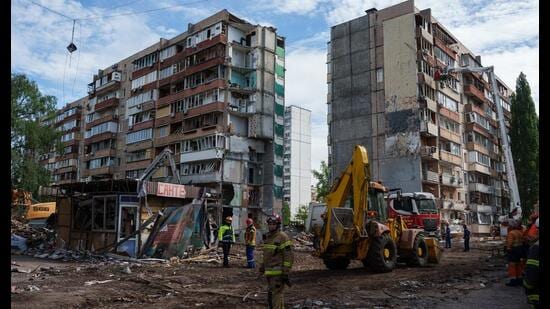
The drone attack on Moscow that killed an Indian worker and injured three others is a rude reminder of the conflict in Ukraine that is now in its fourth year. With the world focussed on Iran, Ukraine has dropped off the radar. Outside of Europe, few nations are interested in this conflict, which was the first to disrupt energy supply lines, especially to Europe and the Global South, and set off a chain of events that has reshaped global power relations. New Delhi, historically close to Moscow and friendly with Kyiv, has tried to walk a tightrope without choosing sides, and Prime Minister Narendra Modi has offered sane advice that “this is an era of peace, not war”.
There are no ceasefire proposals on the table. Both Moscow and Kyiv are willing to bleed each other rather than negotiate territorial claims. In the absence of any external push towards peace-making, closure is unlikely in this war. (AP)
Shockingly, there are no ceasefire proposals on the table. Both Moscow and Kyiv are willing to bleed each other rather than negotiate territorial claims. Europe is too invested in Kyiv; its maximalist positions, especially regarding Nato’s expansion on the continent, complicates any possible outreach to Russia. Washington’s priority is West Asia, and global bodies, including the United Nations, are in no position to mediate peace. In the absence of any external push towards peace-making, closure is unlikely in this war.
The Ukraine war — and the West Asia conflict — highlight a few truths about modern wars. One, warfare has become asymmetrical with the advent of drones; superiority in conventional weapons can’t ensure a quick victory anymore. Two, in a networked world, the pain is felt beyond the immediate war zone. Europe’s economic stagnation started with Ukraine, and West Asia has traumatised national economies across the world. Three, wars don’t provoke regime change, as is evident from Kyiv and Tehran. In fact, they allow even beleaguered incumbent regimes to retrieve lost ground and rally public support. Fourth, there are no early closures to wars. World interest wanes, and the conflict drags on, hurting the Global South especially. The only choice is to pursue peace or nurse the wounds when domestic economies collapse, which may, in fact, trigger fresh conflicts.
No conflict is distant for India. More than 30 Indians have died in the Ukraine conflict, mostly fighting with the Russian military forces. Over 100,000 Indians currently reside in Russia; the Moscow attack brings the war to their homes. The eight-million-strong diaspora in West Asia has been severely impacted by the Iran conflict, potentially affecting remittances. And both conflicts have hurt the Indian economy, with the recent one in West Asia causing an energy crisis and squeezing the current account. Any war is bad for business.