


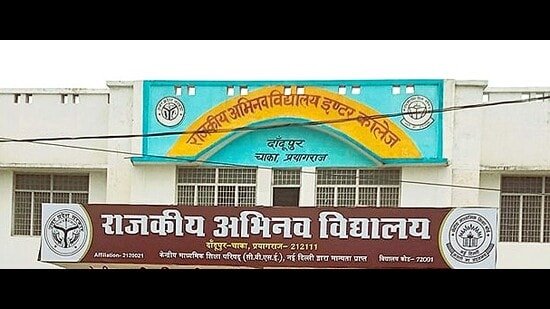
In a major policy shift, the Uttar Pradesh government has decided to bring all 18 Pandit Deendayal Upadhyay Rajkiya Abhinav Vidyalayas under the Uttar Pradesh Madhyamik Shiksha Parishad (UP Board), discontinuing their affiliation with the Central Board of Secondary Education (CBSE).

These English-medium schools, set up at divisional headquarters across the state, will now operate like other government secondary schools under the state board system. Officials said the proposal has been approved by the Secondary Education Department.
A letter issued on May 11 by special secretary Krishna Kumar Gupta to the Director of Secondary Education approved the transition from CBSE to UP Board affiliation, a copy of which is with HT.
With the change, these institutions have also been renamed ‘Pandit Deendayal Upadhyay Model Inter Colleges’, a senior official in the department said.
Officials said the move was driven by ongoing teacher shortages, administrative hurdles, and the financial burden of CBSE renewal fees. The Directorate of Education had sent proposals regarding the transition on August 22, 2024, and April 21, 2026, while the UP Board gave its consent on April 16, 2026.
According to officials, the Secondary Education Department was unable to appoint teachers in accordance with CBSE norms, resulting in repeated queries from the board. They added that CBSE charges a renewal fee of ₹25,000 every five years, but no separate budget provision exists for such expenses in state-run schools.
Officials also noted that the gap between the CBSE and UP Board curriculum has narrowed significantly after the UP Board adopted the NCERT syllabus.
One of the Abhinav Vidyalayas is functioning at Dandupur in Chaka development block of Prayagraj’s trans-Yamuna region. Notably, the first school under the model initiative was inaugurated there on April 23, 2016, when Prayagraj was still known as Allahabad.
The schools, originally launched as Samajwadi Abhinav Vidyalayas in April 2016, were later renamed after Pandit Deendayal Upadhyay following a change in government in the state. Conceived as state-funded model institutions, these schools were aimed at providing modern, high-quality education to rural students on the lines of centrally funded Jawahar Navodaya Vidyalayas (JNVs).
