


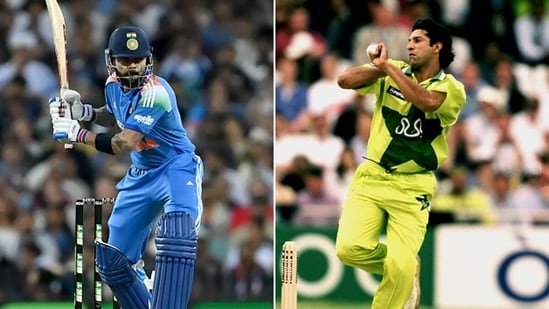
It’s always fun to imagine how some of cricket’s ultimate fantasy matchups would have fared. Imagine Mitchell Starc steaming in with Sunil Gavaskar on strike in an India-Australia Test match, or the sight of Jasprit Bumrah bowling to Brian Lara in the Caribbean. Rohit Sharma marking his guard with Allan Donald in his tracks would have been a clash to watch out for. As would the late great Shane Warne bowling to Joe Root in an Ashes classic. Oh, how about Pat Cummins marking his run-up against Sachin Tendulkar? Tempting, eh?
But amid all these duels, one face-off that promises to stand above the rest is Virat Kohli taking on the greatest left-arm pacer of all time, Wasim Akram. The Master Chaser versus the Sultan of Swing. The greatest ODI pacer taking on the finest batsman the format has ever seen. Throw in the pressure of a Super Over, and the stakes rise even higher. When Ian Bishop picked his winner on the ESPNCricinfo, backing “Wasim bhai”, we were tempted to give it our own version. But would the battle really be that one-sided? Let’s analyse.
A Super Over demands quick and big scoring under pressure, and Akram, at his peak (1989 to 1999), had the measure of some of the finest batters of his era. He dismissed Desmond Haynes 12 times, Sanath Jayasuriya nine times and Brian Lara on seven occasions. Among Indian batters, he dismissed Mohammad Azharuddin and Sourav Ganguly five times each, while Kapil Dev and Rahul Dravid fell to him on four occasions. Akram enjoyed comparatively little success against Tendulkar though, dismissing him only three times in 24 innings.
Akram’s greatness with the white ball became even more pronounced once reverse swing came into play in the death overs. While ball-by-ball data from that era is limited, available archives suggest he conceded fewer than six runs an over between overs 45 and 50 in ODIs. Across 418 deliveries in that phase, Akram gave away 415 runs while picking up 21 wickets. By comparison, Glenn McGrath bowled 854 deliveries, conceding 923 runs and taking 40 wickets at an economy of 6.48. Donald, Waqar Younis and Courtney Walsh also could not quite match Akram’s balance of control and wicket-taking ability.
Akram, in his prime, was an intimidating proposition. His spell in the final of the 1992 Cricket World Cup remains immortal in cricketing folklore. The following year, he picked up 45 ODI wickets, surpassing his own tally of 43 wickets in 1992, when he set a new benchmark for the most wickets by a fast bowler in a calendar year at the time. Many pacers have since gone past those numbers, but Akram set the standard. At his peak, he was surprisingly quick too.
Kohli no pushover in death overs
Out of the 338 times he has been dismissed in white-ball internationals, Kohli has fallen to left-arm pacers 54 times. That’s roughly 16 per cent of his dismissals, a very small fragment. This suggests left-arm pace isn’t really Kohli’s weakness. Next come the death overs. Kohli, especially in T20Is, averages a stunning 54.3 with a strike rate of 192.5, having scored 1032 runs between overs 16 and 20. In ODIs, the numbers dip slightly – 733 runs between overs 45 and 50 from 39 innings at an average of 28.2 and a strike rate of 170.9. Those are still excellent numbers, indicating that Kohli knows how to crack the code at the fag end of an innings.
Here’s the kicker. Against the best fast bowlers in the world, Kohli is fully aware of the nuances of batting in the last five overs. Kagiso Rabada, Trent Boult and Mitchell Starc don’t exactly have the wood over him, nor has Kohli dominated them. Yet, across these three champion pacers – add Jasprit Bumrah and Lasith Malinga to the mix in the IPL – only Rabada has dismissed him twice. If Kohli bats deep, he usually ensures he remains unbeaten.
The death overs are perhaps the closest indicator of how a batter is likely to perform in a Super Over. Since Kohli has batted only thrice in there – once for India and twice for Royal Challengers Bengaluru in the IPL – scoring 16 runs off 10 balls, the sample size remains small.
The Akram vs Kohli Super Over
Finally, to the most exciting bit: Akram bowling to Kohli. First things first, the mere presence of these two behemoths is enough to make it box-office. Anyone who faced Akram in his pomp would tell you that if a batter’s body language dipped even slightly, Akram would run him ragged. But this is no ordinary batter, is he? Kohli has built his career on grabbing the bull by the horns. Two alpha males, two strong personalities. A word exchanged here and there. Both Punjabis. It’s almost an unstoppable force meeting an immovable object kind of situation.
Now, to the six deliveries. Akram would ditch over the wicket for around the stumps and ideally rely on two swinging yorkers, one off-cutter, two half-length deliveries angling away after pitching, and a bouncer. The fuller deliveries give Akram the advantage since Kohli hardly plays the ramp or the paddle. Then again, Kohli’s power game is what makes him capable of tucking into length ball. The off-cutter is Kohli’s to win, but Akram would hold a slight edge with the bouncer. If the target is less than 10, it has Kohli written all over it, but the moment it rises from 11 to 15, Akram’s confidence, in all probability, would trump Kohli’s.
Not that Kohli is any less of a batter. He’s the GOAT for a reason. He knocked off 28 off eight balls in an innings for the ages at the MCG in 2022 and, 10 years earlier, before Kohli became the world-beater that he is today, conjured up that Hobart epic. In a best-case scenario, Kohli would find a way to get on top of Akram – perhaps through an inside-out shot or by using his incredibly strong wrists to pierce the leg side. But given the bag of tricks Akram possessed, he just might outfox Kohli. The thing about Kohli is that he’s a learner; he always wants to improve. In a best-of-five series, perhaps Kohli takes the honours, but in a first-time face-off, Akram shades it… by the barest of margins.
