


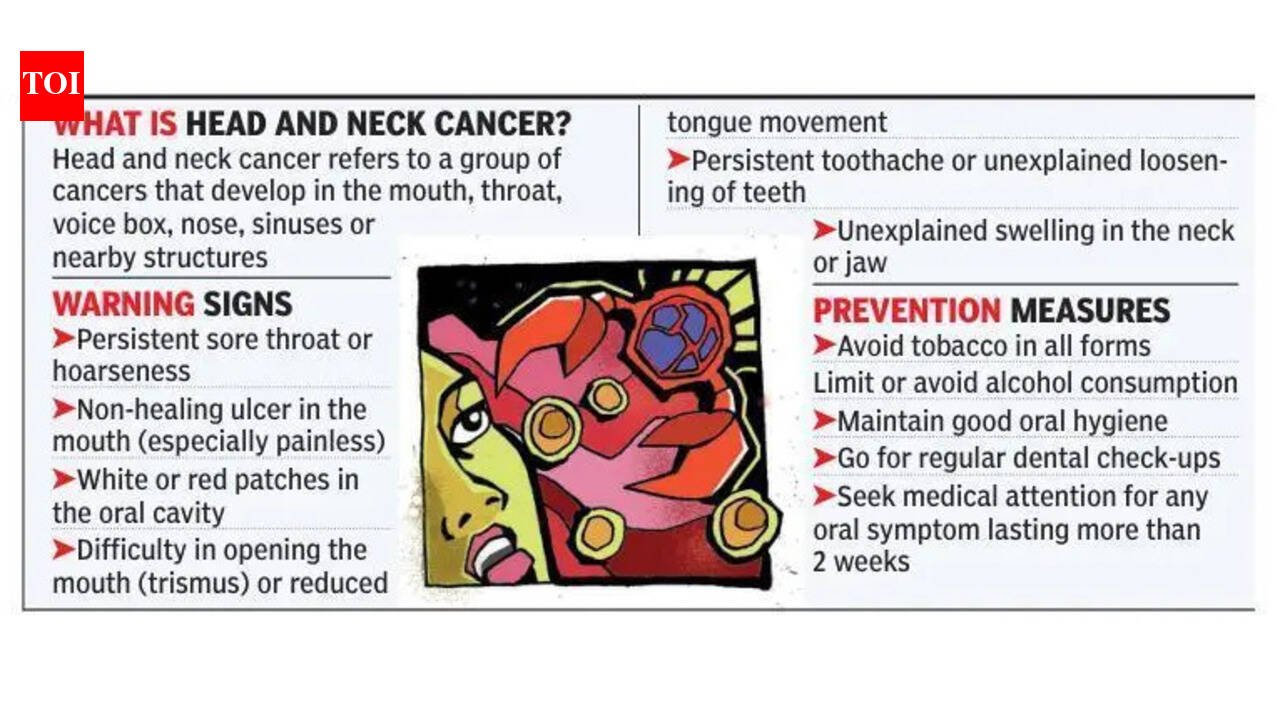
Bengaluru: A 45-year-old man who did not smoke noticed a small, painless lump on the right side of his neck while shaving. Assuming it was a swollen lymph node from a recent mild cold, he ignored it for three months. When the mass gradually grew and his wife urged him to seek medical attention, an ultrasound-guided fine-needle aspiration (FNA) revealed squamous cell carcinoma. Further imaging and a tonsil biopsy confirmed an HPV-positive oropharyngeal primary tumour.With a shift in the demographic profile of patients affected by head and neck cancers, oncologists in Bengaluru urge people not to ignore early signs — persistent sore throat, an unexplained lump in the face, neck, or mouth, or non-healing oral ulcers.“Historically, head and neck cancers mostly affected older men with a history of tobacco and heavy alcohol use. However, the demographic landscape has shifted significantly over the last two decades. There is a well-documented rise in head and neck squamous cell carcinomas — particularly, oropharyngeal cancers — among younger, otherwise healthy individuals in their 30s, 40s and 50s,” said Dr Vishal Rao U S, group director (head & neck surgical oncology), at HCG Cancer Hospital, KR Road.Dr Rao said that the 45-year-old patient achieved a complete response to treatment and preserved his swallowing and speaking functions because the cancer was detected before it spread beyond regional lymph nodes. “It is critical for younger, non-smoking adults to not ignore painless neck masses,” Dr Rao said.Dr Rajashekhar Jaka, consultant for surgical oncology and robotic surgery at Manipal Hospital, Whitefield, noted that most people rarely examine their oral cavity, which makes regular self-checks important. “Early warning signs include white or red patches, non-healing (particularly painless) ulcers, persistent toothache or unexplained tooth loss. Difficulty in opening the mouth (trismus), reduced tongue movement and pain radiating to the ear are also key symptoms. In some cases, neck swelling may occur if the cancer has spread,” he said.While tobacco remains the leading cause of oral cancer, doctors say cases are rising even among non-users. Dr Vinayak Maka, consultant for medical oncology at Ramaiah Memorial Hospital, said, “In my outpatient department I typically see 15 to 16 head and neck cancer patients each month. Increasingly, we are diagnosing cancer in people who have never used tobacco. In Western countries, this proportion is 40%-50%, while in India it is about 20%. These cases may be linked to alcohol use, chronic irritation, HPV infection and certain sexual behaviours.”Dr Jaka added that he now sees oral cancers in patients as young as their 20s and 30s, often linked to lifestyle factors. “People are starting to consume alcohol earlier as they become independent and begin making their own lifestyle choices,” he said.“There may also be increased susceptibility due to changing food habits and reduced physical activity, which can lower immunity over time. Exposure to chemicals and other environmental factors may also play a role,” he added.Doctors emphasise that early detection significantly improves outcomes. Dr Maka explained, “Early-stage cancers can often be treated with focused radiation or minor surgery, with minimal complications and very good outcomes.”What is head and neck cancer? Head and neck cancer refers to a group of cancers that develop in the mouth, throat, voice box, nose, sinuses or nearby structuresWarning SignsPersistent sore throat or hoarsenessNon-healing ulcer in the mouth (especially painless)White or red patches in the oral cavityDifficulty in opening the mouth (trismus) or reduced tongue movementPersistent toothache or unexplained loosening of teethUnexplained swelling in the neck or jawPrevention measuresAvoid tobacco in all forms Limit or avoid alcohol consumptionMaintain good oral hygieneGo for regular dental check-upsSeek medical attention for any oral symptom lasting more than 2 weeks MSID:: 130515916 413 |
