


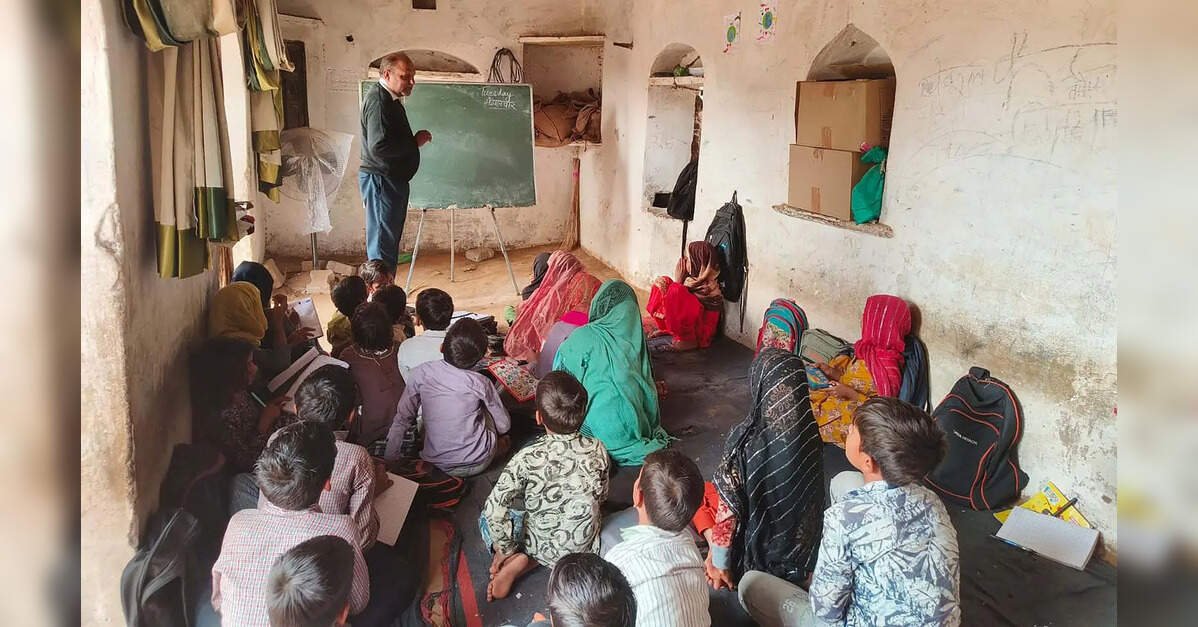
Records show Govt Primary School Kubda Bas in Nuh’s Ferozepur Jhirka block is fully functional. It is, but inside a cattle shed that 29 boys and 33 girls — from Balvatika to Class III — pack into.
When the kids leave, cows and buffaloes take their place, and bags of fodder are carried in. The animals are moved out, and the shed cleaned, in the morning before children come for classes. The stench, however, lingers.
Kubdabass isn’t an isolated case — it is one of at least 19 schools in this Haryana district adjoining Gurgaon and a short drive from Delhi that run without a building.
At Govt Primary School Kalubas, also in Ferozepur Jhirka, 45 boys and 50 girls have their classes in a field, surrounded by cows and goats. Blackboards are tied to tree trunks. This, ironically, is the more comfortable part of the year. In monsoon, the field turns muddy. In winter, cold winds create bone-chilling temperatures.
In July 2020, the state govt sanctioned 68 new schools in the district. But beyond enrolment numbers and UDISE (Unified District Information System for Education) codes, several of the schools either received no basic infrastructure or were stuck with land far from areas they were supposed to cater to.
As a result, schools began operating from makeshift premises. According to villagers, the Kubdabass school has survived only because a local family that owns the shed has allowed children to study on its private property.
Eight-year-old Ayaan says all classes are taught at the same time. During the monsoon, he worries that the roof might fall. Six-year-old Rukhsana “loves coming to school”, though the animals hovering around it bother her.
The school has one govt teacher. Abhay Singh is posted here temporarily. He calls the situation painful and deeply unfair to the children. “I teach them in a room that is unsafe,” he says. When it rains, Abhay says, water leaks from all sides. In summer, the shed becomes too hot to hold even two classes together. “I am forced to make them sit outside in the sun,” he says. “There should be more teachers here. One NGO worker helps, but it is not enough for 62 children of different learning levels.”
Panchayat land has been identified for the school, but it is 3.5 km away, in Rawli. “Small children cannot walk that far every day,” Abhay says.
Nearby land is part of the Aravalis and under the forest department’s jurisdiction. No construction can take place there till it is transferred to the education department. Despite repeated requests to the district education officer and deputy commissioner, there has been no forward movement, locals say.
Barkat Ali, the lone teacher at the Kalu Bas school who has been posted there since Oct 2022, says land is available but not allotted. “There are 10 acres of panchayat land nearby and nearly 80 acres vacant in the village. But the school has not been given even a small portion,” he says. “Education is suffering because of village politics,” he adds.
Parents, however, are thankful for the school, even if it doesn’t have a building and classes happen in adversity. One woman says her family cannot afford private school fees. “Our children will have to stop studying altogether,” she says.
At Mali Bas, a small settlement of Doha village in Nuh, the primary school has been functioning out of the village chaupal for the last five years. Twenty-nine students, from Balvatika to Class V, sit together in one room, on the floor. There is no boundary wall, no toilet and no drinking water. The chaupal is meant for community meetings, and people walk in and out all day. Nine-year-old Salman says when this happens, teachers need to pause lessons and wait till they leave. A girl in Balvatika says “she likes coming to school but feels very thirsty”.
Head teacher Rohtash Kumar says running a school in such conditions is extremely difficult. “There is no washroom for children or teachers, no water and no space to hold separate classes. All this affects learning,” he says. Assistant teachers Rekha and Priyanka, who travel nearly 30 km daily, say the girls, especially, are affected by the lack of toilets. “There is no midday meal either because there is no kitchen, no storage space and no place to cook,” Rohtash adds.
Land identified for the school is 3-4 km away, near Mundaka. “That distance is too far for children. We even tried to exchange it, but no one agreed,” a resident says.
Villagers say enrolment has dropped due to lack of facilities. “Earlier, there were around 50 children studying here. Now, some parents are sending their children to other schools,” a resident says. There have been times the school has come close to shutting down, but parents’ pleas have kept that at bay. Among those who still attend, attendance remains above 90%, showing the determination of parents to give their children an education. Authorities are considering merging the school with a high school in Doha, about 1 km away.
In Ghatwas, the govt primary school is a dilapidated, abandoned room. Torn mosquito nets hang loosely from walls to protect children from insects. A Class V student says the room is crowded and uncomfortable, making it hard to concentrate. “It does not feel like school as there is no place to play,” another student says.
For nearly three years, after a guest teacher retired, the entire primary section of 350 students was handled by one teacher, who was assigned booth level officer duties on top of this.
To address staff shortages, appointments were made through Haryana Kaushal Rozgar Nigam. However, contractual teachers were posted from far-off districts such as Bahadurgarh, Rewari and Mahendergarh, at least two-three hours away. Long travel made daily attendance difficult, and several resigned.
Two Shiksha Sahayaks and three TGTs (trained graduate teachers) have recently joined the middle school section, providing some relief. School officials say land has been identified, but construction hasn’t started for the school building. The junior engineer has asked the panchayat to prepare estimates. But the panchayat lacks the technical capacity to do so. As a result, the file keeps being lobbed between the village development officer and the additional deputy commissioner, sources say.
According to sources, at one point, 525 students were enrolled at the school. Over time, this number has dropped to around 200, who all study in the same room but in batches. A parent says he wants his children to continue their education but feels discouraged at the state of affairs. “There is no proper building and too few teachers. Children need a decent place to learn,” he says.
