



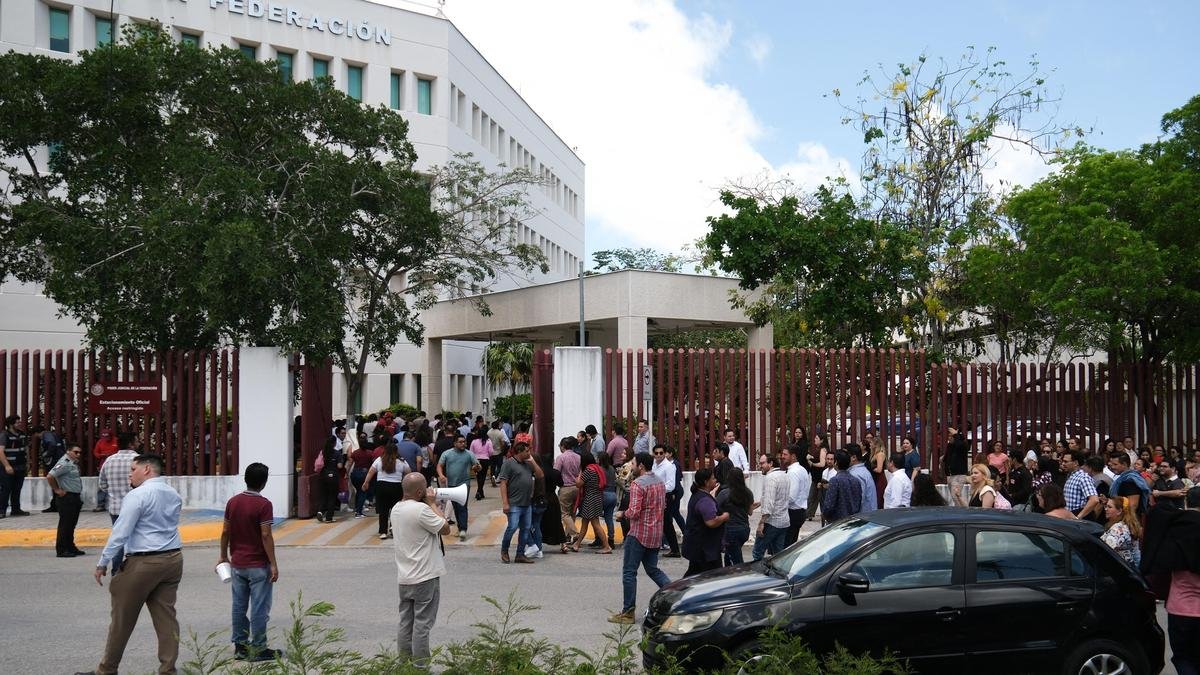
Employees return to the Federal Judiciary building following an evacuation after a 6.1-magnitude earthquake struck off the coast of Cuba and was felt in the Mexican resort cities of Cancun, Playa del Carmen and Tulum, in Cancun, Mexico, on June 8, 2026.
| Photo Credit: Reuters
A 6.1 magnitude earthquake struck near western Cuba on Monday (June 8, 2026), shaking buildings in Havana, and its tremors were felt all the way up to Florida. No injuries or damage were immediately reported.
The quake struck at a depth of 10 km in waters west of Havana, according to the U.S. Geological Survey.
Flavia Pupo, a manager at the Pinar del Rio hotel in western Cuba, described how the building shook, sparking panic. “Everyone here is OK,” she said over telephone. “The people on the street are a little bit scared.”
The latest earthquake was felt as far away as Florida. The National Weather Service in Miami said in a tweet that it received several reports of shaking in the southwestern part of the state. A flood of social media posts Monday (June 8, 2026) afternoon indicated that people felt shaking even north of Orlando.
Maria Moncayo, who works at a law office in downtown Fort Lauderdale, said she had been quietly working at her desk when she started to feel a vibrating sensation. She compared it to someone doing construction in another part of the building, and it lasted about a minute or so.
Ms. Moncayo said she had experienced several earthquakes while living in Ecuador, including a 7.8 magnitude earthquake that left hundreds dead in 2016. But she hadn’t experienced one since moving to Florida seven years ago.
Cuba’s latest blackout underscores deepening economic crisis | In pictures
City lights during a blackout, leaving around 10 million people without power amid a U.S.-imposed oil blockade, in Havana on March 16, 2026. While Cuba produces 40% of its petroleum and has been generating its own power, it hasn’t been sufficient to meet demand as its electric grid continues to crumble.
People gather on a street during a blackout as Cuba’s, in Havana on March 16, 2026. President Miguel Díaz-Canel on Friday (March 13) said the island had not received oil shipments in three months and was operating on solar power, natural gas and thermoelectric plants.
People walk on a street during a blackout in Havana on March 16, 2026. A massive outage over a week ago affected the island’s west, leaving millions without power. Another major blackout affected western Cuba in early December.
Street vendors chat on the Malecón during a blackout in Havana on March 16, 2026. This was the third major blackout in Cuba over the past four months.
People walk on the street during a blackout in Havana on March 16, 2026. President Miguel Díaz-Canel on Friday (March 13) said that the government has had to postpone surgeries for tens of thousands of people.
Gladys Valdes, 76, prepares coffee during the blackout, in Havana on March 16, 2026. “Cuba right now is in very bad shape,” President Donald Trump said, a day after Cuba’s third nationwide blackout in four months as the socialist island’s economy suffers under U.S. sanctions.
People sit on the side of a street during a blackout. The government also has blamed its woes on a U.S. energy blockade after President Donald Trump in January warned of tariffs on any country that sells or provides oil to Cuba.
A person stands on a balcony during a blackout as Cuba’s national electric grid collapsed, in Havana on March 16, 2026. The Trump administration is demanding that Cuba release political prisoners and move toward political and economic liberalisation in return for a lifting of sanctions.
A motortaxi drives on a street during a blackout, in Havana on March 16, 2026. William LeoGrande, a professor at American University who has tracked Cuba for years, said the country’s energy grid hasn’t been maintained properly and its infrastructure is “way past its normal useful life.”
A man uses a flashlight during a blackout as Cuba’s, in Havana on March 16, 2026. State-owned media reported that by late on March 16, 2026, power had been restored to 5% of residents in the capital, Havana, representing some 42,000 customers.
A view of Havana city with the National Capitol building in the background, as Cuba reconnected its electrical grid across much of the island, according to the Energy and Mines Ministry, in Havana, Cuba on March 17, 2026. Cuba’s Ministry of Energy and Mines said on X that the island had restored the electrical system in the western town of Pinar del Rio and the southeastern province of Holguin and that some “microsystems” were beginning to operate in various territories.
1/3
“Since I moved here, it kind of left my mind, but when I felt my desk moving, I thought it was going to be like Ecuador,” Ms. Moncayo said. “It kind of gave me flashbacks, but then I realized that it’s not bad, it’s just a little one.”
Miami-Dade County officials announced that they were evacuating several buildings out of an abundance of caution, including the county’s main government office building, a 28-story high rise in downtown Miami.
Officials also temporarily suspended service for two elevated commuter train services that run through downtown. No injuries or major property damage have been reported.
William Barnhart, a geophysicist with the U.S. Geological Survey, described Monday’s (June 8, 2026) earthquake as extremely rare. It’s the largest earthquake ever recorded in the Gulf of Mexico with modern instruments, which date back to the 1950s. “It’s one of only five or six earthquakes of magnitude five or greater that we’re aware of in the entire Gulf.”
No tsunami was created by this earthquake. Barnhart pointed out that the destructive ocean waves created by earthquakes and other underwater disturbances are more common in the Pacific Ocean, but they can occur in the Atlantic. Western Cuba might experience some strong aftershocks, but they’re unlikely to be felt in Florida, Mr. Barnhart said.
“There’s always a very, very small chance that this could be followed by a larger earthquake and people would feel that,” Mr. Barnhart said. “But in Florida, people shouldn’t expect to feel very much shaking, if any shaking at all, from any aftershocks that happen.”
The Oriente fault zone is located just off Cuba’s southeast coast and has unleashed damaging earthquakes in recent centuries, including a 7.7 magnitude quake in January 2020 in open waters that caused damage in Cuba and the Cayman Islands.
Published – June 09, 2026 07:56 am IST


