


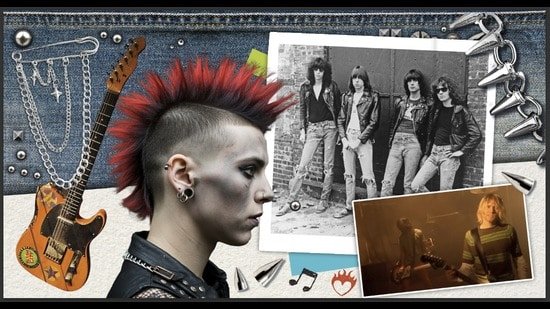
On a sweltering New York evening in August 1974, four young men from Queens walked on stage at a grimy bar in Lower Manhattan and launched into a set so short and ferocious that the audience barely had time to register what was happening before it was over.
The Ramones — Joey, Johnny, Dee Dee and Tommy; not related, just sharing an assumed surname — played about 20 songs in under 20 minutes. There were no solos, ballads or fog machines. Just a count-in of “One, two, three, four” and a wall of buzz-saw noise.
Something had begun. It didn’t even have a name yet.
Pinpointing when punk was born is the kind of exercise critics enjoy and musicians find tedious. But if one must draw a line in the sand, 1976 is a good place to do so.
In January that year, the first issue of Punk magazine hit newsstands, giving the movement its badge and banner. In April that year, Ramones released their debut album: 14 songs, across 29 minutes; the entire thing sounding like it was recorded in a disused garage by people who meant every bruising second of it.
That record, with the ripped jeans on its cover and its lunging energy, can be thought of as punk’s declaration of independence. It is 50 years old this month.
The venue that nursed this revolution into being was CBGB (short for Country, BlueGrass, Blues), a small, foul-smelling club in the East Village where owner Hilly Kristal paid little or nothing, but let bands go where their music led them.
Out of that crucible came not just Ramones but an entire scene: the rock band Television, with their angular, labyrinthine guitar interplay; the Patti Smith Group, mixing Beat poetry with rock primitivism; Blondie, led by Debbie Harry, who would conquer pop radio while never losing her street cred; Richard Hell and the Voidoids, whose guitarist Robert Quine played with a jittery, overloaded ferocity that sounded like a short-circuit in a church.
THE WHAT AND WHY
So what was punk, exactly? At its core, it was a reaction — loud, furious and deliberately opposed to sophistication — to the bloated excesses of mid-1970s rock.
By 1975, stadium rock had become a genre of spectacle: concept albums, orchestral arrangements, laser shows, bands that spent years between records perfecting their multi-layered production. Progressive rock, for all its technical brilliance, had achieved the remarkable feat of making guitar music feel airless and remote.
Punk seemed to say: “Enough. Let’s return to the three-chord song; let’s get back to volume, speed and, above all, attitude; and let’s remember what rock and roll was for before it became an industry.”
There was something deeply democratic about this. One did not need to spend years mastering an instrument to play punk. One simply needed conviction.
The legendary instruction printed in the 1977 British fanzine Sideburns — a diagram of three chord shapes with the caption “Now form a band” — was not satirical. It was a sort of manifesto. Punk lowered the barrier to entry and, in doing so, reminded everyone that rock and roll had always been music made by, and for, people who had nothing much to lose.
POLITICS, ANGER, AND THE SAFETY PIN
The UK, when it caught the punk virus in 1976, charged it with a different electricity.
America’s punk had been largely artistic and aesthetic in its rebellion. Britain’s version arrived at a moment of genuine social crisis: stagflation, mass unemployment, crumbling public services, a political establishment that had run out of ideas. Into this vacuum stepped Sex Pistols, managed by the impresario Malcolm McLaren, who understood spectacle as well as any prog-rock promoter but used it very differently.
Their 1977 single, God Save the Queen (“Don’t be told what you want to want / And don’t be told what you want to need / There’s no future, no future / No future for you”), released in Queen Elizabeth II’s silver jubilee year, was an act of cultural aggression so calculated and yet so genuinely felt that it was banned by BBC and still reached #2 on the UK singles charts.
The Clash were the more politically articulate face of UK punk. Joe Strummer had genuine convictions about class, race and empire, and songs such as White Riot (“All the power’s in the hands / Of the people rich enough to buy it / While we walk the street / Too chicken to even try it… I wanna riot”) named specific grievances.
Siouxsie Sioux transformed punk’s confrontational impulse into something stranger and more theatrical, eventually seeding what would become another genre: Goth.
These were not people making music in a vacuum. They were shaping it against something.
And then there was the fashion.
Punk’s visual aesthetic was as radical as its music, and perhaps more durable. Vivienne Westwood and McLaren’s Kings Road boutique, Sex, was punk’s sartorial laboratory: safety pins as jewellery, bin liners as dresses, hair dyed in improbable colours, teased into impossible shapes. Slashed shirts. Studded leather. DIY facial piercings.
The look said: “I’m not asking for your approval. In fact, I am actively soliciting your disapproval.” It was fashion that was calculated and disorganised at once.
THE PERSONALITIES: THEN AND NOW
Punk thrived because it was necessary, and it produced personalities to match its energy.
Iggy Pop, strictly speaking, predates punk. The Stooges’ raw, confrontational performances in the early 1970s, with Iggy stage-diving and projecting a barely-contained menace, established the template punk would follow. He is rightly considered the proto-godfather of the form and, at 78, continues to perform much as he always has.
Lou Reed’s Velvet Underground provided another strand: the idea that rock could be literary and uncomfortably direct. These were punk’s unwitting progenitors.
The founding generation now lie scattered across time.
Johnny Ramone died in 2004; Joey in 2001; Dee Dee in 2002. Of the CBGB cohort, Patti Smith became an elder stateswoman of American culture, winning the National Book Award for her memoir and delivering a tribute to Bob Dylan at the 2016 Nobel Prize ceremony. Debbie Harry, now 80, still commands a stage.
In Britain, Joe Strummer of The Clash died in 2002, aged just 50, and was mourned by generations. John Lydon aka Johnny Rotten of Sex Pistols, now 70, has drifted so far right that he now sits at odds with his own insurgent past.
THE SECOND, THE THIRD, THE UNDYING WAVE
Punk is less visible today. It has mutated.
The second wave arrived in the American underground of the early 1980s and was harder, faster. This was music, such as the California band Black Flag’s, stripped to its angriest core. Bad Brains brought reggae-inflected intensity and instrumental virtuosity. Husker Du wrote pop hooks over hardcore fury in a way that was prescient of alternative rock.
The alternative rock boom of the 1990s — Nirvana, Sonic Youth, Pixies — was punk’s delayed explosion into mainstream culture.
Kurt Cobain wore the crown openly. And then, as mainstream assimilation is inclined to do, the form softened into something more palatable: Green Day, Blink-182, Avril Lavigne.
Punk-pop was technically proficient, radio-friendly, enormous fun; it carried the original spirit of rebellion, but fantastically diluted.
Whether that constitutes co-option or continuity is a debate that continues.
POST-PUNK
In the spirit of DIY that gave punk its essence, bands were soon taking the genre’s energy and twisting it into newer shapes.
Mark E Smith of The Fall made over 30 albums of deliberately abrasive, repetitive, near-genius sound that defied every convention, including punk’s own.
Ian Curtis of Joy Division, who died at 23, did not live to see how influential his band would be. Gang of Four’s brittle, funk-inflected agit-pop has been cited by virtually every significant indie band of the last four decades.
As a category, post-punk is useful insofar as it identifies a real historical phenomenon: what happened when the punk explosion met conceptual art, reggae and electronic music. It is less useful when applied retrospectively to anything with a guitar and an attitude.
Still, if a pigeonhole must exist, at least this one contains interesting birds.
BEYOND THE MUSIC
The film Jubilee (1978; directed by Derek Jarman) captures the movement at its most nihilistic: girl gangs, anarchic tableaus, a Britain in apocalyptic decay.
Zines, photocopied, stapled and distributed by hand, were punk’s literary form.
The ethics of punk (make your own thing, distribute it yourself, don’t wait for permission) is the direct ancestor of the internet’s creator culture.
Punk lives on, in basements and small venues, in virtually every city with a music culture.
It is alive in bands such as Idles, the Bristol group whose uncompromising anthems of masculinity, grief and anti-fascism have found large audiences. (“You are a Topshop tyrant / Even your haircut’s violent / You look like you’re from Love Island / He stood and the room went silent”, from Never Fight a Man with a Perm; 2018.)
It lives on in Gen Z, who revel in its logic of non-conformism and self-determination in an era of algorithmic conformity.
Fifty years on, what punk gave us is less a genre than a permission slip: to make noise, be difficult, say no, stand for something. Be anyone you choose to be; unapologetically, even unstylishly. That’s my favourite way punk changed the world.
.
THE PLAYLIST: 20 SONGS THAT TELL THE STORY
(Click here to listen as you read)
* The Stooges: I Wanna Be Your Dog (1969)
Before punk had a name, Iggy Pop was already living it. This three-chord drone, equal parts menace and desire, is the ur-text of all that followed. Without it, there is no CBGB, no Ramones, no statement safety pins.
* New York Dolls: Personality Crisis (1973)
Shambolic, glamorous, perpetually on the verge of collapse — the Dolls are the missing link between glam rock and punk. Watch a video to see for yourself.
* Ramones: Blitzkrieg Bop (1976)
Two minutes and twelve seconds long, with arguably the most important opening salvo in rock history. “Hey ho, let’s go” is punk’s anthem: deeply ironic, since the Ramones were completely apolitical.
* Patti Smith: Gloria (1975)
Smith hijacked Van Morrison’s 1964 classic about lust and infatuation, rewrote parts of it, and made it an incantation about desire, blasphemy and reinvention. Her version opens with punk’s great literary line: “Jesus died for somebody’s sins but not mine.”
* Television: Marquee Moon (1977)
This band put back everything punk said it didn’t need — virtuosity, complexity, extended solos — and made it feel urgent anyway. The title track’s 10-minute guitar interplay between Tom Verlaine and Richard Lloyd remains astonishing.
* Sex Pistols: Anarchy in the UK (1976)
If the Ramones lit the fuse, this was the explosion. Johnny Rotten’s opening sneer landed in Britain like a petrol bomb. Fifty years on, it still sounds dangerous.
* The Clash: White Riot (1977)
Two minutes of barely controlled fury announcing a band with real political intelligence and the riffs to match. Joe Strummer was angry about something specific, and you could tell.
* Buzzcocks: Ever Fallen in Love (1978)
Punk could be tender. Pete Shelley proved it more devastatingly than anyone: a song about romantic incompatibility played at furious speed, and one of the great songs of any era.
* Wire: Pink Flag (1977)
A skeletal riff, clipped vocals, no repetition, no waste. Wire were the Samuel Beckett of punk, stripping away everything until only the essential remained.
* Public Image Ltd: Public Image (1978)
Johnny Rotten’s first post-Pistols statement rejected punk’s own orthodoxies almost before they’d fully formed. A cold, bass-driven declaration of reinvention: Post-punk may have started here.
* Joy Division: She’s Lost Control (1979)
Out of Manchester’s grey industrial landscape, Ian Curtis wrote dispatches from somewhere just beyond coherent thought. Bernard Sumner’s guitar, Curtis’s baritone lost in its own labyrinth… this defined the bleaker possibilities punk had set loose.
* Gang of Four: Damaged Goods (1978)
They’d read their Gramsci, absorbed the Situationists, and set it all to a jagged funk groove. Every guitar band of the last four decades owes Gang of Four a debt most can’t afford to repay.
* Black Flag: Rise Above (1981)
Hardcore punk at its most physically relentless. Henry Rollins-era Black Flag turned righteous rage into a rallying cry for a generation with no interest in the mainstream.
* Minor Threat: Straight Edge (1984)
Barely 45 seconds long, Ian MacKaye was a teenager when he wrote it and spent years insisting he hadn’t intended to start a religion. He started a religion. The Straight Edge movement would come to represent abstinence from drugs, independent music production, and access to that music for all.
* Bad Brains: Pay to Cum (1980)
Possibly the fastest song ever recorded, it holds reggae rhythms, hardcore fury, impossible technical precision. Proof that punk has no racial ownership, and has a musical vocabulary still not fully explored.
* Husker Du: Makes No Sense at All (1985)
Bob Mould found the exact intersection of hardcore fury and pure pop melody. Without Husker Du, there is no Nirvana.
* Nirvana: Smells Like Teen Spirit (1991)
The moment punk’s grandchildren crashed into the mainstream. Kurt Cobain was reportedly embarrassed by how big a hit the song became, which is itself a very punk response to success.
* Green Day: Basket Case (1994)
Punk-pop done right: the anxiety is real, the hooks immaculate. This was the song that brought punk to suburban bedrooms worldwide, for better and occasionally for worse.
* Idles: Danny Nedelko (2018)
A love letter to immigration, named after a real friend, it became a singalong anthem for a Britain arguing bitterly with itself. Punk’s capacity for community-building anger did not expire with the 20th century.
* Mannequin Pussy: I Got Heaven (2024)
Philadelphia’s finest draw on hardcore, post-punk and noise rock with entirely contemporary fierceness. This is punk’s DNA expressing itself in a new generation that finds the old arguments over authenticity, identity and resistance still unresolved, and still urgent.
