


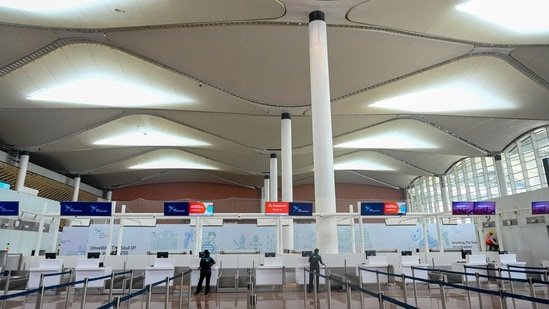
Prime Minister Narendra Modi inaugurated the Noida International Airport in Uttar Pradesh’s Jewar on Saturday, the second international airport in the Delhi-NCR region which is expected to help with the heavy passenger footfall at the Indira Gandhi International (IGI) Airport in the national capital.

The project is being developed in two stages. Passenger capacity is planned to rise from 70 million to 225 million across these stages. In the first stage, there will be four phases, where yearly passenger numbers are expected to increase from 12 million to 70 million.
Follow Noida airport inauguration live updates here.
5 key features of Noida International Airport
Here are some of the key features of the airport:
- The airport is spread over 11,742.45 acres. It will include an 87-acre multi-modal cargo hub and a 40-acre maintenance, repair, and operation hub. It will also be the first airport in India to have an in-house maintenance, repair, and overhaul facility.
- Upon completion, the airport is expected to become India’s largest, with a total capacity of 225 million passengers each year, Shailendra Bhatia, additional CEO of the Yamuna Expressway Industrial Development Authority (YEIDA) and nodal officer for Noida International Airport Limited (NIAL), told HT earlier. The airport is expected to boost economic activity and improve connectivity across NCR.
ALSO READ | Congestion ease at IGI, boost to logistics: PM Modi to inaugurate Noida International airport today
- A total of 87 acres has been set aside for a multi-modal cargo hub, which will include a cargo terminal, warehouses, and a logistics zone. Around 30 acres will be used for domestic, international, and express courier terminals.
- The airport includes a 3,900-metre runway that can handle wide-body aircraft such as the Boeing 777-300ER. It is also equipped with modern navigation systems, including the Instrument Landing System (ILS), along with advanced airfield lighting.
- The airport also includes eco-friendly features such as natural light and ventilation, rainwater harvesting, and plans to use renewable energy, in line with a net-zero emissions target.
