


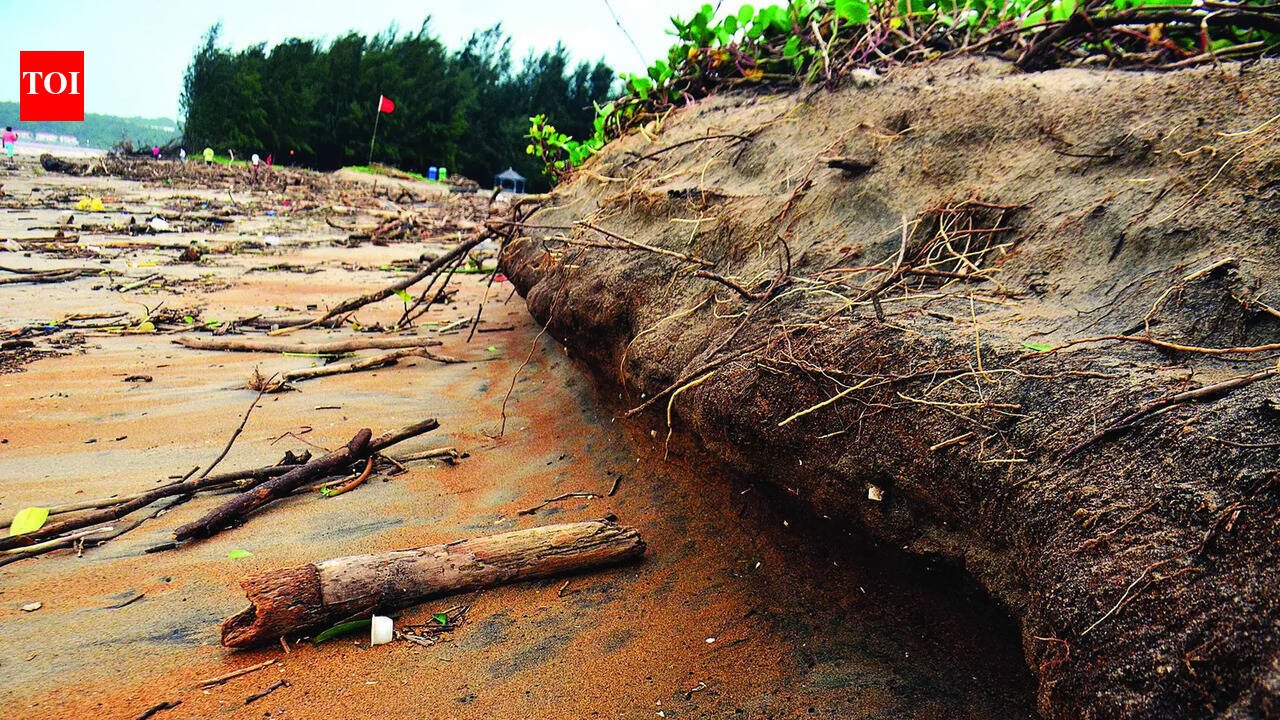
Panaji: Of Goa’s 193.9km-long coastline, there is a decrease in stable coast from 21% to 14%, with 2.7% of the beach area being lost to erosion, a shoreline change report of the National Centre for Sustainable Coastal Management (NCSCM), Chennai, has shown. This works out to only 27km of Goa’s coast being stable.The stable coastline is severely down from an earlier study done over the decade from 2004-06 to 2014-16 by ISRO’s space applications centre, Ahmedabad. It showed that 116.7km of Goa’s coast was found to be stable, one of the most stable among all states and UTs. As per the NCSCM definition, a stretch is classified as a stable coastline when the rate of erosion not more than 0.5m a year or rate of accretion is not higher than 0.5m a year. In stretches of Pernem, for instance, erosion of 0.7m a year was seen.The shoreline changes have been found to be a combined effect of natural and human activities. The destablisation of sand dunes by human activities opens more areas of the coast for erosion.Chief minister Pramod Sawant, who is also environment minister, while tabling observations from the report in the recently-concluded assembly session, said that 50% of the 193.9km of coast of the state is sandy and the other 50% is rocky in nature.He said that an increase in erosion is seen from 22% to 27%, which is 5%. In comparison, the accretion or growth of the coast accumulation of matter was only 2%, from 7% to 9%.Eroding at eight spots, Cavelossim beach bore the impact at most locations along its stretch, as per the report. This was followed by seven in Baina.In Mormugao, seven stretches along Baina, two each along Japanese Garden, Velsao, and Arossim, and one at Bogmalo were seen eroding.The shoreline changes are highly dynamic and seasonal. The NCSCM said that some beaches exhibit only seasonal changes.The National Green Tribunal had passed an order earlier stating that, to tackle erosion, there is a need to replace hard structures like seawalls and gryones with softer options such as beach nourishment. Accordingly, state govt has engaged an institute linked to Netherlands govt, Deltares, to help with restoration of eroded beaches.Sawant said that the work of replenishment of beaches is presently being done by the state in collaboration with Deltares. Deltares, in its assessment, had identified eight erosion hotspots, which could be considered for pilot restoration projects. These include Palolem, Majorda to Cavelossim, Velsao, Candolim, Anjuna, Morjim, Mandrem, and Querim.Deltares had found in its initial assessment that erosion along Goa’s coastline can be managed using natural solutions.The data tabled in the assembly shows that erosion is seen on five stretches each along the Mandrem and Ashvem coast, four along Morjim, three in Querim, two in Arambol, and one in Paliem in Pernem taluka.The report shows that most of the beaches seeing erosion host tourism activities, fish landing, coastal plantation, and include the turtle nesting site in Morjim.In Bardez, five in Candolim, two stretches each Anjuna and Vagator, three in Calangute, and one in Ozram beach showed erosion.Sawant said the erosion is being monitored through satellite images.The report further shows that one stretch each on Tiswadi beaches in Miramar, Caranzalem, Dona Paula, Vainguinim, Odxel, and Bambolim are showing erosion.In Salcete, Utorda, Gonsua, Betalbatim, Colva, Sernabatim, Benaulim, and Varca were the other state beaches witnessing erosion.
