


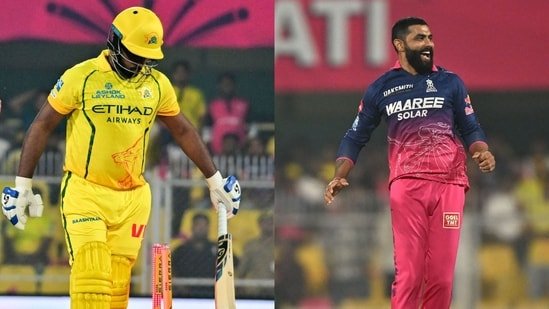
On the official trade sheet, Chennai Super Kings brought in Sanju Samson at ₹18 crore, while Rajasthan Royals took Ravindra Jadeja, whose fee was revised from ₹18 crore to ₹14 crore as part of the deal. On the field in Guwahati, Samson made 6 off 7 at the top, CSK slumped to 41/4 in the powerplay and were bowled out for 127, while Jadeja returned 2 for 18 in 3 overs as RR won by 8 wickets with 47 balls to spare. The trade was agreed in November. The first balance sheet arrived on March 30.
If you borrow the logic of a match-impact ledger rather than stopping at the scorecard, the contrast becomes harsher. A franchise does not pay ₹18 crore for raw runs or wickets. It pays for phase control, role fulfilment and the ability to alter the shape of a match. By that measure, Samson and Jadeja did not merely have different nights. They sat on opposite sides of the same transaction.
The method behind the number
The clean way to judge one match is to turn the season fee into a per-match cost first. For a 14-game league phase, Samson’s ₹18 crore translates to roughly ₹1.286 crore per match. Jadeja’s ₹14 crore comes to ₹1 crore per match. That is the cost side of the equation.
The value side has to be role-adjusted. A powerplay opener batting first on a damp surface is not performing the same job as a lower-middle-order hitter entering at 120/3 on a flat deck. Nor is a spinner bowling at 51/4 equivalent to one bowling at 180/3. So the model has to reward impact when the match is still alive and punish failure when the role has leverage.
That is where Samson’s six hurts. He was not just another batter dismissed cheaply. He was the incoming wicketkeeper-opener, effectively replacing a chunk of what CSK usually expect in structure and experience at the top, especially with MS Dhoni unavailable at the start of the season because of a calf strain. Instead, he was bowled by Nandre Burger at 14/1 in 1.6 overs, and CSK’s top order never recovered.
Samson’s side of the ledger
On a role-adjusted batting model, Sanju Samson’s 6 off 7 is not merely low output. It is a negative return. He consumed balls in the highest-risk phase, failed to absorb movement, and left CSK exposed before the innings had shape. By the end of the sixth over, they were 41/4. By the seventh over, after Jadeja struck twice, they were 57/6. In that context, Samson’s contribution is graded not as neutral underperformance but as an opening-phase deficit.
That matters even more because CSK’s 2025 batting profile had already shown warning signs. Last season, CSK ranked last among the 10 teams in average first-innings score (173), run rate (8.79), boundary percentage (17.98%), average strike rate for No. 1-8 (139.37) and average powerplay score (52). They were also ninth for average opening partnership (21.85) and tenth for opening-partnership run rate (8.42). In other words, Samson was not arriving in a robust batting ecosystem. He was arriving into one that specifically needed repair at the top. The first match brought the same structural weakness back into the light.
Using the match-impact conversion from our model, Samson’s innings comes out to a notional loss of about ₹1.81 crore relative to his per-match cost. That is not literal cash burned, but it is a fair way to describe premium-slot underdelivery in a game that was effectively lost in the first six overs.
Also Read: MS Dhoni was absent, but CSK’s collapse exposed deeper problems against RR
Jadeja’s side of the ledger
Ravindra Jadeja’s return was the opposite. RR’s quicks had already damaged CSK, but the innings was not dead at 38/4. A team can still recover from there with one 50-run stand and a good finish. Jadeja made sure that possibility never grew legs. He removed Sarfaraz Khan for 17 and Shivam Dube for 6, leaving CSK reeling at 57/6, exactly when CSK were trying to locate a bridge into the middle overs. His final figures were 3-0-18-2.
Those wickets were high-leverage wickets, not decorative ones. They came before the innings could stabilise, and they turned a difficult start into a terminal collapse. RR then chased 128 in 12.1 overs, with Vaibhav Sooryavanshi making 52 off 17 and RR smashing 74 in the powerplay. That context matters because Jadeja’s spell did not just reduce CSK’s total; it reduced the size of the chase to the point where RR’s batting could play without caution.
On the same match-impact model, Jadeja’s spell returns a notional profit of about ₹77 lakh against his one-match cost. Again, that is not accounting profit. It is a value over the fee for that game. But it captures the core point: RR paid less for Jadeja than CSK paid for Samson, and on opening evidence, RR got the innings-shaping contribution while CSK got the innings-damaging one.
What CSK lost in the trade
Put the two ledgers together, and the swing is roughly ₹2.58 crore in RR’s favour for this match alone. That is what the trade looked like on first viewing: Chennai paying more and receiving less, Rajasthan paying less and getting the more decisive hand in the game.
To put that number into real-world terms, ₹2.58 crore is enough to buy about 188 Royal Enfield Hunter 350s at their listed starting price of ₹1.37 lakh, or around 215 13-inch MacBook Airs at Apple India’s listed starting price of ₹1,19,900. The number is comic; the cricket behind it was not.
One match does not settle a trade. But some matches expose the risk inside one. This was one of them. Chennai traded out a player who could still control an innings with the ball and brought in a costlier opener to solve a top-order problem. In the first direct comparison, the old problem remained, and the old solution was bowling in pink.
