


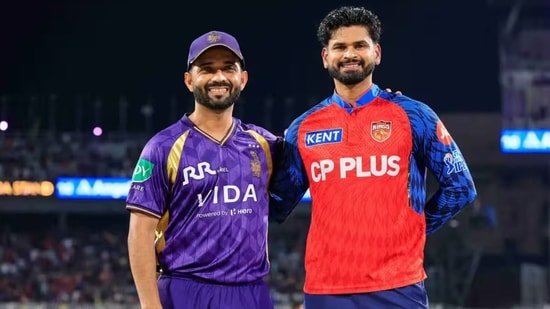
Kolkata Knight Riders were 25/2 in 3.4 overs when rain brought a halt at Eden Gardens on Saturday night, but the bigger damage had already been done. On a surface with early life, under heavy skies and with the Punjab Kings happy to use the conditions, Ajinkya Rahane’s decision to bat first after winning the toss looked baffling almost immediately. Xavier Bartlett struck twice in his first over, removing Finn Allen and Cameron Green, and KKR were left exposed before the game had properly settled. For a side already under pressure early in the season, it was the kind of call that invites a harsher question: did KKR save money on captaincy, only to make themselves poorer in value?
The toss that sharpened the bigger question
That is where the Shreyas Iyer comparison becomes impossible to ignore. KKR let go of a trophy-winning captain after the 2024 title, and Punjab Kings moved hard for him at the 2025 mega auction, paying ₹26.75 crore. Rahane, by contrast, was picked up by KKR for ₹1.5 crore. On paper, that is a massive saving of ₹25.25 crore. In pure accounting terms, KKR can argue they chose efficiency. In cricket terms, especially in T20 cricket, that argument is nowhere near enough.
The cheap captain, the expensive consequence
The first temptation is to make this a simple, expensive-versus-cheap story. That would be lazy. Ajinkya Rahane is not a budget passenger. He had a solid IPL 2025, scoring 390 runs at a strike rate of 147.72, numbers that reflect the reinvention of his white-ball game over recent seasons. But Shreyas Iyer was operating on a different tier altogether. He scored 604 runs in IPL 2025 at a strike rate of 175.07 and an average of 50.33, while also leading Punjab Kings to the final.
In T20 cricket, that combination matters more than raw aggregate alone. Volume without speed can mislead. Speed without volume can flatter. Iyer gave both.
This is really a story about opportunity cost
That is why the monetary angle here is really about opportunity cost. Yes, KKR saved ₹25.25 crore in fee outlay. But what did they give up in exchange? They gave up a captain who had already shown he could lead them through a title-winning campaign, and a middle-order batter whose T20 profile is simply more premium.
Indian batters who can control the middle overs, accelerate hard, handle spin and pace, and captain a side well are among the rarest assets in the league. Iyer is priced not just as a batter, but as a double-value cricketer. Rahane, for all his experience and calm, is a different kind of asset. He is cheaper because the market sees him that way. Saturday’s toss call is exactly the kind of moment that explains why.
Why the contrast feels even harsher
The irony is that KKR’s 2024 title run itself underlined the value of a sharp reading of conditions. In the final against Sunrisers Hyderabad, Shreyas Iyer had said at the toss that he would have preferred to bowl first, and KKR’s attack then ripped through SRH for 113 before the chase was wrapped up with ease. That was not just a result. It was a reflection of a team that generally knew what game it wanted to play.
Saturday night at Eden felt like the opposite. Rain threat, assistance up front, an opposition bowling unit ready to hit the seam, and KKR still chose to put themselves in first. The score at the stoppage only sharpened the sense that this was a strategy working against conditions rather than with them.
Saving money is not the same as buying value
So the strongest monetary reading is not that KKR should simply have matched Punjab’s bid. It is that the franchise chose a cheaper captain and, in doing so, accepted a lower margin for error. When you move from a ₹26.75 crore leader-batter to a ₹1.5 crore stopgap-style call, you are not just reducing spend. You are downgrading the premium attached to decision-making, role security and batting ceiling.
Over a full season, one wrong toss call will not define that trade. But on a night when KKR were 25/2 before the rain had fully arrived, it felt like a very expensive reminder of what they had let go.
